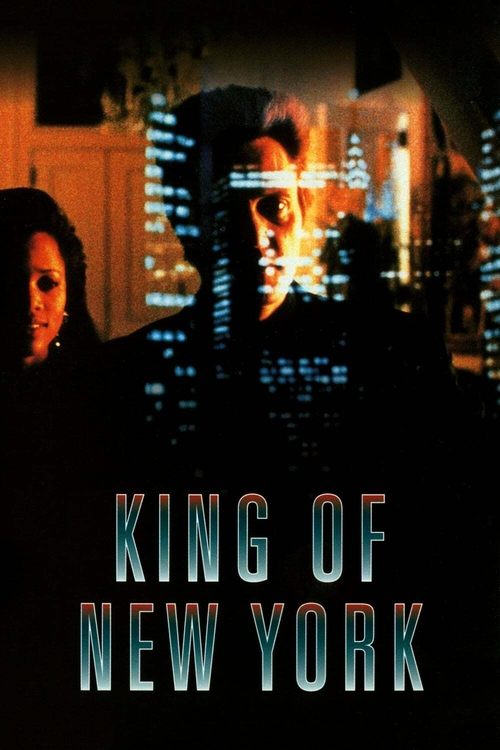
King of New York (1990)
Directed by Abel Ferrara
No — King of New York is not woke, scoring 17 out of 100 on our wokeness meter.
Abel Ferrara's King of New York arrives from 1990 with a reputation for grime, velocity, and Christopher Walken's glacial menace.
Consciousness Markers
The cast is notably multiethnic for a 1990 crime film, with Laurence Fishburne, Wesley Snipes, Giancarlo Esposito, and others in prominent roles, though the diversity is organic to the NYC underworld setting rather than a modern representational statement.
Frank White's Robin Hood-style plan to redistribute drug profits to the poor gives the film a mild anti-wealth, populist streak, but it is framed through criminal philanthropy rather than systemic critique.
A few moralizing speeches, such as White's justification for killing traffickers, give it faint lecture energy, but it is not a preachy social-issue film.
No LGBTQ+ characters, themes, or subtext are present.
The film is overwhelmingly male-focused, with female characters in peripheral roles and no feminist critique or agenda.
Race is not a thematic concern; the multiracial cast reflects the criminal milieu without commentary on racial justice or identity.
No environmental or climate-related themes appear.
No body-positivity themes or diverse body representation are present.
No neurodivergent characters or themes are present.
The film is a fictional contemporary crime story with no historical revisionism.
Why it received this score
Abel Ferrara's King of New York arrives from 1990 with a reputation for grime, velocity, and Christopher Walken's glacial menace. It is a crime film, not a sermon. The story follows Frank White, a drug lord released from Sing Sing, who eliminates rivals and redirects profits toward the poor. That Robin Hood architecture gives the film a populist itch. But the itch is scratched by a man who also shoots his way through the city. The politics remain criminal, not ideological.
The cast is unusually multiethnic for its era. Laurence Fishburne, Wesley Snipes, Giancarlo Esposito, and others fill the underworld with faces that reflect New York's actual demography. The film does not pause to congratulate itself for this. Race is texture, not thesis. The film has no engagement with later identity concerns, no feminist counterweight, no environmental anxiety, and no neurodivergent arc. Women appear at the edges. The movie is a boys' club with guns and bad suits.
A mild anti-wealth streak runs through White's plan to redistribute drug money. It is less a critique of capital than a gangster's vanity project with charitable branding. A few speeches, especially White's condemnation of traffickers and child prostitution, carry a faint lecturing hum. Yet the film never becomes a social-issue tract. It prefers atmosphere, violence, and moral rot. The result is a relic of a different cultural moment, when a crime film could be stylish, ugly, and only accidentally progressive. It earns its place in the canon, but not as a seminar.
Analysis generated by our Consciousness Algorithm


Synopsis
A former drug lord returns from prison determined to wipe out all his competition and distribute the profits of his operations to New York's poor and lower classes in this stylish and ultra violent modern twist on Robin Hood.
Questions about King of New York
Is King of New York woke?
No — King of New York is not woke, scoring 17 out of 100 on our wokeness meter. That earns it a verdict of Ultra Based.
Does King of New York have any woke elements?
1 of the 10 markers register at 30 or above, led by Representation Casting (30). On Representation Casting: The cast is notably multiethnic for a 1990 crime film, with Laurence Fishburne, Wesley Snipes, Giancarlo Esposito, and others in prominent roles, though the diversity is organic to the NYC underworld setting rather than a modern representational statement.
How does King of New York compare to other 1990 movies?
It ranks #9 of the 68 films from 1990 we've scored; their average is 9. The wokest is Nightbreed (60).
How is the Woke Score calculated?
An AI-assisted process researches the film and its reception, scores it 0–100 on ten markers, then combines those into one 0–100 Woke Score. It measures a specific set of 2020s cultural themes, not film quality.