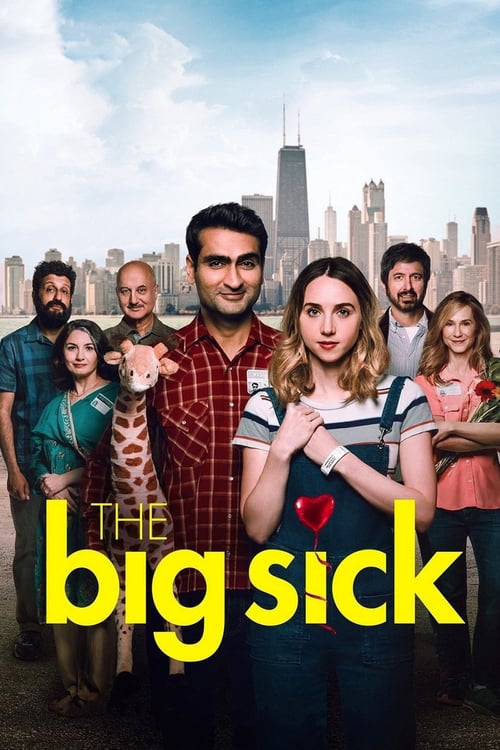
The Big Sick (2017)
Directed by Michael Showalter
Partly — The Big Sick is somewhat woke, scoring 45 out of 100 on our wokeness meter.
The Big Sick arrives at the doorstep of cultural classification carrying a casserole dish and a mild apology.
Consciousness Markers
A mainstream romantic comedy headlined by a Pakistani-American Muslim lead playing a version of himself, with a predominantly South Asian supporting cast as his family; notable for 2017, though the film drew criticism for casting non-South Asian Vella Lovell as a Pakistani love interest and for stereotyping Desi women.
Cultural and racial identity is the film's central engine: the interracial romance, Kumail's immigrant family and arranged-marriage expectations, and a scene where Terry and Beth defend him from racist hecklers all foreground the friction of being a Muslim American.
Emily is a self-possessed grad student who initiates the breakup and holds her ground, and Holly Hunter's Beth is a feisty, assertive presence, but the film is a courtship narrative rather than a vehicle for a feminist thesis.
The film gestures at themes of cultural acceptance and family expectation, but it delivers them through comedy and romance rather than sermonizing; the messaging is warm rather than preachy.
No LGBTQ+ characters or themes appear anywhere in the film.
No environmental or climate themes are present.
Kumail's stand-up grind and the medical-bill backdrop are incidental; there is no critique of wealth, class, or capitalism as a theme.
No body-positivity themes or messaging appear in the film.
No neurodivergent characters or themes are depicted.
The film is a semi-autobiographical true story but makes no revisionist claims about historical events.
Why it received this score
The Big Sick arrives at the doorstep of cultural classification carrying a casserole dish and a mild apology. It is a 2017 romantic comedy of the Apatow lineage, semi-autobiographical, in which a Pakistani-American stand-up comedian named Kumail courts a white grad student named Emily and then spends the second act in a hospital waiting room with her parents. The film is warm, it is well-reviewed, and it is careful. Careful is not the same as committed. Our ledger asks whether a film is animated by the specific progressive sensibilities of the present decade, and this one is animated mostly by the desire to be liked by everyone in the room.
The cultural friction here is genuine and structural, which is why the racial material registers at a respectable level. Kumail's immigrant parents keep producing eligible Pakistani women at the dinner table, the arranged-marriage subplot powers the central conflict, and a scene in which Emily's parents defend him from racist hecklers gives the film a spine it otherwise declines to flex. The casting is a real milestone for a mainstream American romance, a Muslim lead playing a version of himself, a South Asian family with actual screen time. It is also, as its own co-writer later conceded, a film that introduced several Desi women only to reduce them to punchlines, with one love interest played by an actress of no South Asian heritage and a strained accent to match. Progress, like a good casserole, arrives with a burnt edge.
Beyond that, the cupboards are bare. Emily holds her ground and Beth is a force, which earns the film a modest nod toward self-possession, but this is a courtship narrative and it knows it. There is no environmental sermon, no class critique, no body-positivity arc, no neurodivergent thread, no historical revision. The messaging about family and acceptance is delivered through jokes and hugs, never through a lectern. We file it accordingly: a pleasant film, an important one for casting, and a document that will not be studied by future generations for its ideology.
Analysis generated by our Consciousness Algorithm

Synopsis
Pakistan-born comedian Kumail Nanjiani and grad student Emily Gardner fall in love but struggle as their cultures clash. When Emily contracts a mysterious illness, Kumail finds himself forced to face her feisty parents, his family's expectations, and his true feelings.
Questions about The Big Sick
Is The Big Sick woke?
Partly — The Big Sick is somewhat woke, scoring 45 out of 100 on our wokeness meter. That earns it a verdict of Woke-Adjacent.
What makes The Big Sick woke?
2 of the 10 markers register at 30 or above, led by Representation Casting (72) and Racial Consciousness (62). On Representation Casting: A mainstream romantic comedy headlined by a Pakistani-American Muslim lead playing a version of himself, with a predominantly South Asian supporting cast as his family; notable for 2017, though the film drew criticism for casting non-South Asian Vella Lovell as a Pakistani love interest and for stereotyping Desi women.
How does The Big Sick compare to other 2017 movies?
It ranks #43 of the 309 films from 2017 we've scored; their average is 19. The wokest is I Am Not Your Negro (92).
How is the Woke Score calculated?
An AI-assisted process researches the film and its reception, scores it 0–100 on ten markers, then combines those into one 0–100 Woke Score. It measures a specific set of 2020s cultural themes, not film quality.