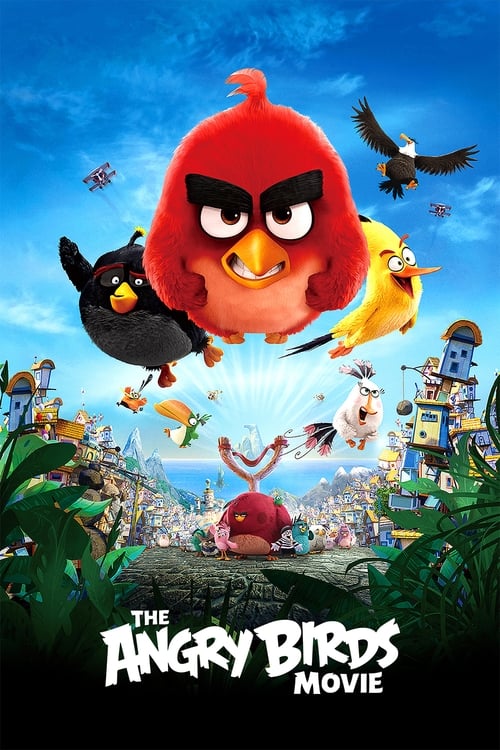
The Angry Birds Movie (2016)
Directed by Clay Kaytis
No — The Angry Birds Movie is not woke, scoring 12 out of 100 on our wokeness meter.
The Angry Birds Movie arrives as a Finnish-financed adaptation of a mobile game about slingshotting poultry, and it carries its cultural burdens lightly, which is to say it carries almost none.
Consciousness Markers
Red's anger issues, Chuck's hyperactivity, and Bomb's uncontrollable explosions are central to the plot and anger management class, giving some neurodivergent-coded representation, though treated comedically.
The voice cast includes several non-white performers in supporting roles, but the film makes no narrative point of representation and the characters are non-human animals.
There are no LGBTQ+ characters, themes, or subtext in the film.
Female characters exist but the film has no feminist agenda, commentary, or gender-focused themes.
The film contains no racial consciousness or racial themes; critical allegorical readings about pigs and immigration are external interpretations, not textual elements.
There is no climate change theme or environmental crusade in the film.
The pigs introduce consumer goods and a party, but the film does not critique capitalism or wealth inequality in any meaningful way.
Mighty Eagle's weight is played for comedy, not as a body-positive statement or critique of body shaming.
The film is a fictional animated comedy with no historical revisionism or reimagining of real events.
The film is a lighthearted children's comedy and does not lecture the audience on social or political issues.
Why it received this score
The Angry Birds Movie arrives as a Finnish-financed adaptation of a mobile game about slingshotting poultry, and it carries its cultural burdens lightly, which is to say it carries almost none. A red bird with a temper is sentenced to an anger management class, where he meets a hyperactive speedster and a black bird who detonates without warning. The film treats these conditions as comic machinery, which is the closest it comes to any modern social awareness. Red's rage, Chuck's inability to slow down, Bomb's intermittent explosive disorder: these are the film's engine, not its thesis. We are invited to laugh at them, and the laughter is affectionate, so the picture earns a modest nod for neurodivergent coding without ever pursuing the thought further.
The voice cast is stocked with performers of color in supporting roles, and the film makes no comment on the fact, which is a point in its favor and also a point against any claim of purposeful representation. The characters are birds. One of them is a pig. There is no gender argument here, no romance worth the name, no climate anxiety, no indictment of the wealthy pigs who arrive bearing consumer goods and a giant slingshot. The pigs do bring stuff. That is not a critique of capital. It is a plot device.
What remains is a brisk, brightly colored children's comedy about suspicion and eggs, one that opened at number one and sold a great many tickets and toys. It lectures no one. It represents little on purpose. It simply exists, competently, and that may be the most honest thing about it. The sequel arrived three years later, as sequels do, and the world was not improved or diminished either way. We file it accordingly, under animated, agreeable, and ideologically inert.
WATCHED: An island of flightless birds, a suspicious red outcast, and a marketing budget that could fund a small nation's cinema. None of it asks anything of us. That is either a failure or a mercy, and after a long week of sermonizing cartoons, I am inclined toward the latter. The pigs get a walled city. The birds get anger. Everyone gets a lesson in trust, delivered at a volume suitable for children. No further instruction is required, and none is offered. A tidy, weightless confection, scored and shelved, its conscience entirely clear because it never formed one to begin with. The eggs are recovered. The credits roll. We move on to the next vintage.
For the record: the film does contain a scene in which a character weeps, and another in which a large eagle is mocked for his weight, both played for laughs, neither meant as commentary. The sommelier's note reads: light body, no finish, faint notes of merchandising. Pairs well with a nap.
Analysis generated by our Consciousness Algorithm


Synopsis
An island populated entirely by happy, flightless birds or almost entirely. In this paradise, Red, a bird with a temper problem, speedy Chuck, and the volatile Bomb have always been outsiders. But when the island is visited by mysterious green piggies, it’s up to these unlikely outcasts to figure out what the pigs are up to.
Questions about The Angry Birds Movie
Is The Angry Birds Movie woke?
No — The Angry Birds Movie is not woke, scoring 12 out of 100 on our wokeness meter. That earns it a verdict of Ultra Based.
Does The Angry Birds Movie have any woke elements?
Very few. None of the 10 markers reaches 30, the level where a marker counts as present; the highest is Neurodivergence at 25.
How does The Angry Birds Movie compare to other 2016 movies?
It ranks #137 of the 285 films from 2016 we've scored; their average is 16. The wokest is 13th (92).
How is the Woke Score calculated?
An AI-assisted process researches the film and its reception, scores it 0–100 on ten markers, then combines those into one 0–100 Woke Score. It measures a specific set of 2020s cultural themes, not film quality.