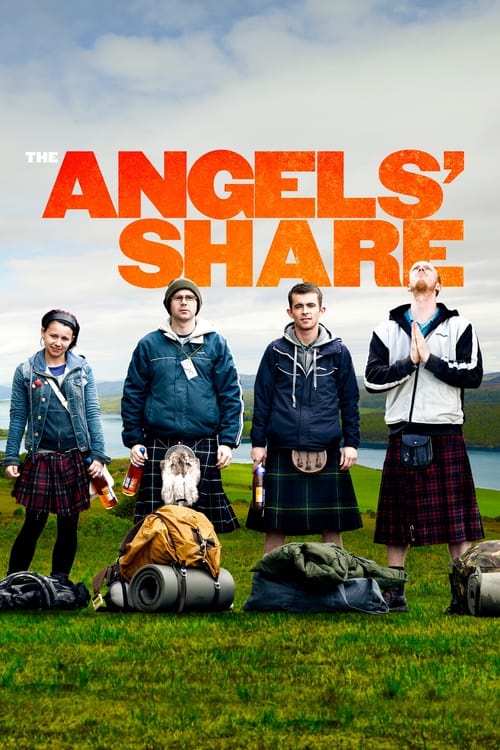
The Angels' Share (2012)
Directed by Ken Loach
No — The Angels' Share is not woke, scoring 14 out of 100 on our wokeness meter.
Ken Loach has spent five decades cataloguing the ways Britain grinds down its poor, and The Angels' Share finds him in an unusually forgiving mood.
Consciousness Markers
Loach's signature class politics are on display: the community-payback lads outwit wealthy whisky collectors and auctioneers to seize a share of a luxury commodity, framing the heist as the underclass taking back from the elite.
Loach is a didactic filmmaker, but this is one of his warmer crowd-pleasers; the class critique is embedded in the caper rather than delivered as a sermon.
The cast is drawn largely from working-class Glasgow and includes non-professional locals like Paul Brannigan, but this is regional and class authenticity rather than the modern diverse-representation project; the ensemble is overwhelmingly white and Scottish.
Leonie and Mo are present and Mo shows initiative in filching the warehouse documents, but the film is a lads' caper centered on Robbie's redemption and contains no feminist argument.
No LGBTQ+ characters, themes, or subtext appear anywhere in the film.
Race is not a subject of the film; the drama is entirely about class, violence, and Scottish working-class life.
No environmental or climate themes are present.
No body-positivity themes or messaging.
No neurodivergence themes or characters are present.
The film is a fictional contemporary story and makes no historical revisionist claims.
Why it received this score
Ken Loach has spent five decades cataloguing the ways Britain grinds down its poor, and The Angels' Share finds him in an unusually forgiving mood. Robbie, a Glasgow father with a newborn and a family feud, is sentenced to community payback, where he and three fellow offenders discover malt whisky and, eventually, a heist. The target is a cask of Malt Mill valued beyond reason, and the scheme amounts to a redistribution of wealth performed with an Irn-Bru bottle. The class politics are unmistakable. Wealthy collectors and auctioneers exist to be fleeced, and the film asks us to cheer. This is the Loach thesis rendered as a caper, a more agreeable delivery mechanism than his customary method.
The ensemble is drawn from working-class Glasgow, populated with locals and non-professionals in pursuit of texture, not a diversity quota. The result is a cast that is almost uniformly white and Scottish, which is regional authenticity and nothing more. Mo and Leonie appear and occasionally act, but the picture belongs to the lads and to Robbie's redemption, and no feminist argument is mounted. Race, climate, disability, and body image are absent as subjects. Loach's concerns have always been narrower and older than the contemporary cultural checklist, and he shows no interest in acquiring newer ones here.
As sermons go, this one is warm. The critique is folded into whisky, banter, and a Proclaimers needle drop, so the audience absorbs the politics without noticing the lecture. It is a crowd-pleaser with a conscience, and the conscience is the sixty-year-old kind about class, not the newer kind about identity. A pleasant evening at the cinema, and a mild entry for the classification ledger.
Analysis generated by our Consciousness Algorithm


Synopsis
Robbie is a Glasgow boy locked in a family feud who just wants a way out. On community service, he meets Rhino, Albert and Mo. Little did Robbie imagine that turning to drink might change their lives, leading them to the distilleries of the Scottish Highlands and the biggest gamble of his life.
Questions about The Angels' Share
Is The Angels' Share woke?
No — The Angels' Share is not woke, scoring 14 out of 100 on our wokeness meter. That earns it a verdict of Ultra Based.
Does The Angels' Share have any woke elements?
1 of the 10 markers register at 30 or above, led by Eat the Rich (42). On Eat the Rich: Loach's signature class politics are on display: the community-payback lads outwit wealthy whisky collectors and auctioneers to seize a share of a luxury commodity, framing the heist as the underclass taking back from the elite.
How does The Angels' Share compare to other 2012 movies?
It ranks #67 of the 230 films from 2012 we've scored; their average is 12. The wokest is Killing Them Softly (92).
How is the Woke Score calculated?
An AI-assisted process researches the film and its reception, scores it 0–100 on ten markers, then combines those into one 0–100 Woke Score. It measures a specific set of 2020s cultural themes, not film quality.