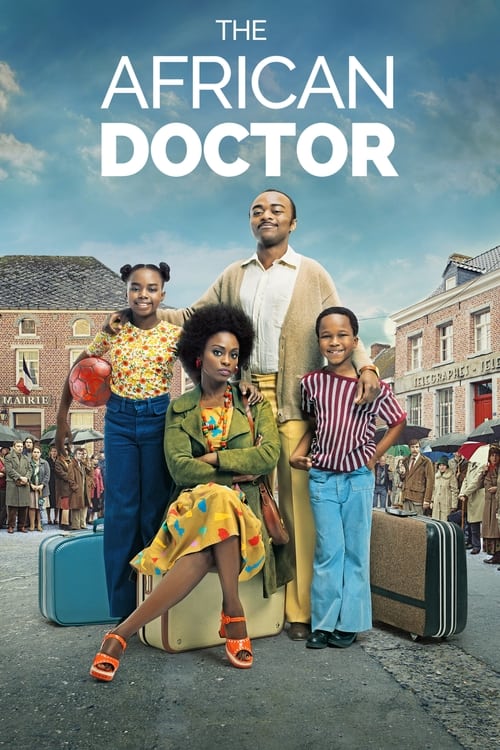
The African Doctor (2016)
Directed by Julien Rambaldi
Yes — The African Doctor is woke, scoring 60 out of 100 on our wokeness meter.
The African Doctor opens with a title that promises a physician and delivers a lesson in rural French sociology.
Consciousness Markers
Racism, prejudice, immigration, and assimilation are the central conflicts; the film explicitly depicts the villagers' distrust and the family's fight for acceptance.
Centered on a Congolese family and a predominantly Black cast portraying African immigrants in rural France; representation is intrinsic to the story.
The film carries an earnest message about tolerance and overcoming prejudice, but it delivers it through character-driven comedy-drama rather than explicit sermonizing.
The wife Anne and daughter Sivi have agency and plotlines, but the film is not structured around a feminist critique.
No LGBTQ+ themes or characters are present in the film.
No environmental or climate-related themes are present.
No anti-capitalist or eat-the-rich themes; the protagonist rejects a dictator's corrupt offer, not capitalism itself.
No body-positive themes or messaging are present.
No neurodivergent characters or themes are present.
The film is a straightforward biopic based on real events, not a revisionist or counter-narrative reimagining of history.
Why it received this score
The African Doctor opens with a title that promises a physician and delivers a lesson in rural French sociology. Seyolo Zantoko, a Congolese doctor who in 1975 turns down a post as Mobutu's personal physician, moves his family to Marly-Gomont, a village in Picardy that has never encountered a Black person. The family is the story, not decoration around someone else's. Marc Zinga and Aïssa Maïga carry the film with a warmth that keeps the premise from curdling into a civics lesson.
The cultural friction is the engine. Villagers lock their doors, the children are bullied at school, patients prefer the French doctor in the next town, and Seyolo is eventually arrested over immigration paperwork days before his citizenship comes through. The screenplay treats this distrust as a problem to be solved through competence and persistence, which it mostly is. Anne and Sivi are given interior lives and their own arcs, including Sivi's soccer heroics and Anne's principled exit to Brussels, though the film is not organized around a feminist argument. It simply lets its women be people.
The message about tolerance is earnest and arrives through character comedy instead of sermonizing, which keeps the preaching at a tolerable volume. There is no LGBTQ content, no environmental concern, no body-positive thread, no neurodivergent character, and no revisionist agenda. Seyolo's refusal of Mobutu's offer is a rejection of corruption, not of capital. The result is a straightforward biopic, adapted from real lives, with a Black ensemble cast and racism as its central subject. It is pleasant, well-meaning, and entirely content to be liked.
Analysis generated by our Consciousness Algorithm
Synopsis
1975. When Seyolo Zantoko, a doctor from the Congo who has managed, along with his family, to flee tyranny, is hired by the mayor of a small town in northern France, he begins a struggle to adapt to a new life and gain the trust of the prejudiced villagers.
Questions about The African Doctor
Is The African Doctor woke?
Yes — The African Doctor is woke, scoring 60 out of 100 on our wokeness meter. That earns it a verdict of Woke.
What makes The African Doctor woke?
3 of the 10 markers register at 30 or above, led by Racial Consciousness (85), Representation Casting (80) and Lecture Energy (35). On Racial Consciousness: Racism, prejudice, immigration, and assimilation are the central conflicts; the film explicitly depicts the villagers' distrust and the family's fight for acceptance.
How does The African Doctor compare to other 2016 movies?
It ranks #9 of the 285 films from 2016 we've scored; their average is 16. The wokest is 13th (92).
How is the Woke Score calculated?
An AI-assisted process researches the film and its reception, scores it 0–100 on ten markers, then combines those into one 0–100 Woke Score. It measures a specific set of 2020s cultural themes, not film quality.