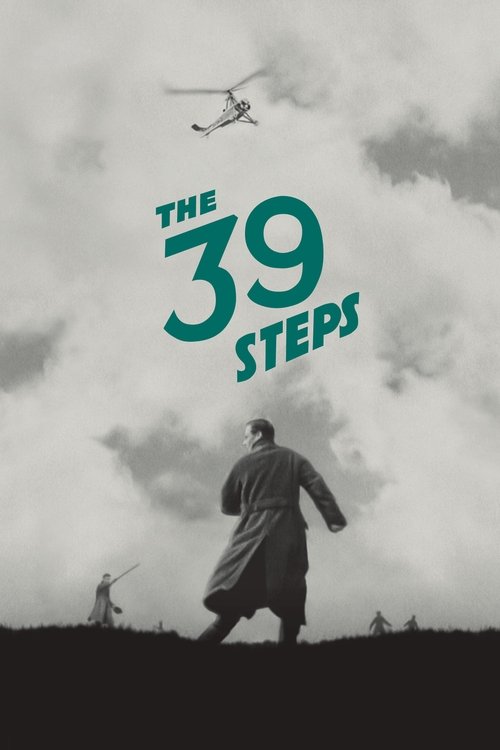
The 39 Steps (1935)
Directed by Alfred Hitchcock
No — The 39 Steps is not woke, scoring 0 out of 100 on our wokeness meter.
Alfred Hitchcock's The 39 Steps arrives from 1935, a year in which the cinema had not yet been issued its modern conscience.
Consciousness Markers
The cast is entirely white British performers of its era, with no deliberate diversity casting or commentary on representation.
There are no LGBTQ+ characters, themes, or subtext acknowledged in the film.
Pamela is the prototypical 'Hitchcock blonde' — icy, handcuffed to the hero, and repeatedly humiliated — a template critics have since identified as decidedly un-feminist.
The film engages no racial themes whatsoever; it is a spy chase through a uniformly white Britain.
No environmental or climate content of any kind.
The villainy is foreign espionage, not capitalism; no economic critique is present.
No body-positivity themes or messaging.
Mr. Memory's prodigious recall is presented as a music-hall novelty act, not as neurodivergence framed through a modern lens.
The film is a fictional thriller loosely adapted from a novel, with no revisionist historical project.
Hitchcock's film is pure suspense and wit; it lectures the audience on nothing.
Why it received this score
Alfred Hitchcock's The 39 Steps arrives from 1935, a year in which the cinema had not yet been issued its modern conscience. The picture was adapted loosely from John Buchan's novel, and Hitchcock discarded most of it, adding the music hall, the Forth Bridge, and both women. Richard Hannay, a Canadian civilian, watches a memory act, acquires a dead spy in his flat, and spends the remainder of the picture fleeing across Scotland while handcuffed to a woman who keeps turning him in. The film is a machine for suspense, and it runs clean. There is no message in the tank.
The treatment of Pamela warrants a note. Madeleine Carroll's character is icy, tethered, and repeatedly humiliated, which critics have since filed under a template with a name attached. The picture has no interest in correcting this, and no awareness that correction might be requested. Similarly, Mr. Memory's prodigious recall is a variety turn, not a case study. The spy ring is foreign, the money is never discussed, and the weather over the moors is simply weather.
The film lectures no one. Its villainy is espionage, its hero is a man wrongly accused, and its final revelation is a design for a silent aircraft engine, which is a MacGuffin and knows it. No sermon is delivered, no audience is scolded, no contemporary grievance is retrofitted onto a yarn about a man running from the police. We are left with craft: the bridge, the autogyro, the political rally where Hannay improvises a speech he does not believe. It is a masterpiece of pure entertainment, and it asks nothing of us but attention. In the ledger of social instruction, it enters no entries. A clean page. Rare, and restful.
Analysis generated by our Consciousness Algorithm


Synopsis
Richard Hanney has a rude awakening when a glamorous female spy falls into his bed - with a knife in her back. Having a bit of trouble explaining it all to Scotland Yard, he heads for the hills of Scotland to try to clear his name by locating the spy ring known as The 39 Steps.
Questions about The 39 Steps
Is The 39 Steps woke?
No — The 39 Steps is not woke, scoring 0 out of 100 on our wokeness meter. That earns it a verdict of Ultra Based.
Does The 39 Steps have any woke elements?
No. All 10 markers score zero.
How does The 39 Steps compare to other 1935 movies?
It ranks #3 of the 4 films from 1935 we've scored; their average is 3. The wokest is Bride of Frankenstein (6).
How is the Woke Score calculated?
An AI-assisted process researches the film and its reception, scores it 0–100 on ten markers, then combines those into one 0–100 Woke Score. It measures a specific set of 2020s cultural themes, not film quality.