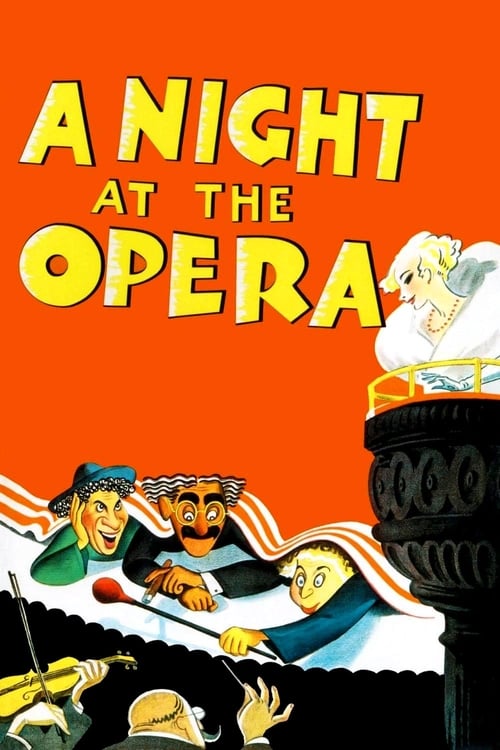
A Night at the Opera (1935)
Directed by Sam Wood
No — A Night at the Opera is not woke, scoring 0 out of 100 on our wokeness meter.
A Night at the Opera arrives from 1935, a year when the Marx Brothers were still permitted to be funny without a moral stapled to the proceedings.
Consciousness Markers
The cast is entirely white, with Italian characters played by white actors; no meaningful racial or ethnic representation is present.
Any cross-dressing or gender-bending is played for farce and disguise, not as LGBTQ+ identity or themes.
Female characters are romantic interests or comic foils; the film advances no feminist critique or agenda.
The film includes Italian immigrant characters but does not engage with racial consciousness or systemic racial issues.
There is no environmental or climate-related content.
The satire targets opera snobs and high society manners, not capitalism or economic inequality in a modern eat-the-rich sense.
No body-positivity themes or body-diverse messaging are present.
Harpo's silent clowning is a comedic persona, not a depiction or advocacy of neurodivergence.
The film is a contemporary 1935 comedy and does not revise or reinterpret historical events.
The film aims for anarchic comedy and musical entertainment, not moral instruction or lecturing.
Why it received this score
A Night at the Opera arrives from 1935, a year when the Marx Brothers were still permitted to be funny without a moral stapled to the proceedings. The plot concerns a wealthy widow, a fraudulent business manager, two young opera singers in love, and a pompous tenor who thoroughly deserves his comeuppance. The brothers sabotage an opening night of Il trovatore. That is the entire ethical program. Nobody learns anything. Nobody grows.
The film's targets are opera snobs, stuffed shirts, and the self-important. This is class resentment of a very old and very unserious kind, aimed at manners and pomposity, not at capital or its structures. The Italian characters exist as comic texture, played by white actors with broad accents, and the film has no thought to spare for what that might mean. Harpo's silence is a clown's silence, honed on the vaudeville circuit, not a statement about anything. A cross-dressing beat or two surfaces in the farcical machinery, present because disguise is funny, and for no other reason. There is no climate to speak of, no bodies to celebrate, no history to revise, and no sermon waiting at the end.
To watch it now is to observe a cultural artifact from a moment before the modern vocabulary of social instruction existed. The stateroom scene packs fifteen people into a closet and asks nothing of us but laughter. The contract scene turns a sanity clause into a punchline. This is comedy as pure verbal and physical assault, and it has no interest in our improvement. We classify it accordingly, with the sober recognition that some films simply predate the assignment.
Analysis generated by our Consciousness Algorithm


Synopsis
The Marx Brothers take on high society and the opera world to bring two lovers together. A sly business manager and two wacky friends of two opera singers help them achieve success while humiliating their stuffy and snobbish enemies.
Questions about A Night at the Opera
Is A Night at the Opera woke?
No — A Night at the Opera is not woke, scoring 0 out of 100 on our wokeness meter. That earns it a verdict of Ultra Based.
Does A Night at the Opera have any woke elements?
No. All 10 markers score zero.
How does A Night at the Opera compare to other 1935 movies?
It ranks #3 of the 4 films from 1935 we've scored; their average is 3. The wokest is Bride of Frankenstein (6).
How is the Woke Score calculated?
An AI-assisted process researches the film and its reception, scores it 0–100 on ten markers, then combines those into one 0–100 Woke Score. It measures a specific set of 2020s cultural themes, not film quality.