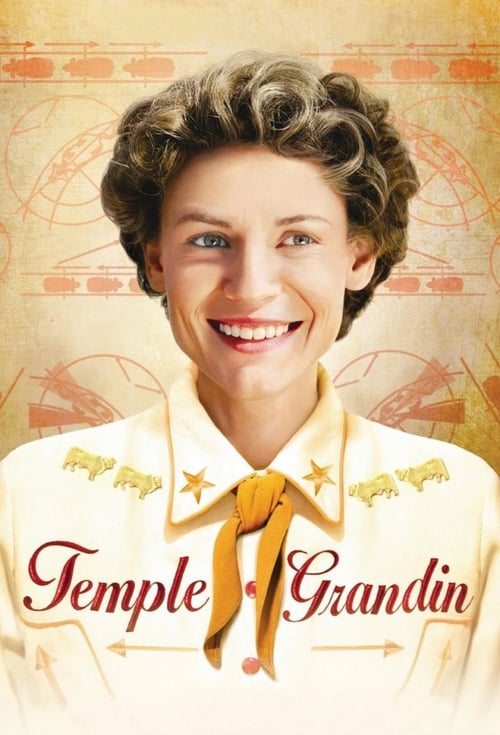
Temple Grandin (2010)
Directed by Mick Jackson
No — Temple Grandin is not especially woke, scoring 36 out of 100 on our wokeness meter.
Temple Grandin arrives from HBO in 2010 as a biographical drama about an autistic woman who redesigned livestock handling systems and, in the process, forced an industry to reconsider its assumptions.
Consciousness Markers
Autism is the film's central subject: it depicts Temple's sensory sensitivities, visual thinking, meltdowns, and the squeeze machine, and frames her neurodivergent perspective as a genuine strength rather than a defect.
Temple repeatedly confronts sexism in the male-dominated cattle-ranching and slaughterhouse industry, and her mother fights to secure her an education rather than institutionalization, giving the film a genuine feminist thread.
The film centers a neurodivergent woman as its protagonist, but the cast is otherwise uniformly white and the lead is played by a neurotypical actress, so the casting itself is not notably diverse.
The film is an inspirational biopic that largely avoids preachiness and sentimentality, though it carries a mild uplift message about perseverance and understanding difference.
There are no LGBTQ+ characters or themes anywhere in the narrative.
The film has no engagement with racial themes or racialized characters; the story is entirely about a white protagonist's individual struggle.
No environmental or climate themes are present; the livestock material concerns animal welfare, not ecological crisis.
The film is about improving industry practices within the existing livestock and slaughterhouse system, not critiquing capitalism or wealth.
There is no body-positivity content; the film does not address body image or size acceptance.
The film is a faithful biopic of real events and people; it corrects the era's medical misconceptions about autism but does not reinterpret history through a modern ideological lens.
Why it received this score
Temple Grandin arrives from HBO in 2010 as a biographical drama about an autistic woman who redesigned livestock handling systems and, in the process, forced an industry to reconsider its assumptions. The film's central preoccupation is neurodivergence, and it treats the subject with unusual specificity: the sensory overload, the visual thinking, the squeeze machine built from scratch to calm a nervous system that refuses to calm itself. Claire Danes plays the role without sentimentality, and the screenplay resists turning its subject into a checklist of symptoms. This is the film's real achievement, and it is a substantial one.
There is also a feminist thread running through the proceedings. Temple collides repeatedly with the men who run cattle ranches and slaughterhouses, and her mother wages a quiet campaign to secure her daughter an education instead of an institution. That thread is genuine. The surrounding social consciousness is thinner. The cast is white throughout, the narrative shows no interest in race, and questions of class, sexuality, and ecology never surface. Temple improves the machinery of the meat industry; she does not interrogate it. The film is content to work inside the system it depicts.
The inspirational register is present but restrained, a mild uplift about perseverance and the value of a different kind of mind. It never lectures. It never begs. It simply tells the story of a woman who saw the world sideways and made the world adjust. For a television biopic, that restraint is close to miraculous. The classification is straightforward: a serious film about a serious subject, with one dominant preoccupation and a few quieter ones beneath it.
Analysis generated by our Consciousness Algorithm


Synopsis
A biopic of Temple Grandin, an autistic American who has become one of the leading scientists in humane livestock handling.
Questions about Temple Grandin
Is Temple Grandin woke?
No — Temple Grandin is not especially woke, scoring 36 out of 100 on our wokeness meter. That earns it a verdict of Based.
Does Temple Grandin have any woke elements?
2 of the 10 markers register at 30 or above, led by Neurodivergence (88) and Feminist Agenda (45). On Neurodivergence: Autism is the film's central subject: it depicts Temple's sensory sensitivities, visual thinking, meltdowns, and the squeeze machine, and frames her neurodivergent perspective as a genuine strength rather than a defect.
How does Temple Grandin compare to other 2010 movies?
It ranks #13 of the 238 films from 2010 we've scored; their average is 11. The wokest is My Name Is Khan (84).
How is the Woke Score calculated?
An AI-assisted process researches the film and its reception, scores it 0–100 on ten markers, then combines those into one 0–100 Woke Score. It measures a specific set of 2020s cultural themes, not film quality.