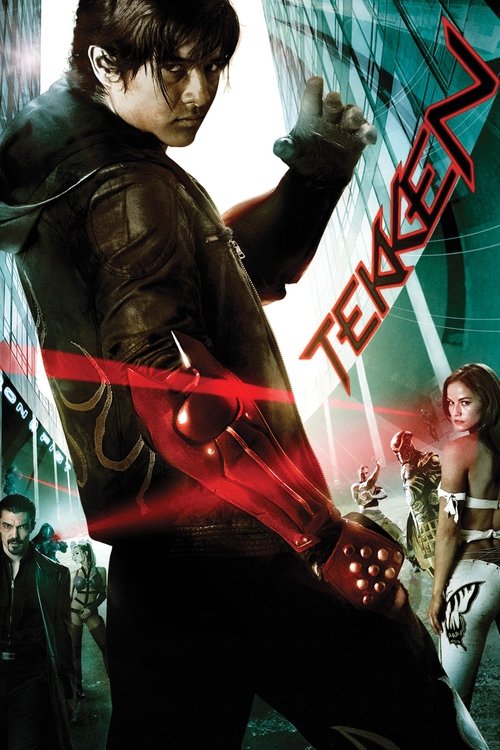
Tekken (2010)
Directed by Dwight H. Little
No — Tekken is not woke, scoring 16 out of 100 on our wokeness meter.
Tekken arrives from 2009 with the solemn purpose of converting a beloved fighting game into a live-action feature, and it does so by removing the devil mutations, the animal combatants, and most of the joy.
Consciousness Markers
The premise centers on megacorporations replacing governments and a resistance movement fighting the corrupt Tekken Corporation, giving it a genuine anti-corporate, eat-the-rich undercurrent.
The cast is genuinely diverse, led by Jon Foo with Cary-Hiroyuki Tagawa, Ian Anthony Dale, Lateef Crowder, Cung Le, and Tamlyn Tomita, but this reflects the international martial-arts source material rather than any deliberate representation agenda.
Female fighters like Christie, Nina, and Anna Williams are competent combatants, but the film offers no feminist messaging or commentary; they function as standard action archetypes.
The film features a multiethnic cast but engages in no racial themes; if anything, it drew criticism for whitewashing the Brazilian character Christie Monteiro.
The director explicitly stated there was no intent to provide political context, and the film delivers its corporate-dystopia backdrop as pure action spectacle rather than moral instruction.
No LGBTQ+ characters, themes, or subtext appear anywhere in the film.
The post-apocalyptic setting stems from world wars and corporate takeover, not climate change; no environmental themes are present.
No body-positivity themes; the film is a conventional martial-arts action piece with no commentary on body image.
No neurodivergent characters or themes are present.
The film is a fictional dystopian sci-fi story with no historical revisionism.
Why it received this score
Tekken arrives from 2009 with the solemn purpose of converting a beloved fighting game into a live-action feature, and it does so by removing the devil mutations, the animal combatants, and most of the joy. The remainder is a dystopian tournament picture in which corporations have replaced governments, the masses are placated with televised violence, and a young man named Jin Kazama punches his way toward revenge. The film is not subtle about its corporate villains, and that gives it a mild anti-establishment pulse. The Tekken Corporation is greedy, repressive, and willing to kill for market share. This is not a political sermon. The director has said he had no interest in providing context, and the movie treats its oppressive boardrooms as set dressing for spin kicks.
The cast is notably multiethnic, with Jon Foo, Cary-Hiroyuki Tagawa, Ian Anthony Dale, Lateef Crowder, Cung Le, and Tamlyn Tomita filling the frame. That diversity comes from the international source material and a sensible desire for credible martial artists. It does not arrive with a thesis. The women fight well, including Christie, Nina, and Anna, but they remain action archetypes. No romantic or political awakening follows. The film's treatment of Christie drew complaints about whitewashing, which is a casting controversy, not a racial argument the movie itself makes. LGBTQ themes, body image commentary, neurodivergent characters, climate anxiety, and historical revisionism are absent. The film is too busy arranging elbow strikes.
Tekken wants to be Rocky with a body count, and it achieves something closer to a direct-to-video shrug. The fight choreography has moments of real athletic commitment. The storytelling does not. Its anti-corporate undercurrent is genuine but shallow, a useful backdrop for a revenge plot that never quite coheres. The film avoids preaching, which keeps its social consciousness at a low simmer. It is a modest artifact of video game adaptation, neither offensive nor enlightened, just a collection of fighters hitting marks in a neon slum. We score it as we find it: a mild corporate critique wrapped in a tournament movie that has no interest in explaining itself. The sequel potential is noted. The ambition is not.
Analysis generated by our Consciousness Algorithm


Synopsis
In the year of 2039, after World Wars destroy much of the civilization as we know it, territories are no longer run by governments, but by corporations; the mightiest of which is the Mishima Zaibatsu. In order to placate the seething masses of this dystopia, Mishima sponsors Tekken, a tournament in which fighters battle until only one is left standing.
Questions about Tekken
Is Tekken woke?
No — Tekken is not woke, scoring 16 out of 100 on our wokeness meter. That earns it a verdict of Ultra Based.
Does Tekken have any woke elements?
2 of the 10 markers register at 30 or above, led by Eat the Rich (45) and Representation Casting (35). On Eat the Rich: The premise centers on megacorporations replacing governments and a resistance movement fighting the corrupt Tekken Corporation, giving it a genuine anti-corporate, eat-the-rich undercurrent.
How does Tekken compare to other 2010 movies?
It ranks #49 of the 238 films from 2010 we've scored; their average is 11. The wokest is My Name Is Khan (84).
How is the Woke Score calculated?
An AI-assisted process researches the film and its reception, scores it 0–100 on ten markers, then combines those into one 0–100 Woke Score. It measures a specific set of 2020s cultural themes, not film quality.