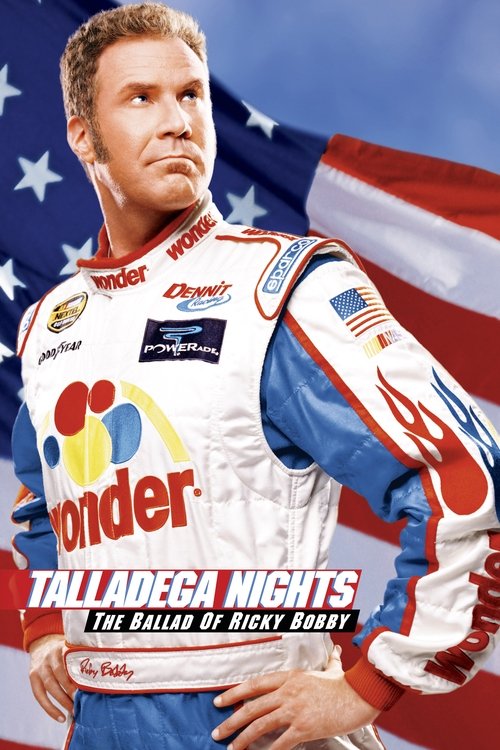
Talladega Nights: The Ballad of Ricky Bobby (2006)
Directed by Adam McKay
No — Talladega Nights: The Ballad of Ricky Bobby is not woke, scoring 16 out of 100 on our wokeness meter.
Adam McKay's 2006 study of a NASCAR driver who cannot lose gracefully arrives with a title that promises balladry and delivers a man screaming his own name into a camera.
Consciousness Markers
Jean Girard is an openly gay Formula One driver with a husband, Gregory, and the film's climax features Ricky kissing him on the lips; the portrayal is largely affectionate rather than a punchline, though it remains broad comedy.
The film satirizes NASCAR's sponsorship economy, the Dennit family's ownership, and brand-saturated Americana (Applebee's, Wonder Bread), but the mockery is affectionate rather than a call to eat the rich.
The ensemble includes Michael Clarke Duncan as crew chief Lucius Washington and a mixed supporting cast, but these are natural, unremarked presences in a 2006 studio comedy rather than casting-as-statement.
Jane Lynch's disciplinarian mother and Amy Adams's Susan are given some agency, but Carley is a trophy wife traded between teammates and the film's gaze is thoroughly male.
Michael Clarke Duncan's Lucius is a dignified presence, but the film engages in no racial commentary whatsoever; NASCAR's demographics go entirely unexamined.
The film is a broad comedy with essentially no preaching; the closest it comes is a mild 'family matters more than winning' moral in the final scene.
A film celebrating stock-car racing and fast food has no environmental conscience and makes no gesture toward one.
No body-positivity themes; physical comedy about weight and appearance is played for laughs without any countervailing message.
No neurodivergence themes present; Ricky's psychosomatic fear is treated as a plot obstacle, not a condition.
No historical revisionism; the film is a contemporary fictional sports comedy.
Why it received this score
Adam McKay's 2006 study of a NASCAR driver who cannot lose gracefully arrives with a title that promises balladry and delivers a man screaming his own name into a camera. The satirical target is not the sport but the sponsorship economy wrapped around it, and the jokes about Applebee's, Wonder Bread, and the Dennit family's bored ownership land with a precision that suggests genuine familiarity. That the film never converts this mockery into an indictment is its saving grace. It likes the machinery it is teasing. A comedy that wanted to eat the rich would have to stop ordering the mozzarella sticks.
The most culturally forward element here is Sacha Baron Cohen's Jean Girard, a French Formula One driver with a husband named Gregory, presented with affection and a complete absence of panic. The climactic kiss between Girard and Ricky Bobby is staged as an absurd gesture of respect, not a punchline at anyone's expense, which for a 2006 studio comedy is unusually relaxed. Elsewhere the film is content to be a product of its moment. Leslie Bibb's Carley exists to be traded between teammates. Michael Clarke Duncan brings dignity to the pit crew, and the film asks nothing of his race, which is neither a failing nor a virtue, merely a fact.
What the film does not attempt is instruction. There is no sermon on climate, no lesson about bodies, no diagnosis of the mind, no revision of the historical record. The closing moral, that family outlasts the checkered flag, is delivered with a shrug and then immediately undercut by everyone leaving for Applebee's. The result is a broad, silly, occasionally brilliant comedy with almost nothing to teach us and no apparent desire to try. In an era of films that arrive with a syllabus attached, that restraint reads as a luxury.
Analysis generated by our Consciousness Algorithm


Synopsis
The fastest man on four wheels, Ricky Bobby, is one of the greatest drivers in NASCAR history. A big, hairy American winning machine, Ricky has everything a dimwitted daredevil could want, a luxurious mansion, a smokin' hot wife, and all the fast food he can eat. But Ricky's turbo-charged lifestyle hits an unexpected speed bump when he's bested by flamboyant Euro-idiot Jean Girard and reduced to a fear-ridden wreck.
Questions about Talladega Nights: The Ballad of Ricky Bobby
Is Talladega Nights: The Ballad of Ricky Bobby woke?
No — Talladega Nights: The Ballad of Ricky Bobby is not woke, scoring 16 out of 100 on our wokeness meter. That earns it a verdict of Ultra Based.
Does Talladega Nights: The Ballad of Ricky Bobby have any woke elements?
1 of the 10 markers register at 30 or above, led by LGBTQ+ Themes (45). On LGBTQ+ Themes: Jean Girard is an openly gay Formula One driver with a husband, Gregory, and the film's climax features Ricky kissing him on the lips; the portrayal is largely affectionate rather than a punchline, though it remains broad comedy.
How does Talladega Nights: The Ballad of Ricky Bobby compare to other 2006 movies?
It ranks #46 of the 211 films from 2006 we've scored; their average is 11. The wokest is An Inconvenient Truth (92).
How is the Woke Score calculated?
An AI-assisted process researches the film and its reception, scores it 0–100 on ten markers, then combines those into one 0–100 Woke Score. It measures a specific set of 2020s cultural themes, not film quality.