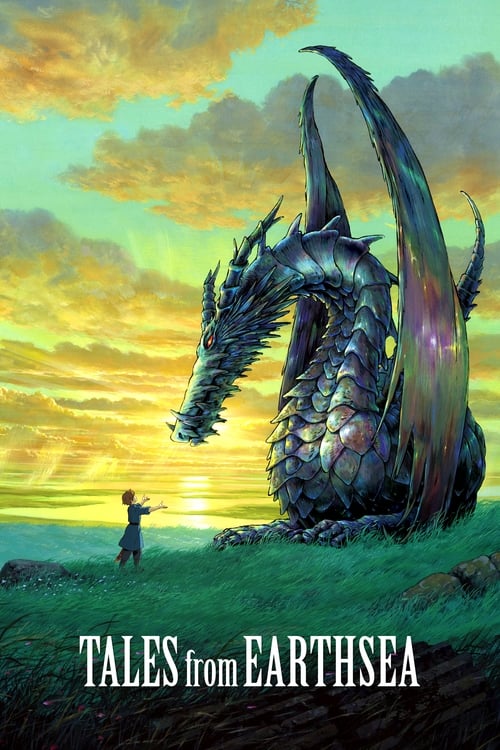
Tales from Earthsea (2006)
Directed by Goro Miyazaki
No — Tales from Earthsea is not woke, scoring 7 out of 100 on our wokeness meter.
Tales from Earthsea arrives as a curious artifact from a time before the culture began auditing its own entertainment.
Consciousness Markers
Therru and Tenar are capable female characters who act with agency, but the film does not advance a feminist agenda or critique patriarchy.
The plot involves a collapsing world balance, dwindling crops, and returning dragons, giving it a mild environmental fantasy theme rather than a climate crusade.
The film has some philosophical dialogue about life, death, and balance, but it is not preachy or lecture-driven in a modern activist sense.
The film features a Japanese voice cast and fantasy character designs with no modern diverse casting agenda or commentary on representation.
There are no LGBTQ+ themes, characters, or relationships in the film.
The film includes a slavery subplot, but it is not framed through modern racial consciousness or commentary on systemic racism.
There is no critique of capitalism, wealth inequality, or economic systems in the film.
Therru is a burn victim, but her scars are not used to promote body positivity or challenge beauty standards.
Arren's inner turmoil and shadow self are not presented as neurodivergence or a neurodiversity theme.
The film is a fantasy adaptation and does not engage with historical revisionism.
Why it received this score
Tales from Earthsea arrives as a curious artifact from a time before the culture began auditing its own entertainment. Goro Miyazaki's debut adapts Ursula K. Le Guin with a straight face and a heavy hand, delivering a world where crops fail, dragons return, and a young prince carries a shadow he cannot name. The film has things on its mind: the balance of the world, the fear of death, the cost of a father's murder. It simply declines to organize any of that into a message for the audience. There is no casting agenda here, no commentary on identity, no instruction manual tucked into the scenery. The voice cast is Japanese, the characters are fantasy archetypes, and nobody pauses to explain what any of it signifies for the viewer's politics.
The women of the story, Tenar and Therru, act with resolve and take up swords when the occasion demands it. That is competence, not a thesis. Therru's burns are treated as tragedy and mystery, never as an invitation to reconsider beauty standards. A slavery subplot drifts past without a single gesture toward systemic critique. The environmental thread, dwindling harvests and returning dragons, reads as fantasy cosmology instead of a warning about the planet. When the film does speak, in Sparrowhawk's musings on life and death, it sounds like a weary wizard thinking out loud, not a screenwriter addressing the room.
The result is a handsomely mounted adaptation that respects its source and its audience in equal measure. It is slow, occasionally muddled, and far less than the sum of its parts. It is also entirely innocent of the cultural preoccupations that would define the following decade. For that, if nothing else, it deserves a quiet nod of recognition.
Analysis generated by our Consciousness Algorithm


Synopsis
As crops dwindle and dragons reappear, mankind stands on the verge of total chaos. Lord Archmage Sparrowhawk, a powerful wizard, and Arren, a troubled young prince, search for the force behind this mysterious imbalance that threatens to destroy the land of Earthsea.
Questions about Tales from Earthsea
Is Tales from Earthsea woke?
No — Tales from Earthsea is not woke, scoring 7 out of 100 on our wokeness meter. That earns it a verdict of Ultra Based.
Does Tales from Earthsea have any woke elements?
Very few. None of the 10 markers reaches 30, the level where a marker counts as present; the highest is Climate Crusade at 10.
How does Tales from Earthsea compare to other 2006 movies?
It ranks #111 of the 211 films from 2006 we've scored; their average is 11. The wokest is An Inconvenient Truth (92).
How is the Woke Score calculated?
An AI-assisted process researches the film and its reception, scores it 0–100 on ten markers, then combines those into one 0–100 Woke Score. It measures a specific set of 2020s cultural themes, not film quality.