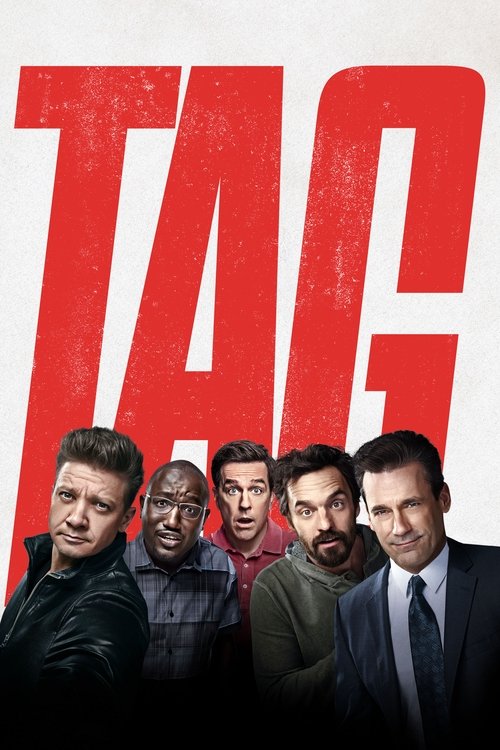
Tag (2018)
Directed by Jeff Tomsic
No — Tag is not woke, scoring 13 out of 100 on our wokeness meter.
Tag is a 2018 studio comedy about grown men chasing one another through Spokane, and it approaches its premise with the solemnity of a regional sales conference.
Consciousness Markers
The ensemble includes Hannibal Buress and Rashida Jones alongside the white leads, giving the cast a modest degree of diversity, but the film makes no comment on it and it reads as standard studio-comedy casting.
Isla Fisher's Anna is a ferociously competitive presence, and the ending amends the rules so the women (Anna, Susan, Rebecca) can join the game, a mild gesture toward inclusion that never rises to an agenda.
This is a broad action-comedy built for laughs; it delivers no moralizing or preachy messaging, save for a sincere closing note about friendship.
There are no LGBTQ+ characters, relationships, or themes anywhere in the film.
Hannibal Buress's character exists naturally within the friend group with no racial commentary, subtext, or thematic engagement whatsoever.
No environmental or climate themes appear in the film.
The film is a mainstream studio comedy with no critique of wealth, class, or capitalism.
No body-positivity themes or messaging are present.
No neurodivergent characters or themes are depicted.
The film adapts a real story straightforwardly without reinterpreting or revising historical narratives.
Why it received this score
Tag is a 2018 studio comedy about grown men chasing one another through Spokane, and it approaches its premise with the solemnity of a regional sales conference. The film is based on a true story, though it treats the source material as a springboard for broad physical comedy and a final act of hospital-bed sincerity. The ensemble is game, the pacing is brisk, and the emotional conclusion about friendship is delivered without much fuss.
On the cultural ledger, the film is mostly blank. Hannibal Buress and Rashida Jones appear in the friend group and adjacent professional orbit, and the movie makes no comment on their presence; this is standard studio casting, not a statement. Isla Fisher's Anna is a ferociously competitive presence, and the ending amends the rules so the women can join the game, a mild gesture toward inclusion that never hardens into an agenda. There is no LGBTQ material, no climate sermon, no class critique, no body-positive or neurodivergent thread, and no historical revisionism. The real-life tag brothers are adapted straightforwardly, with no attempt to reinterpret their story for a contemporary moral.
The film's only preachy impulse arrives at the end, when it asks us to feel something about enduring friendship, and even that is kept brief. Otherwise Tag is an action-comedy built for laughs, and it delivers them with the efficiency of a product designed for a Friday night. It is not a film with a message. It is a film with a game, a wedding, and a hospital bed. The cultural temperature here is room temperature, and the film seems content to remain there.
Analysis generated by our Consciousness Algorithm


Synopsis
For one month every year, five highly competitive friends hit the ground running in a no-holds-barred game of tag they’ve been playing since the first grade. This year, the game coincides with the wedding of their only undefeated player, which should finally make him an easy target. But he knows they’re coming...and he’s ready.
Questions about Tag
Is Tag woke?
No — Tag is not woke, scoring 13 out of 100 on our wokeness meter. That earns it a verdict of Ultra Based.
Does Tag have any woke elements?
Very few. None of the 10 markers reaches 30, the level where a marker counts as present; the highest is Representation Casting at 25.
How does Tag compare to other 2018 movies?
It ranks #160 of the 325 films from 2018 we've scored; their average is 20. The wokest is Return (92).
How is the Woke Score calculated?
An AI-assisted process researches the film and its reception, scores it 0–100 on ten markers, then combines those into one 0–100 Woke Score. It measures a specific set of 2020s cultural themes, not film quality.