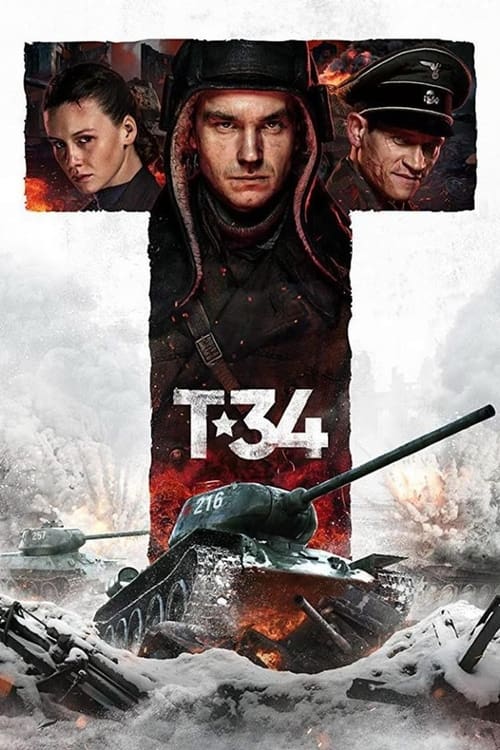
T-34 (2018)
Directed by Alexey Sidorov
No — T-34 is not woke, scoring 4 out of 100 on our wokeness meter.
T-34 is a Russian war spectacle that has been scrubbed clean of the sermonizing usually attached to the genre.
Consciousness Markers
Anya, the female interpreter, is given some agency by stealing a minefield map and joining the escape, but she remains a supporting figure in a story centered on a male tank crew.
Critics specifically observed the film largely strips out ideological and patriotic preaching in favor of pure action spectacle, leaving minimal lecture energy.
A Russian production with a predominantly Russian and German cast playing ethnically appropriate roles; no deliberate diversity casting or commentary on representation.
No LGBTQ+ characters, themes, or subtext whatsoever in this WWII tank-escape action film.
No engagement with race or racial justice themes; the conflict is framed entirely along national and military lines.
No environmental or climate themes present.
Despite its Soviet setting, the film is a patriotic action spectacle with no critique of capitalism or wealth.
No body-positivity themes or messaging.
No neurodivergent characters or themes.
Critics note the film mythologizes and gamifies WWII, but this is nationalist fantasy rather than a modern progressive reinterpretation of history.
Why it received this score
T-34 is a Russian war spectacle that has been scrubbed clean of the sermonizing usually attached to the genre. A captured tank commander, Nikolai Ivushkin, spends three years in German custody before engineering an escape in a refurbished T-34-85, and the film treats this as an excuse for armor clanking through picturesque Czech towns. Critics on the Russian side noted with approval that the patriotic itch was mostly left unscratched. There is no lecture here. The tank does the talking, and the tank speaks exclusively in high explosive.
Anya, the camp interpreter, steals a minefield map, talks her way into the escape, and rides off toward Czechoslovakia with the crew. This is agency of a modest sort, granted to a woman who remains a supporting figure in a story about men and their machine. Beyond her, the film has no interest in the cultural questions occupying Western cinema of the same period. The cast is Russian and German, playing Russian and German roles, and nobody pauses to reflect on it. There is no engagement with race, no environmental conscience, no critique of wealth or capital, no attention to body image or neurodivergence. The conflict is national and military, and it stays that way.
The historical record gets mythologized into a video game, which is a different sin from the revisionist kind. Critics compared the film to a gaming championship, complete with respawn logic and a villain who shakes hands before falling from a bridge. That is nationalist fantasy, not a progressive rereading of the past. There is craft here, and noise, and a dedication to the tank crews of the Great Patriotic War. The film knows exactly what it is, and it has no intention of being anything else.
Analysis generated by our Consciousness Algorithm


Synopsis
In 1944, a courageous group of Russian soldiers managed to escape from German captivity in a half-destroyed legendary T-34 tank. Those were the times of unforgettable bravery, fierce fighting, unbreakable love, and legendary miracles.
Questions about T-34
Is T-34 woke?
No — T-34 is not woke, scoring 4 out of 100 on our wokeness meter. That earns it a verdict of Ultra Based.
Does T-34 have any woke elements?
Very few. None of the 10 markers reaches 30, the level where a marker counts as present; the highest is Feminist Agenda at 12.
How does T-34 compare to other 2018 movies?
It ranks #269 of the 325 films from 2018 we've scored; their average is 20. The wokest is Return (92).
How is the Woke Score calculated?
An AI-assisted process researches the film and its reception, scores it 0–100 on ten markers, then combines those into one 0–100 Woke Score. It measures a specific set of 2020s cultural themes, not film quality.