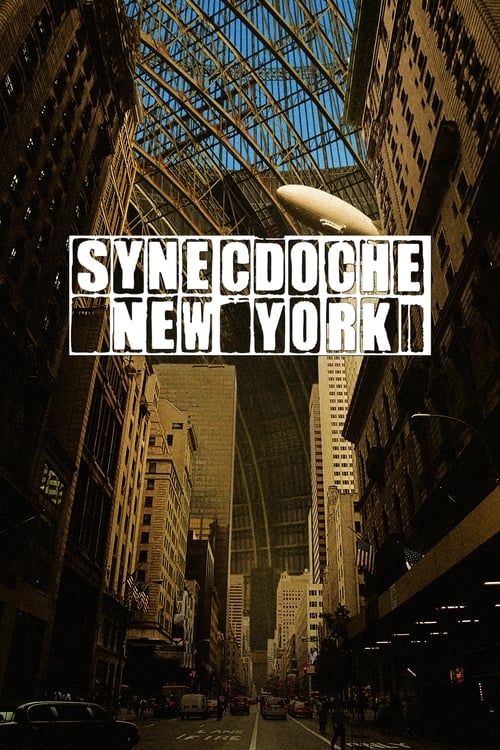
Synecdoche, New York (2008)
Directed by Charlie Kaufman
No — Synecdoche, New York is not woke, scoring 6 out of 100 on our wokeness meter.
Charlie Kaufman's directorial debut concerns a theater director named Caden Cotard who receives a MacArthur grant and promptly spends it constructing a life-size replica of New York inside a warehouse, then a replica of the replica, until the whole enterprise collapses under the weight of its own sincerity.
Consciousness Markers
The film features many women but largely defines them through Caden's anxieties and desires; the gender-bending of the Ellen role is psychological, not a feminist statement.
The film is steeped in psychological conditions (Cotard and Capgras delusions, schizophrenic auditory hallucination, anxiety, depression), but treats them as existential dread rather than as neurodivergent identity to be affirmed.
The film is philosophically dense and self-consciously arty, but it interrogates mortality and art rather than lecturing the audience on social or political issues.
The film touches on the tension between art and commerce (the MacArthur grant, the commercial failure of ambitious work) but never frames this as a systemic anti-capitalist critique.
The cast is almost entirely white, with no evident effort at diverse or representative casting; the film's concerns are existential rather than demographic.
No LGBTQ+ themes or characters. Caden's assumption of the role of Ellen is framed through Jungian anima psychology, not queer identity.
No engagement with racial themes or consciousness whatsoever.
No environmental or climate themes present.
Bodies in the film are sites of decay, illness, and mortality rather than celebration; no body-positivity themes.
No historical revisionism; the film is a surreal, present-tense psychological drama with no historical subject matter.
Why it received this score
Charlie Kaufman's directorial debut concerns a theater director named Caden Cotard who receives a MacArthur grant and promptly spends it constructing a life-size replica of New York inside a warehouse, then a replica of the replica, until the whole enterprise collapses under the weight of its own sincerity. The film has been called a masterpiece and a self-indulgent slog, sometimes by the same people on different days. It has never been mistaken for a work of contemporary social instruction. Its obsessions are mortality, memory, and the slow failure of the body, subjects that predate the current cultural moment by several thousand years.
The cast is white and stays that way, and nobody involved appears to have given the matter a thought. Women populate the film generously, though nearly all of them arrive as projections of Caden's longing or dread. His wife leaves for Berlin, his daughter acquires a full-body tattoo, his lover lives in a house that is perpetually on fire. When Caden assumes the role of a housekeeper named Ellen, the gesture belongs to Jungian psychology, the man confronting his anima, not to any statement about gender. His ailments point toward Cotard delusion, Capgras delusion, and the auditory hallucinations of schizophrenia, and the film treats each as furniture in a haunted house. Nobody is affirmed. Everybody is dying.
There is a mild friction between art and money, since the grant funds the folly and the commercial world ignores it, but the film never builds that friction into an argument about systems. The weather is not a character. History does not intrude. Bodies here are sites of lesion and decay, which is the opposite of a celebration. The film does lecture, at length, about death and the impossibility of knowing another person, a form of sermonizing that nobody has yet filed a complaint about. It ends with a man being told to die by a voice in his ear. A serious picture, then, and almost entirely useless for our purposes.
Analysis generated by our Consciousness Algorithm


Synopsis
A theater director struggles with his work, and the women in his life, as he attempts to create a life-size replica of New York inside a warehouse as part of his new play.
Questions about Synecdoche, New York
Is Synecdoche, New York woke?
No — Synecdoche, New York is not woke, scoring 6 out of 100 on our wokeness meter. That earns it a verdict of Ultra Based.
Does Synecdoche, New York have any woke elements?
Very few. None of the 10 markers reaches 30, the level where a marker counts as present; the highest is Feminist Agenda at 12.
How does Synecdoche, New York compare to other 2008 movies?
It ranks #129 of the 212 films from 2008 we've scored; their average is 12. The wokest is Milk (68).
How is the Woke Score calculated?
An AI-assisted process researches the film and its reception, scores it 0–100 on ten markers, then combines those into one 0–100 Woke Score. It measures a specific set of 2020s cultural themes, not film quality.