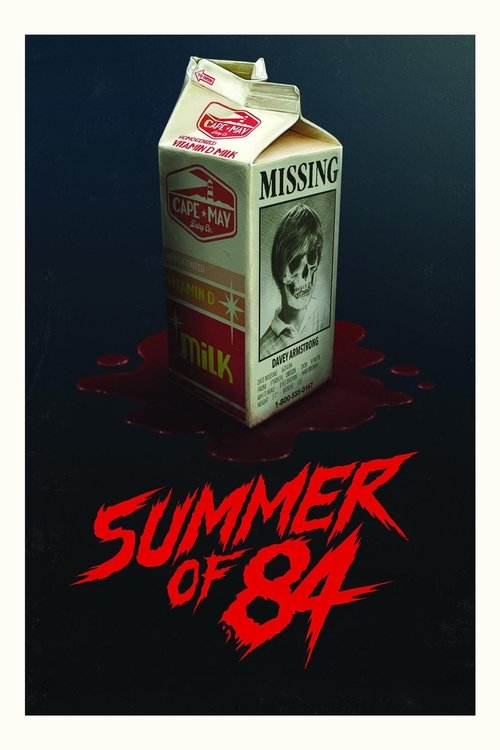
Summer of 84 (2018)
Directed by François Simard
No — Summer of 84 is not woke, scoring 4 out of 100 on our wokeness meter.
Summer of 84 arrives dressed in the familiar denim of Reagan-era nostalgia, following four teenage boys on their paper routes and walkie-talkie stakeouts as they build a case against the mild-mannered cop next door.
Consciousness Markers
The cast is overwhelmingly white, with the core friend group and antagonist all Caucasian; no deliberate emphasis on diverse or inclusive casting.
Nikki is given a modest interior life (divorcing parents, her own departure) but remains a peripheral figure in a male-centric coming-of-age narrative with no feminist framing.
The film is a genre thriller with no didactic messaging or moralizing; it aims to unsettle rather than instruct.
Passing details like a foreclosed house and a demolished treehouse gesture at economic precarity but carry no systemic critique.
No LGBTQ+ characters, relationships, or themes appear anywhere in the film.
The film engages no racial themes or commentary whatsoever; the suburban setting is uniformly white.
No environmental or climate themes are present.
No body-positivity themes or messaging.
No neurodivergent characters or themes are explored.
The 1980s setting is nostalgic backdrop, not a revisionist reframing of history.
Why it received this score
Summer of 84 arrives dressed in the familiar denim of Reagan-era nostalgia, following four teenage boys on their paper routes and walkie-talkie stakeouts as they build a case against the mild-mannered cop next door. The directors, working as a trio, understand that suburbia is scariest when the lawns are immaculate and the smiles are fixed. The result is a slow-burn thriller with a genuinely nasty final act, one that trades the genre's usual catharsis for a lingering, unresolved dread. It is competent, moody, and entirely content to be a genre picture.
The cultural inventory here is thin and unapologetically so. The friend group is a quartet of white boys, the villain a white policeman, the crush a white girl named Nikki who is granted just enough interior life (divorcing parents, an impending departure) to function as a person before the plot moves on. No racial themes surface. No queer characters appear. No environmental sermon is preached. The script gestures once or twice at economic precarity, a foreclosed house, a treehouse demolished by a belligerent father, but these details sit as texture, not argument. Nobody in the film is interested in diagnosing the systems that produced the town's quiet cruelties; they are interested in surviving them.
What the film does with its remaining energy is unsettle. There is no lecture, no moralizing coda, no attempt to convert its audience to a cause. The camera lingers on a basement wall of framed photographs and lets the horror speak. For a genre piece with a modest budget and a Sundance slot, that restraint is its own small virtue. We are left with a well-made chiller that aspires to nothing beyond making us check the locks, and in an era of films straining to mean something, that narrow ambition registers as almost quaint.
Analysis generated by our Consciousness Algorithm


Synopsis
After suspecting that their police officer neighbor is a serial killer, a group of teenage friends spend their summer spying on him and gathering evidence, but as they get closer to discovering the truth, things get dangerous.
Questions about Summer of 84
Is Summer of 84 woke?
No — Summer of 84 is not woke, scoring 4 out of 100 on our wokeness meter. That earns it a verdict of Ultra Based.
Does Summer of 84 have any woke elements?
Very few. None of the 10 markers reaches 30, the level where a marker counts as present; the highest is Representation Casting at 12.
How does Summer of 84 compare to other 2018 movies?
It ranks #269 of the 325 films from 2018 we've scored; their average is 20. The wokest is Return (92).
How is the Woke Score calculated?
An AI-assisted process researches the film and its reception, scores it 0–100 on ten markers, then combines those into one 0–100 Woke Score. It measures a specific set of 2020s cultural themes, not film quality.