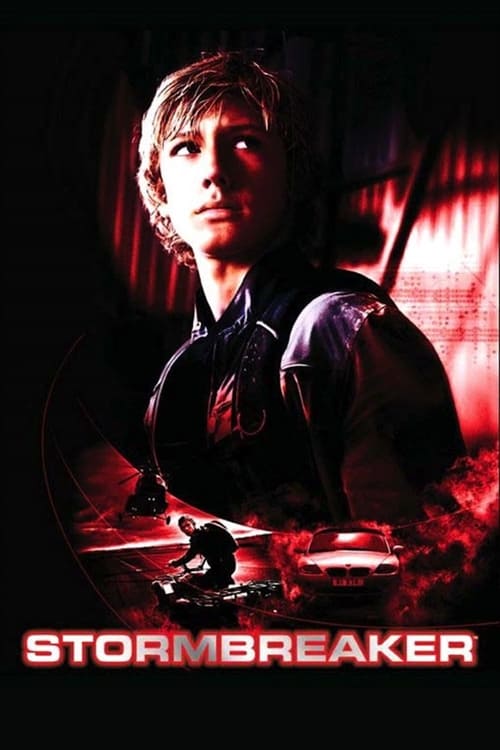
Stormbreaker (2006)
Directed by Geoffrey Sax
No — Stormbreaker is not woke, scoring 9 out of 100 on our wokeness meter.
Stormbreaker arrives in 2006 as a modest British teen-spy confection, adapted by Anthony Horowitz from his own novel, and it carries the earnestness of a franchise pilot that never got its second episode.
Consciousness Markers
The cast includes Sophie Okonedo and Ashley Walters in supporting roles, but their presence is unremarked and incidental to a pre-2010 British production; no deliberate diversity-driven casting agenda is evident.
Mrs. Jones heads MI6 Special Operations and Jack Starbright bests the villain's henchwoman in a fight, but these are conventional genre beats rather than a feminist thesis.
The antagonist is a billionaire industrialist, but his villainy is personal megalomania rather than a critique of capitalism as a system.
The film is a brisk teen adventure with no preachy messaging or moralizing monologues.
No LGBTQ+ characters, themes, or subtext appear anywhere in the film.
The film engages no racial themes or commentary; casting is diverse but narratively silent on race.
No environmental or climate themes are present.
No body-positivity themes; the deformed henchman Mr. Grin is played for menace, not acceptance.
No neurodivergent characters or themes are depicted.
The film is a straightforward adaptation of a contemporary spy novel with no historical revisionism.
Why it received this score
Stormbreaker arrives in 2006 as a modest British teen-spy confection, adapted by Anthony Horowitz from his own novel, and it carries the earnestness of a franchise pilot that never got its second episode. A fourteen-year-old orphan is conscripted by MI6 after his uncle dies, then sent to a Cornish lair to investigate a billionaire's gift of computers to every school in England. The computers contain smallpox. The billionaire is Mickey Rourke. This is the entire moral architecture of the film, and it holds.
On the matter of social consciousness, the production is largely a time capsule of its moment. Sophie Okonedo runs MI6 Special Operations and Ashley Walters leads an SAS training unit, both present without ceremony, which is to say the casting reflects a modern Britain without pausing to announce it. Alicia Silverstone's housekeeper wins a fight against the villain's henchwoman with the assistance of a blowfish, a sequence that flatters nobody's ideology. The antagonist is a billionaire industrialist, though his grievance is a childhood grudge against the Prime Minister, not a systemic indictment of capital. He wants to poison schoolchildren because he was bullied. That is a personal matter.
The film lectures no one. There is no messaging, no moralizing monologue, no moment where the narrative stops to instruct the audience on how to feel about the world. It is brisk, competent, and forgotten. The critical consensus found it lacking in originality and believability, and the box office agreed, recouping roughly half of its budget and ending Horowitz's cinematic ambitions. What remains is a curious artifact: a children's espionage picture so devoid of agenda that its only provocation is how thoroughly it declines to have one.
Analysis generated by our Consciousness Algorithm


Synopsis
After the death of his uncle, 14-year-old schoolboy Alex Rider is forced by the Special Operations Division of the UK's secret intelligence service, MI6, into a mission which will save millions of lives.
Questions about Stormbreaker
Is Stormbreaker woke?
No — Stormbreaker is not woke, scoring 9 out of 100 on our wokeness meter. That earns it a verdict of Ultra Based.
Does Stormbreaker have any woke elements?
Very few. None of the 10 markers reaches 30, the level where a marker counts as present; the highest is Representation Casting at 22.
How does Stormbreaker compare to other 2006 movies?
It ranks #75 of the 211 films from 2006 we've scored; their average is 11. The wokest is An Inconvenient Truth (92).
How is the Woke Score calculated?
An AI-assisted process researches the film and its reception, scores it 0–100 on ten markers, then combines those into one 0–100 Woke Score. It measures a specific set of 2020s cultural themes, not film quality.