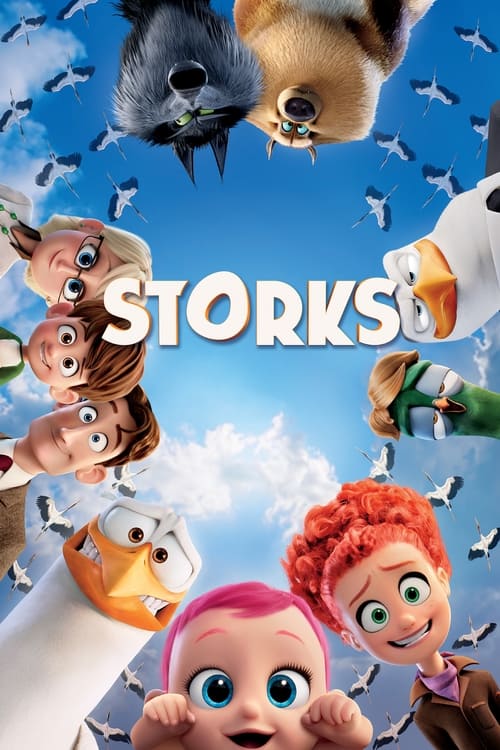
Storks (2016)
Directed by Doug Sweetland
No — Storks is not especially woke, scoring 32 out of 100 on our wokeness meter.
Storks arrives in 2016 as a Warner Animation Group product, brightly colored and hyperactive, about birds who once delivered babies and now deliver packages for Cornerstore.com.
Consciousness Markers
The villain is the CEO of Cornerstore.com, a thinly veiled Amazon-style internet retail giant obsessed with stock prices; the film ends with the corporation destroyed and the storks returning to their non-commercial calling.
GLAAD specifically praised the film as 'casually inclusive of same-sex couples,' with same-gender parents appearing among the families receiving babies.
The voice cast is notably diverse (Keegan-Michael Key, Jordan Peele, Danny Trejo) and the film includes same-gender couples in background family scenes, though no character's identity is foregrounded.
Tulip is a capable, inventive female lead who builds her own flying craft and ultimately becomes co-boss, but the film never frames this as a gender statement.
There is a mild thematic nudge about workaholic parents neglecting their children, but it is delivered through plot and character rather than preachy monologue.
The film features a diverse cast but contains no racial themes, commentary, or consciousness in its narrative.
No environmental or climate themes appear in the film.
No body-positive themes or messaging are present.
Pigeon Toady is characterized as awkward and attention-seeking, but this is played for comedy rather than as neurodivergent representation.
The film invents its own mythology about storks and does not revise or reinterpret historical events.
Why it received this score
Storks arrives in 2016 as a Warner Animation Group product, brightly colored and hyperactive, about birds who once delivered babies and now deliver packages for Cornerstore.com. The film's cultural footprint is modest but not empty. Its voice cast includes Keegan-Michael Key, Jordan Peele, and Danny Trejo, and the background families awaiting infants include same-gender parents. GLAAD described the film as casually inclusive of same-sex couples, which is accurate in the way a wallpaper pattern is accurate: present, unremarked, not load-bearing. The film does not stage a conversation about identity. It simply lets some couples exist at the edges of the frame. That earns a measure of credit, though not a parade.
Tulip, the human orphan raised by storks, is inventive and competent. She builds a flying craft, solves problems, and ends the film as co-boss of Stork Mountain. The screenplay never treats this as a gender argument. She is a capable character in a film that needs one. The anti-capitalist strain is stronger. Hunter, the CEO stork, runs Cornerstore.com with an eye on stock prices and a hatred of the old baby-delivery mission. The villain is a thinly veiled internet retail titan, and the climax destroys his corporation. The storks return to delivering babies, which is framed as a restoration of purpose over profit. This is a mild corporate satire for children, delivered with a straight face and a crane.
Other progressive markers are absent. There is no racial consciousness, no climate crusade, no body-positive messaging, and no neurodivergent representation. Pigeon Toady is awkward and attention-seeking, but the film mines him for comedy, not dignity. History is not revised. The workaholic parents, Henry and Sarah, learn to pay attention to their son, and the lesson arrives through plot mechanics. No sermon follows. The film's social consciousness is therefore a scattered affair: a few inclusive background couples, a competent heroine, and a destroyed retail monopoly. It is not a lecture. It is a cartoon with a mild case of conscience.
Analysis generated by our Consciousness Algorithm
Part of


Synopsis
Storks deliver babies…or at least they used to. Now they deliver packages for a global internet retail giant. Junior, the company’s top delivery stork, is about to be promoted when he accidentally activates the Baby Making Machine, producing an adorable and wholly unauthorized baby girl...
Questions about Storks
Is Storks woke?
No — Storks is not especially woke, scoring 32 out of 100 on our wokeness meter. That earns it a verdict of Based.
Does Storks have any woke elements?
3 of the 10 markers register at 30 or above, led by Eat the Rich (50), LGBTQ+ Themes (45) and Representation Casting (40). On Eat the Rich: The villain is the CEO of Cornerstore.com, a thinly veiled Amazon-style internet retail giant obsessed with stock prices; the film ends with the corporation destroyed and the storks returning to their non-commercial calling.
How does Storks compare to other 2016 movies?
It ranks #37 of the 285 films from 2016 we've scored; their average is 16. The wokest is 13th (92).
How is the Woke Score calculated?
An AI-assisted process researches the film and its reception, scores it 0–100 on ten markers, then combines those into one 0–100 Woke Score. It measures a specific set of 2020s cultural themes, not film quality.