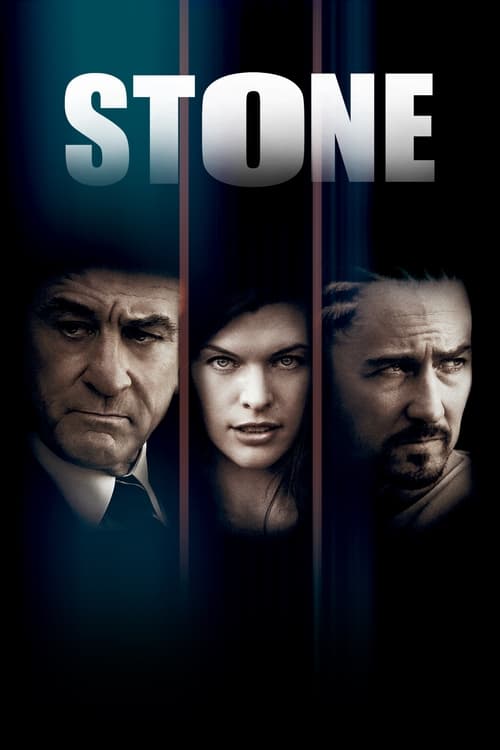
Stone (2010)
Directed by John Curran
No — Stone is not woke, scoring 3 out of 100 on our wokeness meter.
John Curran's Stone arrives with the solemn self-regard of a chamber piece that believes it is saying something profound about men, sin, and the fires we set.
Consciousness Markers
Milla Jovovich's Lucetta functions as a seductress and pawn in the men's game, and the film's treatment of its female characters is conventional rather than agenda-driven.
Critics noted heavy-handed symbolism around spiritual awakening and morality, but the film preaches no modern social-justice message.
The cast is overwhelmingly white, with no deliberate or commented-upon diverse casting choices; the story is a psychological duel between two white men.
No LGBTQ+ characters, themes, or subtext appear anywhere in the film.
Race is entirely absent as a theme; the film concerns crime, faith, and moral decay without any racial consciousness.
Arson and fire feature prominently, but as criminal and symbolic elements, not as environmental commentary.
No critique of capitalism, wealth, or class structures is present in this prison-and-parole drama.
Body image and physical self-acceptance are not addressed in any form.
No neurodivergent characters or themes are depicted or discussed.
The film is a fictional original screenplay with no historical revisionism or reframing of real events.
Why it received this score
John Curran's Stone arrives with the solemn self-regard of a chamber piece that believes it is saying something profound about men, sin, and the fires we set. Robert De Niro plays Jack Mabry, a parole officer weeks from retirement, and Edward Norton plays the arsonist who wants out early. They circle each other across a prison table, trading dialogue that the press materials surely called sparring. The film opens with a man dangling his own daughter out a window to keep his wife from leaving, which sets a tone the rest of the runtime struggles to match. What follows is a slow, humid descent into mutual manipulation, and it is rendered with the kind of heavy-handed symbolism that critics at the time found hard to forgive. Every object means something. Every silence is a sermon. The spiritual awakening literature Stone reads is not subtle, and neither is the fire that closes the loop.
The cultural inventory here is remarkably sparse. The cast is white and the story never once glances at that fact, because race is simply not its business. There are no queer currents, no environmental sermonizing dressed up as arson, no economic grievance against the wealthy, no meditation on bodies or brains that work differently. Milla Jovovich's Lucetta is deployed as a seductress and a bargaining chip, which is a conventional arrangement and not a manifesto. The film's moral instruction runs entirely toward old-fashioned questions of guilt, faith, and whether a man can be forgiven. Madylyn reads the house fire as divine punishment. That is the register. It is theology, not sociology.
What remains is a picture that preaches without a modern congregation. The sermonizing is real, but it is aimed at the soul, not at society, and audiences stayed home in sufficient numbers to make the point moot. We are left with two fine actors playing against type in a film that mistakes murk for depth. It is not offensive. It is merely certain of itself, which in this line of work is almost never enough.
Analysis generated by our Consciousness Algorithm


Synopsis
Parole officer Jack Mabry has only a few weeks left before retirement and wishes to finish out the cases he's been assigned. One such case is that of Gerald 'Stone' Creeson, a convicted arsonist who is up for parole. Jack is initially reluctant to indulge Stone in the coarse banter he wishes to pursue and feels little sympathy for the prisoner's pleads for an early release. Seeing little hope in convincing Jack himself, Stone arranges for his wife to seduce the officer, but motives and intentions steadily blur amidst the passions and buried secrets of the corrupted players in this deadly game of deception.
Questions about Stone
Is Stone woke?
No — Stone is not woke, scoring 3 out of 100 on our wokeness meter. That earns it a verdict of Ultra Based.
Does Stone have any woke elements?
Very few. None of the 10 markers reaches 30, the level where a marker counts as present; the highest is Feminist Agenda at 5.
How does Stone compare to other 2010 movies?
It ranks #186 of the 238 films from 2010 we've scored; their average is 11. The wokest is My Name Is Khan (84).
How is the Woke Score calculated?
An AI-assisted process researches the film and its reception, scores it 0–100 on ten markers, then combines those into one 0–100 Woke Score. It measures a specific set of 2020s cultural themes, not film quality.