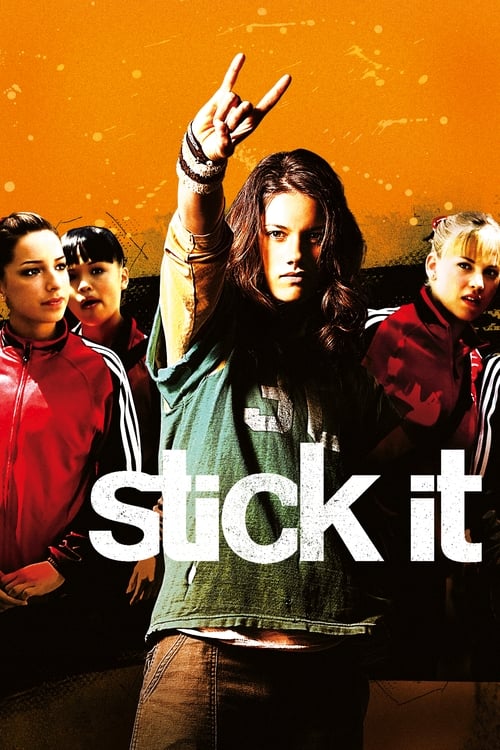
Stick It (2006)
Directed by Jessica Bendinger
No — Stick It is not especially woke, scoring 33 out of 100 on our wokeness meter.
Jessica Bendinger's Stick It is a 2006 teen comedy-drama about Haley Graham, a former gymnastics prodigy sentenced to an elite academy after a construction-site bike race.
Consciousness Markers
The plot centers on young female athletes rebelling against arbitrary judging and body policing, with a strong undercurrent of female solidarity and agency.
A central protest involves gymnasts deliberately showing bra straps to challenge a prudish deduction, making a modest statement about bodily autonomy and dress-code policing.
The film features a female-led ensemble and several non-white gymnasts in supporting roles, but diversity is incidental rather than a stated casting priority.
The third act delivers explicit speeches and a protest about unfair rules and scoring, giving the film a moderate message-driven streak.
There are no LGBTQ+ characters, themes, or subtext in the film.
Race is not addressed or thematized; the diverse gymnasts exist without racial commentary.
There is no environmental or climate-related content.
The film critiques a corrupt gymnastics judging system, not capitalism or economic inequality.
No neurodivergent characters or themes are present.
The film is fictional and does not revise or reinterpret historical events.
Why it received this score
Jessica Bendinger's Stick It is a 2006 teen comedy-drama about Haley Graham, a former gymnastics prodigy sentenced to an elite academy after a construction-site bike race. The film has a female lead, a female director, and a gym full of young women whose frustrations with scoring, coaching, and parental pressure drive the plot. Several non-white gymnasts appear in supporting roles, though the film never frames their presence as a statement. That diversity is simply part of the ensemble, not a thesis.
The film's strongest progressive current is feminist: it treats arbitrary judging and dress-code policing as legitimate objects of rage. The bra-strap protest is the clearest example, a small rebellion over bodily autonomy that lands with more force than the script's speeches. Female solidarity builds across the final act. Beyond that, the film is quiet. There is no LGBTQ material, no climate concern, no economic critique, no neurodivergent arc, and no historical revision. Race exists on screen without racial consciousness. The villains are judges and rules, not capitalism.
When Stick It finally argues, it argues loudly. The third act turns into a coordinated protest, complete with speeches about unfair scoring and a gymnast insurrection that forces the judges to bend. The message is on-the-nose, but it is aimed at a broken sport, not a broken society. The film wants us to cheer for the athletes, and we do. It is a modest, era-bound artifact: a teen comedy with a rebellious pulse and a limited political imagination.
Analysis generated by our Consciousness Algorithm


Synopsis
Haley is a naturally gifted athlete but, with her social behavior, the teen seems intent on squandering her abilities. After a final brush with the law, a judge sentences her to an elite gymnastics academy run by a legendary, hard-nosed coach. Once there, Haley's rebellious attitude wins her both friends and enemies.
Questions about Stick It
Is Stick It woke?
No — Stick It is not especially woke, scoring 33 out of 100 on our wokeness meter. That earns it a verdict of Based.
Does Stick It have any woke elements?
4 of the 10 markers register at 30 or above, led by Feminist Agenda (55), Body Positivity (40) and Lecture Energy (30). On Feminist Agenda: The plot centers on young female athletes rebelling against arbitrary judging and body policing, with a strong undercurrent of female solidarity and agency.
How does Stick It compare to other 2006 movies?
It ranks #14 of the 211 films from 2006 we've scored; their average is 11. The wokest is An Inconvenient Truth (92).
How is the Woke Score calculated?
An AI-assisted process researches the film and its reception, scores it 0–100 on ten markers, then combines those into one 0–100 Woke Score. It measures a specific set of 2020s cultural themes, not film quality.