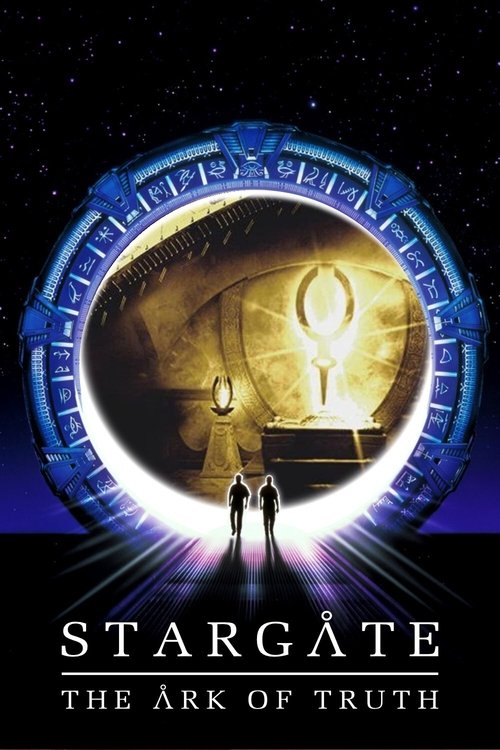
Stargate: The Ark of Truth (2008)
Directed by Robert C. Cooper
No — Stargate: The Ark of Truth is not woke, scoring 7 out of 100 on our wokeness meter.
Stargate: The Ark of Truth arrives as a direct-to-video epilogue to a television series cancelled before it could finish its own story, which is a polite way of saying this is a two-hour apology note with spaceships.
Consciousness Markers
The cast includes Christopher Judge as Teal'c and several women in prominent roles, but this reflects the established SG-1 ensemble rather than any deliberate diversity initiative.
The Ark of Truth plot is essentially a device for exposing religious dogma as a lie, giving the film a mild anti-theocratic sermonizing streak, though it stays within action-adventure bounds.
Carter and Vala are competent military and resistance figures, but the film offers no feminist thesis or commentary on gender.
Teal'c is a Black lead, but his race is never addressed or thematized; he exists as a character, not a statement.
No LGBTQ characters or themes appear anywhere in the film.
No environmental or climate themes whatsoever.
No economic critique; the conflict is entirely military and theological.
No body-positivity content.
No neurodivergence themes or characters.
The film is set in a fictional sci-fi universe with no historical revisionism.
Why it received this score
Stargate: The Ark of Truth arrives as a direct-to-video epilogue to a television series cancelled before it could finish its own story, which is a polite way of saying this is a two-hour apology note with spaceships. Robert C. Cooper writes and directs, and the cast of Stargate SG-1 files in to close the Ori arc with the solemnity of pallbearers. The plot concerns a box, a false box, a second box in a distant galaxy, and an ancient device that reveals to true believers that their gods are frauds. There is also a Replicator subplot, because a film of this vintage cannot end without one.
The cultural markers here are faint and mostly inherited. Christopher Judge's Teal'c remains a Black lead in a franchise that never once asks him to explain himself, and Amanda Tapping's Carter and Claudia Black's Vala handle weapons and command decisions with a competence the script takes for granted. None of this is presented as a thesis. It is simply the ensemble as it stood. The one real streak of sermonizing comes from the Ark itself, a machine whose entire function is to disprove religious authority, which gives the final act a faint anti-theocratic hum. The film is careful to let Vala and Tomin agree that the faith carried a worthwhile message, so even the heresy is housebroken.
Everything else is absent. No environmental lament, no economic grievance, no body politics, no neurological identity, no revision of any actual history. The conflict is military and theological, and it resolves with a beam of light and a shutdown code. For a 2008 genre picture, the restraint reads less like conviction and more like a different era entirely. We score it accordingly and move on.
Analysis generated by our Consciousness Algorithm


Synopsis
SG-1 searches for an ancient weapon which could help them defeat the Ori, and discover it may be in the Ori's own home galaxy. As the Ori prepare to send ships through to the Milky Way to attack Earth, SG-1 travels to the Ori galaxy aboard the Odyssey. The International Oversight committee have their own plans and SG-1 finds themselves in a distant galaxy fighting two powerful enemies.
Questions about Stargate: The Ark of Truth
Is Stargate: The Ark of Truth woke?
No — Stargate: The Ark of Truth is not woke, scoring 7 out of 100 on our wokeness meter. That earns it a verdict of Ultra Based.
Does Stargate: The Ark of Truth have any woke elements?
Very few. None of the 10 markers reaches 30, the level where a marker counts as present; the highest is Representation Casting at 22.
How does Stargate: The Ark of Truth compare to other 2008 movies?
It ranks #122 of the 212 films from 2008 we've scored; their average is 12. The wokest is Milk (68).
How is the Woke Score calculated?
An AI-assisted process researches the film and its reception, scores it 0–100 on ten markers, then combines those into one 0–100 Woke Score. It measures a specific set of 2020s cultural themes, not film quality.