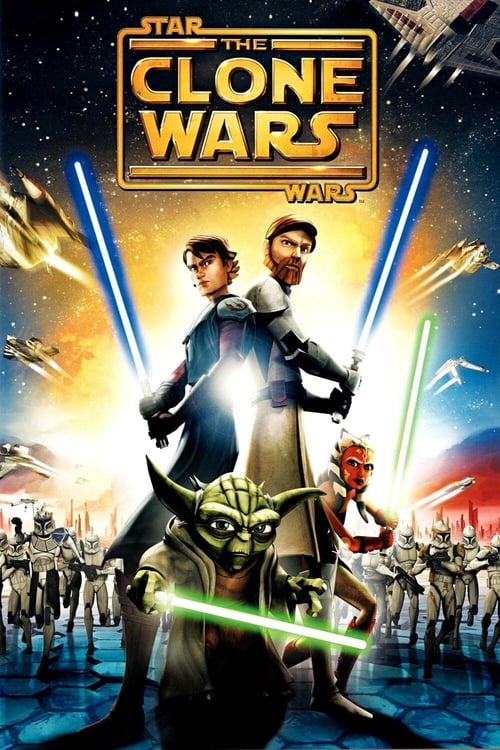
Star Wars: The Clone Wars (2008)
Directed by Dave Filoni
No — Star Wars: The Clone Wars is not woke, scoring 8 out of 100 on our wokeness meter.
The Clone Wars arrived in 2008 as a theatrical release assembled from the opening episodes of a television series, a decision George Lucas described as almost an afterthought.
Consciousness Markers
The voice cast includes Samuel L. Jackson as Mace Windu and a diverse array of actors, and introduces Ahsoka Tano, a female Togruta Jedi. However, diversity is largely incidental to the Star Wars universe rather than a deliberate modern casting push.
Ahsoka Tano is a capable young female Jedi apprentice and Asajj Ventress is a formidable female antagonist, but the film does not advance an explicit feminist agenda or critique patriarchy.
No LGBTQ+ characters, themes, or subtext appear in the film.
The film features alien species and clones but engages no racial themes, commentary, or consciousness.
No environmental or climate-related themes are present.
The plot involves crime lords and a galactic war, but it does not critique capitalism or wealth inequality.
No body positivity themes or messaging.
No neurodivergent characters or themes.
The film is a fictional space opera with no historical revisionism.
The film is an action-adventure pilot and does not lecture the audience on social issues.
Why it received this score
The Clone Wars arrived in 2008 as a theatrical release assembled from the opening episodes of a television series, a decision George Lucas described as almost an afterthought. Warner Bros. distributed it. McDonald's built a Happy Meal around it. The film grossed sixty-eight million dollars, the smallest haul in the franchise's history. Watching it now, we find a pilot wearing a feature's clothes. The seams show. The animation is stiff, the pacing episodic, and the dialogue carries the functional quality of something written for a child holding a plastic lightsaber.
On the question of cultural messaging, the film is inert. Ahsoka Tano, the young Togruta apprentice assigned to Anakin Skywalker, is capable and headstrong. Asajj Ventress is a genuinely menacing antagonist. These are presences, not arguments. Nobody pauses to explain what their existence means. Samuel L. Jackson returns as Mace Windu, and the voice cast is varied in the manner of a franchise that has always drawn from a broad pool. None of it arrives as a statement. The film has no interest in climate, in wealth inequality (despite a plot built around a crime lord and his kidnapped son), in racial commentary, or in any other subject a more conscientious production might have smuggled in.
The result is a curious artifact: a film with a female lead and no thesis, a war story with no position, a piece of intellectual property that wants only to introduce characters and move merchandise. There is something restful about it. It lectures nobody. The Hutt clan sits at the center of the plot, a galactic oligarchy of slavers and racketeers, and the film declines to make a single observation about it. That restraint may be the most unfashionable thing about the whole endeavor.
Analysis generated by our Consciousness Algorithm
Part of

Synopsis
As the Clone Wars sweep through the galaxy, Anakin Skywalker and his new Padawan learner Ahsoka Tano plunge into a dangerous mission to rescue the kidnapped son of crime lord Jabba the Hutt.
Questions about Star Wars: The Clone Wars
Is Star Wars: The Clone Wars woke?
No — Star Wars: The Clone Wars is not woke, scoring 8 out of 100 on our wokeness meter. That earns it a verdict of Ultra Based.
Does Star Wars: The Clone Wars have any woke elements?
Very few. None of the 10 markers reaches 30, the level where a marker counts as present; the highest is Feminist Agenda at 15.
How does Star Wars: The Clone Wars compare to other 2008 movies?
It ranks #110 of the 212 films from 2008 we've scored; their average is 12. The wokest is Milk (68).
How is the Woke Score calculated?
An AI-assisted process researches the film and its reception, scores it 0–100 on ten markers, then combines those into one 0–100 Woke Score. It measures a specific set of 2020s cultural themes, not film quality.