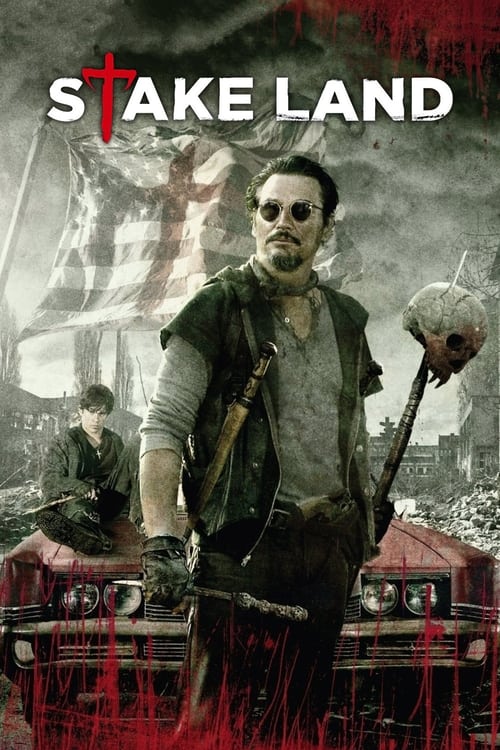
Stake Land (2010)
Directed by Jim Mickle
No — Stake Land is not woke, scoring 7 out of 100 on our wokeness meter.
Stake Land is a road movie with fangs, a vampire plague that empties the American heartland and sends a teenage boy and his grizzled mentor north toward Canada.
Consciousness Markers
The cast is overwhelmingly white, with Sean Nelson as Willie, a former Marine, being the notable exception. His presence is natural to the story and never commented upon.
Sister, Belle, and Peggy are capable survivors with moments of agency, but the narrative remains a male-driven mentor/protégé survival story, and the women are variously victimized, enslaved, or fridged.
The Brotherhood's religious extremism is portrayed as toxic, but the film dramatizes this through action rather than sermonizing, keeping any messaging understated.
The collapse is vaguely attributed to 'economic and political disaster,' but the film offers no critique of capitalism; its antagonist is a religious fundamentalist militia, not the wealthy.
Willie's race is never addressed and carries no thematic weight; the film engages no racial commentary whatsoever.
No LGBTQ+ characters, themes, or subtext appear anywhere in the film.
The apocalypse is a vampiric plague, not an environmental or climate-driven catastrophe. No climate themes are present.
No body-positivity themes or messaging are present.
No neurodivergent characters or themes are depicted.
The film is a fictional post-apocalyptic horror story with no historical revisionism.
Why it received this score
Stake Land is a road movie with fangs, a vampire plague that empties the American heartland and sends a teenage boy and his grizzled mentor north toward Canada. The filmmakers wanted to emphasize isolation and small moments of cooperation over bloodshed, and the result is patient and moody. The economic and political collapse preceding the outbreak gets a single mention and no examination. The catastrophe is viral, not environmental, so the ecological dread available to any story about a dying continent goes untouched.
The cast is almost entirely white. Sean Nelson appears as Willie, a former Marine, and his presence carries no commentary and no thematic weight. He is a survivor among survivors. There is no romantic or sexual material beyond the grim business of rape and enslavement, and no gestures toward bodily self-acceptance or neurological difference. The women are permitted competence, Sister with her rifle, Peggy with her crossbow, Belle with her stubborn hope, but the story belongs to the men, and the women are taken, used, or killed to move it along.
The true villains are the Brotherhood, a fundamentalist militia that reads the plague as divine instruction and drops vampires onto settlements from helicopters. The film treats their extremism as poison, though it does so by staging atrocities instead of announcing a thesis, which keeps the sermonizing brief. There is no indictment of wealth or markets; the antagonists are zealots, not oligarchs. The appeal is easy to see. It is efficient, atmospheric, and largely untroubled by the cultural questions of a later decade, which is either a limitation or a relief depending on the viewer's appetite for homework.
Analysis generated by our Consciousness Algorithm


Synopsis
Martin was a normal teenage boy before the country collapsed in an empty pit of economic and political disaster. A vampire epidemic has swept across what is left of the nation's abandoned towns and cities, and it's up to Mister, a death dealing, rogue vampire hunter, to get Martin safely north to Canada, the continent's New Eden.
Questions about Stake Land
Is Stake Land woke?
No — Stake Land is not woke, scoring 7 out of 100 on our wokeness meter. That earns it a verdict of Ultra Based.
Does Stake Land have any woke elements?
Very few. None of the 10 markers reaches 30, the level where a marker counts as present; the highest is Representation Casting at 15.
How does Stake Land compare to other 2010 movies?
It ranks #125 of the 238 films from 2010 we've scored; their average is 11. The wokest is My Name Is Khan (84).
How is the Woke Score calculated?
An AI-assisted process researches the film and its reception, scores it 0–100 on ten markers, then combines those into one 0–100 Woke Score. It measures a specific set of 2020s cultural themes, not film quality.