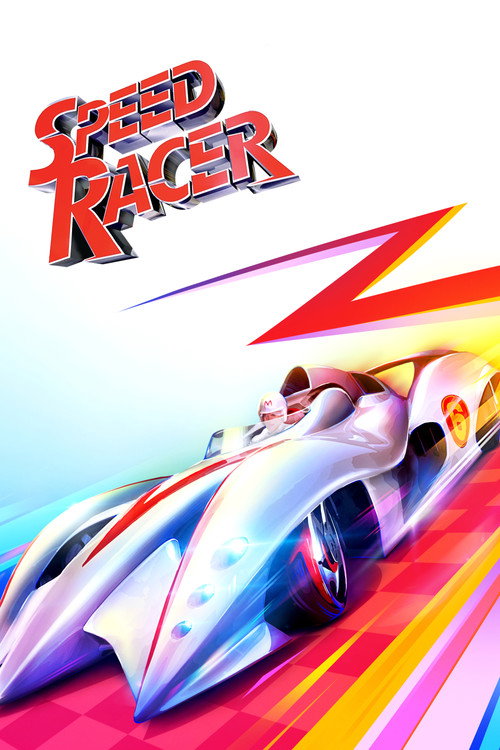
Speed Racer (2008)
Directed by Lana Wachowski
No — Speed Racer is not especially woke, scoring 23 out of 100 on our wokeness meter.
Speed Racer arrives in 2008 as a hundred-million-dollar act of aesthetic aggression wearing the costume of a family picture, and the costume did not hold.
Consciousness Markers
The central conflict is explicitly anti-corporate: the villain is a CEO who fixes races, buys out family businesses, and puts a bounty on the hero, while Speed rejects corporate money to stay loyal to his family's independent company.
The cast is notably international and multiethnic, with Hiroyuki Sanada, Rain, Yu Nan, Richard Roundtree, and Nayo K. Wallace in prominent roles, reflecting the Japanese source material, though the diversity is organic rather than message-driven.
The anti-corporate message is delivered through action and villainous monologues rather than preachy lecturing, keeping the didacticism mild.
The Togokahn family and other international racers give the film a global texture, but race is never a subject of commentary or thematic concern.
Trixie is a capable, active participant in the racing and detective work, and Mom Racer and Horuko have agency, but the film makes no feminist argument and centers its male hero throughout.
There are no LGBTQ+ characters, themes, or subtext anywhere in the film.
Environmental themes are entirely absent; the film is about racing and corporate corruption, not climate.
There is no body-positivity theme or messaging in the film.
No neurodivergent characters or themes are present; Spritle's antics are played for comedy, not as representation.
The film is a stylized adaptation of a fictional anime and makes no historical claims to revise.
Why it received this score
Speed Racer arrives in 2008 as a hundred-million-dollar act of aesthetic aggression wearing the costume of a family picture, and the costume did not hold. The Wachowskis took a 1966 Japanese cartoon about a boy who drives very fast and rebuilt it as pop-art collage, saturated color and fluid transitions, an approach that puzzled the studio and most of the audience. Underneath the candy shell sits a plain grievance. A corporation fixes races, buys out independent shops, and puts a bounty on a teenager who declines its money. Roger Allam's Royalton explains all of this at length, in a monologue so theatrical that it stops just short of a sermon. The anger is genuine. The sermon is brief. The cars are loud.
The cast is genuinely international, drawing Hiroyuki Sanada, Rain, Yu Nan, Richard Roundtree, and Nayo K. Wallace into a Berlin-shot production that never pauses to congratulate itself. Christina Ricci's Trixie drives, investigates, and takes part in the action, though the story belongs to a young man and his martyred brother. Mom Racer and Horuko Togokahn get moments of competence, unremarked. Beyond that the cupboard is bare. No climate anxiety. No body-positivity program. No neurodivergent character framed as such. No romantic arrangement outside the standard pairing. No history quietly rewritten for present-day comfort. Spritle and the chimpanzee are present, and they are not representation.
Which leaves a film that is louder about economics than about identity, and even that argument is carried by stunts and villainy instead of speeches. The progressive content here is inherited, incidental, and entirely uninterested in being noticed. It is a corporate critique dressed as a toy commercial, and the toy commercial is the part that stuck. On the index, this lands in modest territory: too strange to be propaganda, too sincere about family and independent business to be dismissed. A curious artifact. The chimpanzee remains a problem.
Analysis generated by our Consciousness Algorithm
Part of


Synopsis
Speed Racer is a young and brilliant racing driver. When corruption in the racing leagues costs his brother his life, Speed must team up with the police and the mysterious Racer X to bring an end to the corruption and criminal activities.
Questions about Speed Racer
Is Speed Racer woke?
No — Speed Racer is not especially woke, scoring 23 out of 100 on our wokeness meter. That earns it a verdict of Based.
Does Speed Racer have any woke elements?
2 of the 10 markers register at 30 or above, led by Eat the Rich (55) and Representation Casting (40). On Eat the Rich: The central conflict is explicitly anti-corporate: the villain is a CEO who fixes races, buys out family businesses, and puts a bounty on the hero, while Speed rejects corporate money to stay loyal to his family's independent company.
How does Speed Racer compare to other 2008 movies?
It ranks #25 of the 212 films from 2008 we've scored; their average is 12. The wokest is Milk (68).
How is the Woke Score calculated?
An AI-assisted process researches the film and its reception, scores it 0–100 on ten markers, then combines those into one 0–100 Woke Score. It measures a specific set of 2020s cultural themes, not film quality.