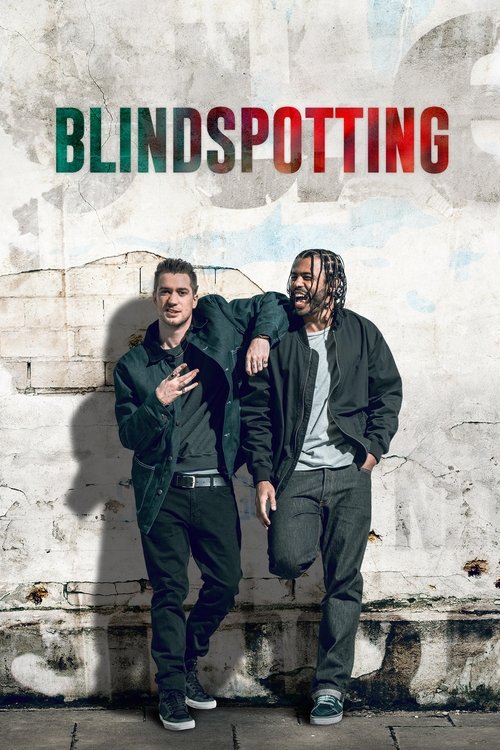
Blindspotting (2018)
Directed by Carlos López Estrada
Yes — Blindspotting is woke, scoring 71 out of 100 on our wokeness meter.
Blindspotting arrives with its thesis already printed on the windshield.
Consciousness Markers
Racial injustice, police violence against Black men, cultural appropriation, and Black identity in a gentrifying Oakland are the film's central concerns.
The film is led by and centers Black and other actors of color, authentically portraying Oakland's diverse community; casting is integral to its cultural specificity.
The climax is an explicit freestyle rap lecture against police violence and gentrification, and the screenplay frequently voices social commentary directly.
The film critiques gentrification, displacement, and wealthy newcomers, but frames it more as cultural loss than a systemic anti-capitalist indictment.
Female characters like Val and Ashley have agency and narrative importance, but the film does not advance a feminist agenda or critique patriarchy.
No LGBTQ+ characters, themes, or subtext are present.
No environmental or climate-related themes appear.
No body positivity themes or body-diverse representation are present.
Collin's hallucinations stem from trauma, not neurodivergence, and the film does not explore neurodiverse identity.
The film is set in the present and does not revise or reinterpret historical events.
Why it received this score
Blindspotting arrives with its thesis already printed on the windshield. A parolee named Collin, three days from freedom, watches a white officer gun down a fleeing Black man, and from that moment the film has no interest in ambiguity. The camera lingers on his sleepless nights, his visions, his mounting dread, and the message is delivered with the gentle insistence of a leaf blower at dawn. Carlos López Estrada directs with real energy, and the Oakland locations feel lived in, specific, and unsentimental. It is a well-made picture. It is also a picture that would like a word with you.
The film's true subject is the city itself, and its anger is aimed squarely at the newcomers pricing out the people who made the place worth pricing. Wealthy transplants, ironic t-shirts, and a party full of guests who mistake a threat for a joke all get their turn in the dock. The critique lands closer to cultural grief than economic analysis, mourning a neighborhood instead of indicting a system, but the resentment is plainly there and it is not subtle. The friendship between Collin and Miles carries the emotional weight, and Rafael Casal's Miles is a study in borrowed grievance, a white man mourning a loss he never had to suffer. That is the sharpest idea in the script.
And then the climax arrives, a freestyle rap delivered at gunpoint to the offending officer, and whatever restraint the film had been holding onto walks calmly out of the room. Every theme gets restated in verse, at volume, for several minutes. The performances are strong, the soundtrack is genuinely of its place, and the whole thing is assembled with obvious care. It simply cannot resist telling us what it has already shown us. A film this fluent in its own city should trust its audience a little more. It does not, and we are all seated for the lecture.
Analysis generated by our Consciousness Algorithm


Synopsis
Collin must make it through his final three days of probation for a chance at a new beginning. He and his troublemaking childhood best friend, Miles, work as movers, and when Collin witnesses a police shooting, the two men’s friendship is tested as they grapple with identity and their changed realities in the rapidly-gentrifying neighborhood they grew up in.
Questions about Blindspotting
Is Blindspotting woke?
Yes — Blindspotting is woke, scoring 71 out of 100 on our wokeness meter. That earns it a verdict of Woke.
What makes Blindspotting woke?
4 of the 10 markers register at 30 or above, led by Racial Consciousness (92), Representation Casting (82) and Lecture Energy (80). On Racial Consciousness: Racial injustice, police violence against Black men, cultural appropriation, and Black identity in a gentrifying Oakland are the film's central concerns.
How does Blindspotting compare to other 2018 movies?
It ranks #9 of the 325 films from 2018 we've scored; their average is 20. The wokest is Return (92).
How is the Woke Score calculated?
An AI-assisted process researches the film and its reception, scores it 0–100 on ten markers, then combines those into one 0–100 Woke Score. It measures a specific set of 2020s cultural themes, not film quality.