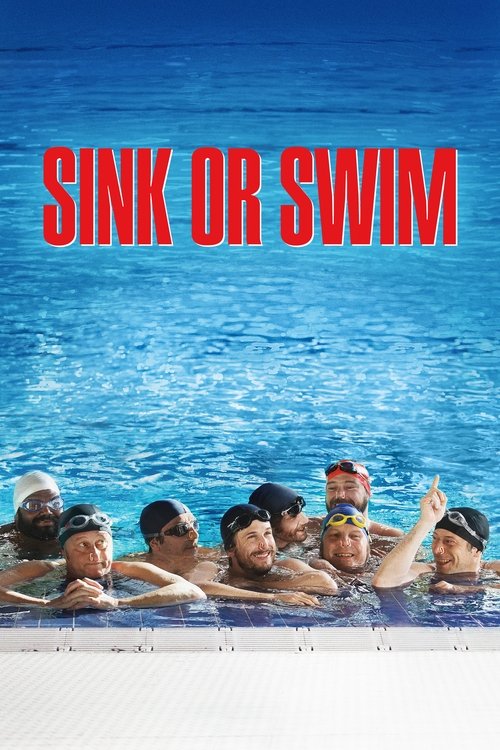
Sink or Swim (2018)
Directed by Gilles Lellouche
No — Sink or Swim is not woke, scoring 9 out of 100 on our wokeness meter.
Gilles Lellouche's Sink or Swim concerns Bertrand, forty years old, two years into a depression he cannot medicate his way out of, who stumbles into purpose by joining an all-male synchronized swimming team.
Consciousness Markers
The film celebrates non-ideal male bodies in swimsuits, challenging traditional athletic aesthetics with a gentle, comedic touch.
The ensemble includes Leïla Bekhti, a French actress of Algerian descent, but her presence is natural and unremarked upon, offering only a modest nod to diversity.
No LGBTQ+ characters or themes are present; the synchronized swimming team is resolutely heterosexual in its midlife crises.
A female former champion coaches the men, but the film's focus remains on male bonding and depression, not feminist critique.
Race is never addressed; the film is a Gallic slice of life with no racial commentary.
No environmental themes; the only water is in the pool.
No critique of capitalism; the men's struggles are personal, not economic.
Depression is a central theme, but it is a mood disorder, not typically classified as neurodivergence; no autistic or ADHD coding.
No historical revisionism; it's a contemporary story.
The film imparts life lessons about friendship and mental health, but does so with a light comedic touch rather than a sermon.
Why it received this score
Gilles Lellouche's Sink or Swim concerns Bertrand, forty years old, two years into a depression he cannot medicate his way out of, who stumbles into purpose by joining an all-male synchronized swimming team. It premiered out of competition at Cannes in 2018, which is the festival's polite way of saying it is pleasant and will not be troubling the jury. The film is a French comedy drama of the gentlest sort, in which sad men in nose clips learn to float together. The water is a metaphor. The water is always a metaphor.
Where the film does register on our instruments is in its treatment of the male body. These are not athletes. They are men of a certain age and a certain softness, filmed in swimsuits without apology and without mockery, and the camera declines to punish them for it. This is a genuine, if modest, departure from the usual athletic aesthetic, and it earns its credit honestly. Leïla Bekhti appears among the ensemble, an actress of Algerian descent in a role that neither announces nor explains itself. Her presence is simply there, unremarked, which is the quietest possible form of inclusion and the only kind this film attempts.
Everything else is absent. There is no racial commentary, no environmental conscience, no economic grievance, no queer subplot, no feminist argument, and no historical revisionism. Depression is the film's real subject, but it is treated as sorrow rather than as a condition requiring a diagnostic label. The lessons about friendship and middle-aged despair arrive softly, wrapped in slapstick and a Europop finale, never once ascending the pulpit. It is a film that wants to comfort you and then go home. We have sat through a great many films that wanted to instruct us. This one merely wants to be liked, and it mostly succeeds.
Analysis generated by our Consciousness Algorithm


Synopsis
40-year-old Bertrand has been suffering from depression for the last two years and is barely able to keep his head above water. Despite the medication he gulps down all day, every day, and his wife's encouragement, he is unable to find any meaning in his life. Curiously, he will end up finding this sense of purpose at the swimming pool, by joining an all-male synchronised swimming team.
Questions about Sink or Swim
Is Sink or Swim woke?
No — Sink or Swim is not woke, scoring 9 out of 100 on our wokeness meter. That earns it a verdict of Ultra Based.
Does Sink or Swim have any woke elements?
Very few. None of the 10 markers reaches 30, the level where a marker counts as present; the highest is Body Positivity at 20.
How does Sink or Swim compare to other 2018 movies?
It ranks #203 of the 325 films from 2018 we've scored; their average is 20. The wokest is Return (92).
How is the Woke Score calculated?
An AI-assisted process researches the film and its reception, scores it 0–100 on ten markers, then combines those into one 0–100 Woke Score. It measures a specific set of 2020s cultural themes, not film quality.