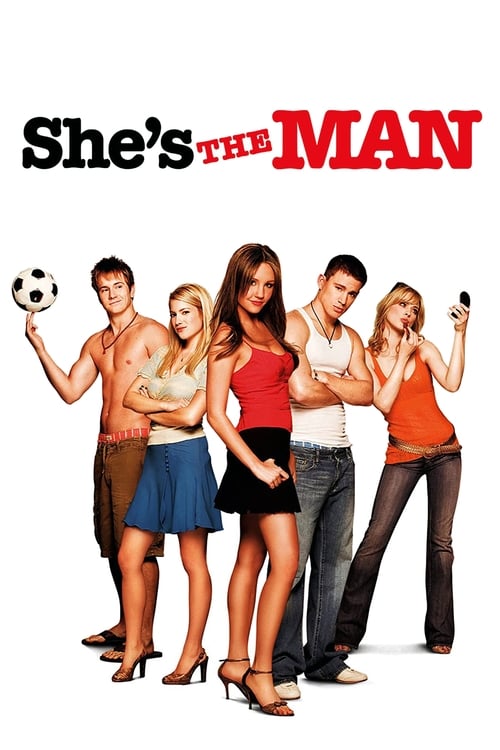
She's the Man (2006)
Directed by Andy Fickman
No — She's the Man is not especially woke, scoring 20 out of 100 on our wokeness meter.
The 2006 teen comedy She's the Man takes Twelfth Night, strips out the iambic pentameter, and hands the remaining contraption to Amanda Bynes, who plays Viola Hastings, a girl who impersonates her twin brother to win a place on an elite boarding school's soccer team.
Consciousness Markers
Viola's central arc is an explicit fight against sexism: she is cut from the girls' team, denied a boys' tryout, mocked by her dismissive ex, and ultimately vindicated by scoring the winning goal on the boys' squad.
Standard mid-2000s studio teen-comedy ensemble with a mostly white principal cast and a few Black supporting players (Jessica Lucas, Brandon Jay McLaren) who exist without commentary; no deliberate diversity-forward casting agenda.
The Shakespearean cross-dressing premise generates a running stream of gender-and-sexuality confusion comedy (Olivia falling for a girl in drag, Duke's conflicted feelings), but it is played strictly for laughs rather than as an LGBTQ identity statement.
The feminist point is delivered through slapstick and a soccer rematch rather than speeches; there is only mild 'girls can play too' moralizing at the margins.
No engagement whatsoever with race as a theme; characters of color are present only as ordinary ensemble members.
No environmental or climate content of any kind.
No economic critique or class-consciousness themes; the elite boarding-school setting is treated as backdrop, not as commentary.
The film largely mines 'unattractive nerd' Eunice for comedy rather than celebrating body diversity; no body-positivity message present.
No neurodivergence themes or characters framed as such.
It is a loose adaptation of Twelfth Night, not a reworking of history or a corrective to the historical record.
Why it received this score
The 2006 teen comedy She's the Man takes Twelfth Night, strips out the iambic pentameter, and hands the remaining contraption to Amanda Bynes, who plays Viola Hastings, a girl who impersonates her twin brother to win a place on an elite boarding school's soccer team. It is a studio product of its moment: bright, brisk, and content to treat Shakespeare as a marketing hook. The plot runs on disguise and mistaken identity, and the film has the sense to keep moving before anyone inspects the logic too closely. Channing Tatum broods handsomely. Vinnie Jones shouts. The machine works.
Where the film carries an actual argument, it is a modest one about girls and sport. Viola is cut from her team, refused a tryout, and patronized by a boyfriend who calls her better than half his squad and then sides with the coach against her. Her vindication arrives as a winning goal scored on the boys' team. That is a real grievance, dramatized without much throat clearing, and the film commits to it. The preaching stays at the margins. The point lands through slapstick and a rematch, not speeches. The cross-dressing generates a steady hum of gender confusion: Olivia swooning for a girl in drag, Duke unsettled by his feelings for his roommate. It is played for laughs. It never once presents itself as a statement about identity.
Elsewhere the film is simply of its era. The cast is largely white, with a few Black performers in the ensemble who receive no comment and require none. Race never enters the frame as a subject. Neither does class, despite all that boarding school money, nor the environment, nor neurodivergence. On body image the film is retrograde: Eunice the nerd exists as a punchline, and the camera is not kind to her. This is not a film with a doctrine. It has one grievance about who gets to play soccer, and it pursues that grievance with a smile and a decent joke rate. The rest is 2006.
Analysis generated by our Consciousness Algorithm


Synopsis
Viola Hastings is in a real jam. Complications threaten her scheme to pose as her twin brother, Sebastian, and take his place at a new boarding school. She falls in love with her handsome roommate, Duke, who loves beautiful Olivia, who has fallen for Sebastian! As if that were not enough, Viola's twin returns from London ahead of schedule but has no idea that his sister has already replaced him on campus.
Questions about She's the Man
Is She's the Man woke?
No — She's the Man is not especially woke, scoring 20 out of 100 on our wokeness meter. That earns it a verdict of Based.
Does She's the Man have any woke elements?
1 of the 10 markers register at 30 or above, led by Feminist Agenda (62). On Feminist Agenda: Viola's central arc is an explicit fight against sexism: she is cut from the girls' team, denied a boys' tryout, mocked by her dismissive ex, and ultimately vindicated by scoring the winning goal on the boys' squad.
How does She's the Man compare to other 2006 movies?
It ranks #34 of the 211 films from 2006 we've scored; their average is 11. The wokest is An Inconvenient Truth (92).
How is the Woke Score calculated?
An AI-assisted process researches the film and its reception, scores it 0–100 on ten markers, then combines those into one 0–100 Woke Score. It measures a specific set of 2020s cultural themes, not film quality.