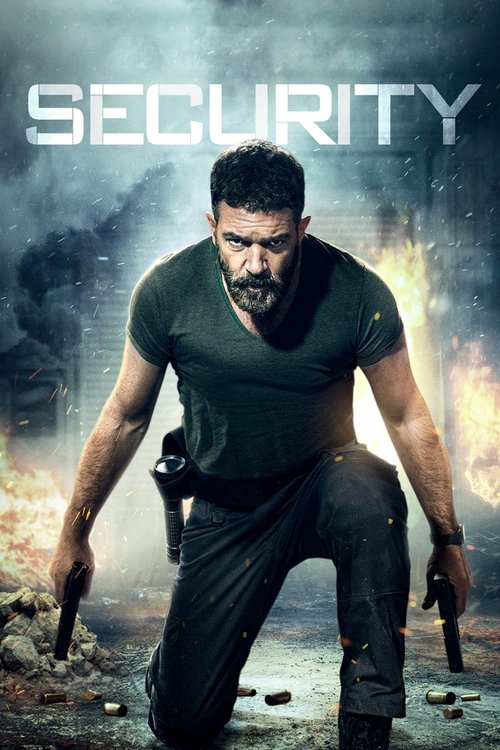
Security (2017)
Directed by Alain Desrochers
No — Security is not woke, scoring 9 out of 100 on our wokeness meter.
Security arrives with a premise that any video store in 1995 would have shelved without a second glance: a washed-up ex-Marine, a shuttered mall, a terrified witness, and a team of mercenaries with a contract to fill.
Consciousness Markers
The cast is internationally diverse (Banderas, Cung Le, Jiro Wang, Wright), but these are natural action-genre hires with no commentary or representational intent.
Ruby is a competent female guard and Jamie is a resourceful witness, but neither is framed through any feminist thesis; they are standard genre roles.
No LGBTQ+ characters, themes, or subtext appear anywhere in the film.
The film has no engagement with race as a theme; the diverse cast exists without any racial consciousness.
No environmental or climate content whatsoever.
No critique of capitalism or wealth; the villains are mercenaries motivated by a criminal contract, not economic ideology.
No body-positivity themes or messaging present.
No neurodivergent characters or themes are depicted.
A fictional action thriller with no historical revisionism.
The film delivers pure genre thrills with no moralizing, messaging, or preachy monologues.
Why it received this score
Security arrives with a premise that any video store in 1995 would have shelved without a second glance: a washed-up ex-Marine, a shuttered mall, a terrified witness, and a team of mercenaries with a contract to fill. Antonio Banderas plays Eddie Deacon with the weary dignity of a man who has run out of options. Ben Kingsley collects a paycheck as Charlie, the mercenary chief who threatens his own men with the murder of their families should they fail. It is a siege picture. Doors are barricaded, traps are rigged from hardware-store inventory, and people die in the correct order. Alain DesRochers directs with efficiency and no apparent interest in saying anything at all.
The film assembles a genuinely international cast. Banderas is Spanish, Cung Le is Vietnamese-American, Jiro Wang is Taiwanese, Gabriella Wright is British. None of this is offered as a statement. These are working actors hired to fill genre slots, and the film treats their presence as unremarkable, which it is. Ruby, the female guard, handles herself competently and dies for it. Jamie, the young witness, tasers the villain before Eddie finishes him. Both are standard issue. No thesis is advanced about either of them, and the script never pauses to explain what their existence means.
The mercenaries are criminals for hire, not a metaphor for late capitalism. The environment never enters the frame as a concern. There is no sermonizing, no moralizing, no third-act speech explaining what the audience ought to feel. The result is a lean, forgettable thriller that respects its own shallowness. In an era when even a mall siege comes with homework attached, that restraint deserves a quiet nod of respect.
Analysis generated by our Consciousness Algorithm


Synopsis
An ex-special services veteran, down on his luck and desperate for work, takes a job as a security guard at a run-down mall in a rough area of town. On his first night on the job, he opens the door to a distraught and desperate young girl who has fled the hijacking of a Police motorcade that was transporting her to testify as a witness in a trial. Hot on her heels is the psychopathic hijacker and his team of henchmen, who will stop at nothing to extract and eliminate the witness.
Questions about Security
Is Security woke?
No — Security is not woke, scoring 9 out of 100 on our wokeness meter. That earns it a verdict of Ultra Based.
Does Security have any woke elements?
Very few. None of the 10 markers reaches 30, the level where a marker counts as present; the highest is Representation Casting at 18.
How does Security compare to other 2017 movies?
It ranks #171 of the 309 films from 2017 we've scored; their average is 19. The wokest is I Am Not Your Negro (92).
How is the Woke Score calculated?
An AI-assisted process researches the film and its reception, scores it 0–100 on ten markers, then combines those into one 0–100 Woke Score. It measures a specific set of 2020s cultural themes, not film quality.