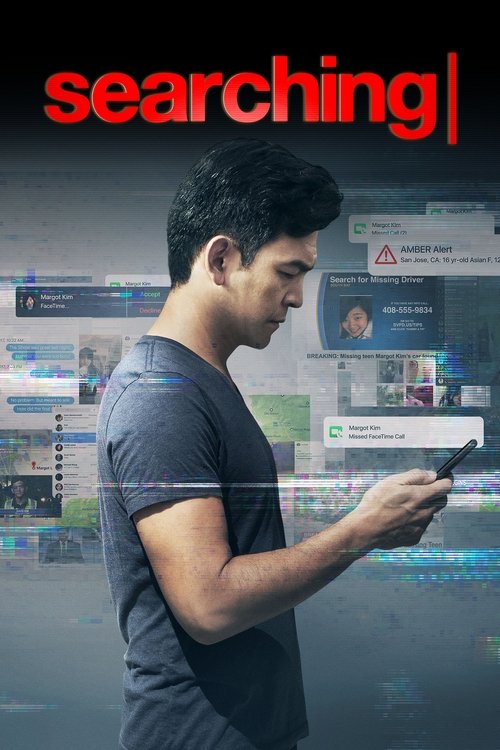
Searching (2018)
Directed by Aneesh Chaganty
No — Searching is not especially woke, scoring 21 out of 100 on our wokeness meter.
Aneesh Chaganty's debut conducts its entire investigation through browser windows, chat logs, and a webcam pointed at a grieving man's face.
Consciousness Markers
Headlined by John Cho as an Asian-American father, notably the first mainstream Hollywood thriller led by an Asian-American actor, with an Asian-American family at the center. The casting is a genuine milestone, though it is presented naturally rather than as a stated representational thesis.
The Kim family is Asian-American, but the film never interrogates race, identity, or systemic inequity; the casting is incidental to the mystery plot.
The screenlife format comments lightly on digital-age detachment, but the film prioritizes suspense over moral instruction and never lectures the audience.
No LGBTQ+ characters, themes, or subtext appear anywhere in the film.
Debra Messing plays a capable female detective, but the film advances no feminist argument or gendered critique; she functions as a plot mechanism.
No environmental or climate themes are present; a storm serves only as a plot device to explain Margot's survival.
The film gestures at social media and tech culture as a setting but mounts no critique of capitalism or wealth.
No body-positivity themes or messaging appear in the film.
No neurodivergent characters or themes are depicted or discussed.
The film is a contemporary fictional thriller with no historical subject matter to revise.
Why it received this score
Aneesh Chaganty's debut conducts its entire investigation through browser windows, chat logs, and a webcam pointed at a grieving man's face. The gimmick should collapse under its own weight within twenty minutes. It does not. The film understands that a desktop is a confession, that a search history is a personality, and it mines that insight for real unease. John Cho plays David Kim with a stillness that curdles into panic, and the movie never once pauses to admire its own cleverness. It simply keeps typing.
The cultural ledger here is thinner than the film's reputation might suggest. Casting an Asian-American actor as the lead of a mainstream Hollywood thriller was a genuine milestone in 2018, and the Kim family sits at the center of the story without apology or explanation. That is representation of the sturdiest kind, built into the architecture instead of bolted on. The film never interrogates it. Race is never a subject, only a fact of casting. The screenplay has no interest in systemic anything. It wants to find a missing girl.
Elsewhere the ledger is nearly blank, and this is to the film's credit. There is no sermonizing about technology, no lecture on the loneliness of the digital age, only a plot that happens to unfold inside that loneliness. Debra Messing's detective is competent and unexamined. The story's villains are motivated by shame and maternal panic, not by ideology. The result is a taut, humane thriller that happens to be quietly progressive in its casting and utterly uninterested in saying so. Refreshing, in its way.
Analysis generated by our Consciousness Algorithm


Synopsis
After David Kim's 16-year-old daughter goes missing, a local investigation is opened and a detective is assigned to the case. But 37 hours later and without a single lead, David decides to search the one place no one has looked yet, where all secrets are kept today: his daughter's laptop.
Questions about Searching
Is Searching woke?
No — Searching is not especially woke, scoring 21 out of 100 on our wokeness meter. That earns it a verdict of Based.
Does Searching have any woke elements?
1 of the 10 markers register at 30 or above, led by Representation Casting (45). On Representation Casting: Headlined by John Cho as an Asian-American father, notably the first mainstream Hollywood thriller led by an Asian-American actor, with an Asian-American family at the center.
How does Searching compare to other 2018 movies?
It ranks #100 of the 325 films from 2018 we've scored; their average is 20. The wokest is Return (92).
How is the Woke Score calculated?
An AI-assisted process researches the film and its reception, scores it 0–100 on ten markers, then combines those into one 0–100 Woke Score. It measures a specific set of 2020s cultural themes, not film quality.