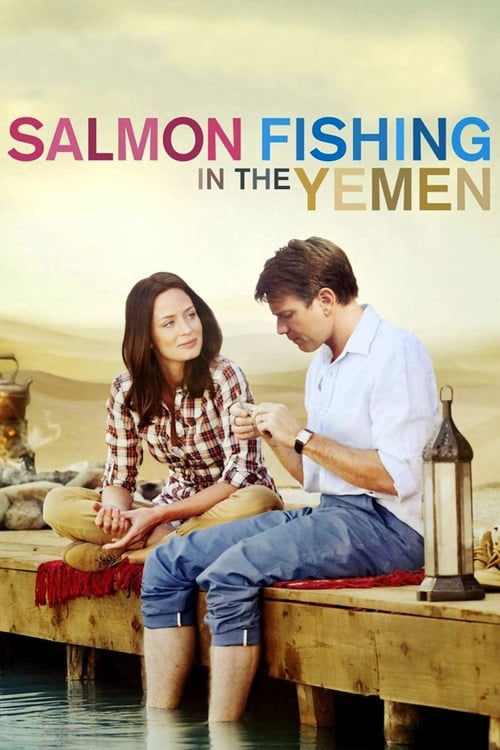
Salmon Fishing in the Yemen (2012)
Directed by Lasse Hallström
No — Salmon Fishing in the Yemen is not especially woke, scoring 22 out of 100 on our wokeness meter.
Lasse Hallström's 2012 adaptation of Paul Torday's epistolary novel arrives as a gentle, well-tailored thing, the sort of British comedy that apologizes for its own ambitions before anyone can object.
Consciousness Markers
Egyptian actor Amr Waked is cast as the Sheikh, a dignified and central Arab character, and the film foregrounds cross-cultural casting between British and Middle Eastern leads.
The plot engages Britain's relationship with the Islamic world and presents the Yemeni sheikh sympathetically, though it is framed as diplomacy and faith rather than racial justice.
The press secretary Patricia Maxwell was gender-swapped from a man in the novel to a woman, and Harriet is a competent professional, but neither is framed as a feminist statement.
The sheikh delivers gentle speeches about faith, harmony, and the nobility of fishing, but the film stays light and avoids preaching.
No LGBTQ+ characters, themes, or subtext appear anywhere in the film.
No environmental or climate themes are present; the desert setting is a logistical challenge, not an ecological message.
The satire targets political spin and government bureaucracy, not capitalism or wealth inequality.
No body positivity themes or content.
Alfred is characterized as shy and socially awkward, but this is played for romantic-comedy charm, not as neurodivergence.
No historical revisionism; the film is a contemporary fictional story.
Why it received this score
Lasse Hallström's 2012 adaptation of Paul Torday's epistolary novel arrives as a gentle, well-tailored thing, the sort of British comedy that apologizes for its own ambitions before anyone can object. A fisheries expert (Ewan McGregor) is dragooned by a consultant (Emily Blunt) into realizing a Yemeni sheikh's dream of fly-fishing in the desert, while a Downing Street press secretary (Kristin Scott Thomas) spins the whole affair as a diplomatic good-news story. The film is pleasant, modest, and entirely content to be so.
Its cultural instincts are real but decorous. Egyptian actor Amr Waked carries the sheikh with dignity and screen presence, and the film places an Arab lead at its emotional center without comment or apology. The plot takes Britain's relationship with the Islamic world seriously enough to make the sheikh its moral authority, though the framing is diplomacy and personal faith, not racial justice. Patricia Maxwell was a man in the novel and became a woman here, and both she and Harriet are capable professionals, yet the screenplay treats this as casting convenience, not thesis.
Beyond that, the cupboard is bare. There is no LGBTQ content, no ecological argument (the desert is a plumbing problem), no assault on capital, no body-positivity thread, and no neurodivergent reading of Alfred's shyness, which the film uses as romantic-comedy texture. The sheikh delivers soft sermons about harmony and faith, and the film keeps them brief, preferring charm to instruction. It is a nice hour and three-quarters, and it knows it.
Analysis generated by our Consciousness Algorithm
Part of


Synopsis
A fisheries expert is approached by a consultant to help realize a sheik's vision of bringing the sport of fly-fishing to the desert and embarks on an upstream journey of faith and fish to prove the impossible possible.
Questions about Salmon Fishing in the Yemen
Is Salmon Fishing in the Yemen woke?
No — Salmon Fishing in the Yemen is not especially woke, scoring 22 out of 100 on our wokeness meter. That earns it a verdict of Based.
Does Salmon Fishing in the Yemen have any woke elements?
1 of the 10 markers register at 30 or above, led by Representation Casting (35). On Representation Casting: Egyptian actor Amr Waked is cast as the Sheikh, a dignified and central Arab character, and the film foregrounds cross-cultural casting between British and Middle Eastern leads.
How does Salmon Fishing in the Yemen compare to other 2012 movies?
It ranks #37 of the 230 films from 2012 we've scored; their average is 12. The wokest is Killing Them Softly (92).
How is the Woke Score calculated?
An AI-assisted process researches the film and its reception, scores it 0–100 on ten markers, then combines those into one 0–100 Woke Score. It measures a specific set of 2020s cultural themes, not film quality.