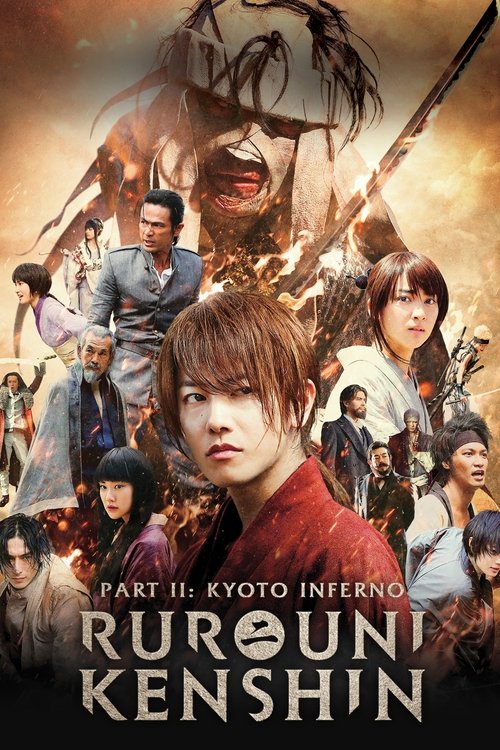
Rurouni Kenshin Part II: Kyoto Inferno (2014)
Directed by Keishi Otomo
No — Rurouni Kenshin Part II: Kyoto Inferno is not woke, scoring 0 out of 100 on our wokeness meter.
Kyoto Inferno arrives as the second installment of a trilogy adapted from a manga that ran for years and sold in quantities that make most Western franchises look modest.
Consciousness Markers
The cast is entirely Japanese, reflecting the source material's setting and production context rather than a deliberate modern diversity initiative. No evidence of inclusive or race-swapped casting.
No LGBTQ+ characters, relationships, or themes appear in the film.
Female characters such as Kaoru and Misao are present and capable, but the film does not advance a modern feminist agenda or critique patriarchy.
The story is set in Meiji-era Japan and deals with political factions, not racial identity or systemic racial justice.
No environmental or climate-change themes are present.
Shishio's rebellion is about political power and revenge, not economic inequality or anti-capitalist critique.
No body-positivity themes or body-diverse messaging.
No neurodivergent characters or themes are explored.
The film uses a historical Meiji setting and figures like Ōkubo Toshimichi, but it is a fictional manga adaptation, not a modern revisionist historical narrative.
The film is an action drama that shows rather than lectures; it contains no preachy social-justice monologues.
Why it received this score
Kyoto Inferno arrives as the second installment of a trilogy adapted from a manga that ran for years and sold in quantities that make most Western franchises look modest. Kenshin, a reformed assassin with a reversed blade and a vow against killing, is dispatched by the Meiji government to stop a former colleague named Shishio, who survived being set on fire and has decided to burn the country down in return. The plot involves a broken sword, a kidnapped infant, a ninja innkeeper, and roughly four hundred fights. It is, in other words, a story about revenge and the difficulty of refusing it.
The film contains no detectable trace of contemporary social messaging. The cast is Japanese because the story is Japanese and the production was Japanese. Women wield blades and opinions, and nobody pauses to congratulate the screenplay for it. Shishio's grievance is with a government that betrayed him, not with capital, and the Meiji setting serves as a backdrop for swordplay instead of a platform for commentary on the present. Nobody lectures. Nobody explains the moral of a scene after the scene has ended. The film trusts the audience to infer that killing is bad from the fact that everyone who does it looks miserable.
This is either a limitation or a relief, depending on the viewer's appetite for instruction. As a piece of cultural accounting, the film registers as a zero across every modern ledger we maintain, which is not a criticism so much as an observation about what a 2014 Japanese action picture was built to do. It was built to be watched. It succeeds. There is a certain melancholy in noting how rare that has become.
Analysis generated by our Consciousness Algorithm
Part of


Synopsis
Kenshin has settled into his new life with Kaoru and his other friends when he is approached with a request from the Meiji government. Makoto Shishio, a former assassin like Kenshin, was betrayed, set on fire and left for dead. He survived, and is now in Kyoto, plotting with his gathered warriors to overthrow the new government. Against Kaoru's wishes, Kenshin reluctantly agrees to go to Kyoto and help keep his country from falling back into civil war.
Questions about Rurouni Kenshin Part II: Kyoto Inferno
Is Rurouni Kenshin Part II: Kyoto Inferno woke?
No — Rurouni Kenshin Part II: Kyoto Inferno is not woke, scoring 0 out of 100 on our wokeness meter. That earns it a verdict of Ultra Based.
Does Rurouni Kenshin Part II: Kyoto Inferno have any woke elements?
No. All 10 markers score zero.
How does Rurouni Kenshin Part II: Kyoto Inferno compare to other 2014 movies?
It ranks #271 of the 303 films from 2014 we've scored; their average is 13. The wokest is Selma (68).
Is Rurouni Kenshin Part II: Kyoto Inferno the most woke Rurouni Kenshin movie?
No. It ranks #3 of the 5 Rurouni Kenshin films we've scored; the wokest is Rurouni Kenshin: The Beginning (7).