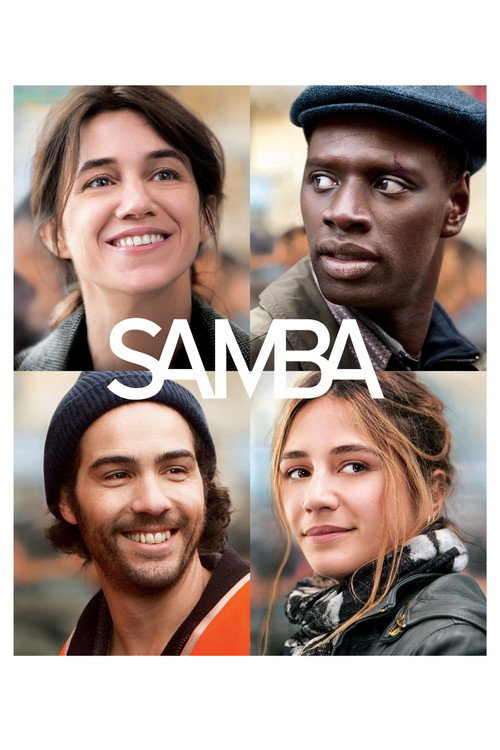
Samba (2014)
Directed by Éric Toledano
Yes — Samba is woke, scoring 67 out of 100 on our wokeness meter.
Samba arrives from the directors of Intouchables, which is the sort of provenance that tells you everything about its temperament before a single frame unspools.
Consciousness Markers
The film is built around a Senegalese migrant lead (Omar Sy) and a predominantly non-white, immigrant cast, placing Black and North African actors at the center of a mainstream French production. The diversity is intrinsic to the story rather than a casting stunt, but the representation is substantial.
The core subject is the precarious existence of a Black undocumented migrant in France, including detention, deportation orders, and bureaucratic discrimination. Racial and immigration consciousness is central to the plot rather than incidental.
The film is a well-meaning social dramedy with a message about immigration and solidarity, but critics noted its message is diffuse and lost amid plot contrivances. It gestures at moral instruction without sustained preaching.
The film depicts the exploitation of undocumented workers in low-wage jobs and the indignities of the labor and immigration system, offering a mild critique of economic precarity. It is not, however, a strident anti-capitalist polemic.
Alice is a female senior executive navigating burnout and reclaiming her life, giving her genuine agency as a co-lead. However, the film does not advance an explicit feminist thesis or critique of patriarchy.
No LGBTQ+ characters, relationships, or themes are present in the narrative.
There is no environmental or climate-related content in the film.
No body positivity themes or body-image commentary appear in the film.
No neurodivergent characters or themes are depicted.
The film is a contemporary fictional drama and makes no attempt to revise or reinterpret historical events.
Why it received this score
Samba arrives from the directors of Intouchables, which is the sort of provenance that tells you everything about its temperament before a single frame unspools. The film follows a Senegalese dishwasher through the French immigration apparatus, and it does so with its lead, Omar Sy, planted firmly at the center of a mainstream production. This is representation that functions as architecture, not ornament. The cast surrounding him is largely Black and North African, and the story cannot exist without them. The racial consciousness here is not a garnish sprinkled over a romance. It is the substance: detention centers, deportation orders, the quiet humiliation of paperwork, the way a man with no papers becomes a problem to be processed. There is a critique of labor exploitation buried in the dish pits and the day-labor queues, though it never hardens into a proper polemic. The film is content to sigh at the system instead of indicting it.
Charlotte Gainsbourg's Alice, a burnt-out executive clawing her way back to some semblance of a life, carries real agency as a co-lead. She is not a rescue fantasy. She is a woman with her own collapse to manage. That said, the film advances no thesis about patriarchy, and it seems unaware that it might have one. The economic commentary stays similarly soft-edged. We see undocumented workers squeezed into precarious jobs, and we understand the indignity of it, but the movie prefers a shrug to a fist.
What the film does not contain is instructive. There is no queer presence, no environmental conscience, no meditation on body image, no neurodivergent character, and no interest in reinterpreting the historical record. It is a contemporary story about contemporary suffering. The moral instruction it offers is diffuse, gesturing toward solidarity without ever settling on a sermon. Critics found the message lost amid plot contrivances, and that assessment holds. It is a warm film with a foggy thesis, which is a very French way to be earnest.
Analysis generated by our Consciousness Algorithm


Synopsis
Samba migrated to France 10 years ago from Senegal, and has since been plugging away at various lowly jobs. Alice is a senior executive who has recently undergone a burnout. Both struggle to get out of their dead-end lives. Samba's willing to do whatever it takes to get working papers, while Alice tries to get her life back on track until fate draws them together.
Questions about Samba
Is Samba woke?
Yes — Samba is woke, scoring 67 out of 100 on our wokeness meter. That earns it a verdict of Woke.
What makes Samba woke?
3 of the 10 markers register at 30 or above, led by Representation Casting (68), Racial Consciousness (65) and Lecture Energy (30). On Representation Casting: The film is built around a Senegalese migrant lead (Omar Sy) and a predominantly non-white, immigrant cast, placing Black and North African actors at the center of a mainstream French production.
How does Samba compare to other 2014 movies?
It ranks #3 of the 303 films from 2014 we've scored; their average is 13. The wokest is Selma (68).
How is the Woke Score calculated?
An AI-assisted process researches the film and its reception, scores it 0–100 on ten markers, then combines those into one 0–100 Woke Score. It measures a specific set of 2020s cultural themes, not film quality.