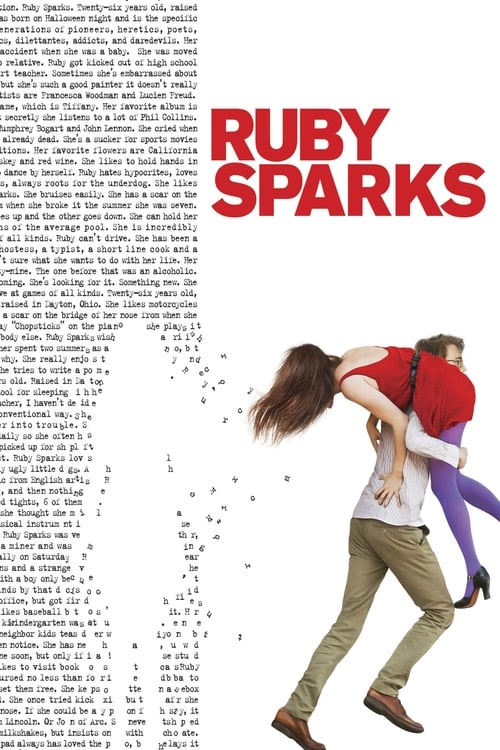
Ruby Sparks (2012)
Directed by Jonathan Dayton
No — Ruby Sparks is not especially woke, scoring 34 out of 100 on our wokeness meter.
Ruby Sparks arrives in 2012 as a romantic comedy with a cruel streak hidden under its cardigan.
Consciousness Markers
The film is centrally concerned with a man's attempt to control and idealize a woman, critiquing the male gaze and the Pygmalion fantasy; Kazan explicitly framed it around 'being gazed at but never seen.'
The supporting cast includes performers such as Alia Shawkat, Aasif Mandvi, Antonio Banderas, and Toni Trucks, but their presence is not used to make an explicit commentary on representation. This yields a modest baseline rather than a deliberate diversity statement.
The feminist critique is dramatized through the plot rather than delivered in direct speeches, giving it some thematic seriousness but limited preachiness.
There are no LGBTQ+ characters, relationships, or themes in the film.
Race is not a thematic concern, and the minority supporting characters are not used to explore racial issues.
No environmental or climate themes appear.
The film's conflicts are romantic and creative, not economic; it offers no critique of capitalism or wealth.
No body-image, size-acceptance, or body-positivity themes are present.
Calvin's anxiety and therapy are character traits, but the film does not frame him or others through a neurodivergence lens.
The film is a contemporary fantasy romance with no historical revisionism.
Why it received this score
Ruby Sparks arrives in 2012 as a romantic comedy with a cruel streak hidden under its cardigan. Paul Dano plays Calvin, a novelist who once mattered and now sulks in Los Angeles, until a dream woman named Ruby, played by the film's writer Zoe Kazan, materializes from his typewriter. The premise is Pygmalion for the therapy era, and the directors Jonathan Dayton and Valerie Faris keep the tone light enough that the darker currents can sneak up on us. Calvin is not a monster. He is worse in the ordinary way: a man who mistakes his own loneliness for a license to define another person.
The film's central concern is the male gaze and the violence of idealization. Ruby is not a Manic Pixie Dream Girl, as Kazan has insisted, but a case study in what happens when a woman is gazed at and never seen. The supporting cast includes Alia Shawkat, Aasif Mandvi, Antonio Banderas, and Toni Trucks, yet their presence is not deployed as a thesis about representation. It is simply a well-populated world. The screenplay saves its argument for the plot, especially the typewriter sequence in which Calvin rewrites Ruby into humiliation. That scene is the film's thesis, and it lands without a podium.
Elsewhere, the film keeps its cultural ambitions narrow. Its conflicts are romantic and creative, not economic or environmental. Calvin's anxiety is a character trait, not a diagnosis. The past is not revised. The body is not a battleground. Sexuality and race are simply not the film's subjects. The feminist critique is real and sustained, but it is dramatized instead of preached, which keeps the sermonizing to a minimum. The result is a sharp little fable about creative ownership and romantic delusion. It does not solve the problem it describes. It merely makes the problem look uncomfortably familiar.
Analysis generated by our Consciousness Algorithm
Part of


Synopsis
Calvin is a young novelist who achieved phenomenal success early in his career but is now struggling with his writing – as well as his romantic life. Finally, he makes a breakthrough and creates a character named Ruby who inspires him. When Calvin finds Ruby, in the flesh, sitting on his couch about a week later, he is completely flabbergasted that his words have turned into a living, breathing person.
Questions about Ruby Sparks
Is Ruby Sparks woke?
No — Ruby Sparks is not especially woke, scoring 34 out of 100 on our wokeness meter. That earns it a verdict of Based.
Does Ruby Sparks have any woke elements?
1 of the 10 markers register at 30 or above, led by Feminist Agenda (78). On Feminist Agenda: The film is centrally concerned with a man's attempt to control and idealize a woman, critiquing the male gaze and the Pygmalion fantasy; Kazan explicitly framed it around 'being gazed at but never seen.'
How does Ruby Sparks compare to other 2012 movies?
It ranks #18 of the 230 films from 2012 we've scored; their average is 12. The wokest is Killing Them Softly (92).
How is the Woke Score calculated?
An AI-assisted process researches the film and its reception, scores it 0–100 on ten markers, then combines those into one 0–100 Woke Score. It measures a specific set of 2020s cultural themes, not film quality.