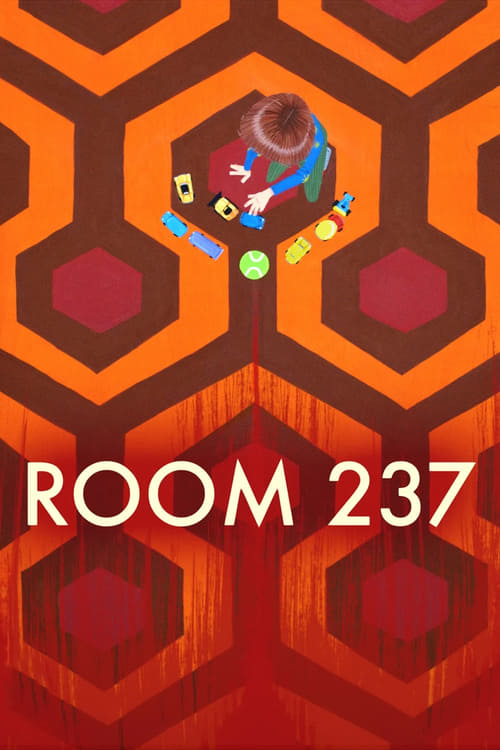
Room 237 (2012)
Directed by Rodney Ascher
No — Room 237 is not especially woke, scoring 28 out of 100 on our wokeness meter.
Rodney Ascher's 2012 documentary assembles five voices, all of them white, most of them male, and each of them convinced that Stanley Kubrick buried a private code inside The Shining.
Consciousness Markers
A central segment argues Kubrick faked the Apollo 11 moon landing footage, a literal revisionist rewriting of recorded history, alongside a Holocaust-allegory reading of the film.
The film is wall-to-wall voice-over theorists expounding their theses, which is structurally lecture-like, though it presents rather than moralizes and explicitly declines to endorse the claims.
One segment reads The Shining as an allegory of Native American dispossession and American imperialism, citing the burial-mound premise and Calumet baking powder cans, giving the film a genuine racial-consciousness thread.
The documentary's on-camera theorists are a uniformly white, mostly male cohort of Kubrick obsessives; no casting choices signal any representational intent.
No LGBTQ+ content, characters, or subtext appears anywhere in the film's discussion of The Shining.
One theorist happens to be a woman, but the film advances no feminist reading or gender-conscious argument whatsoever.
No environmental or climate themes are raised in any of the interpretations.
The closest gesture is a theorist's reading of Jack's 'contract with an employer' tirade as Kubrick's own isolation, but this is not framed as a critique of capitalism.
No body-image or body-positivity content is present.
The Shining's 'shining' is a psychic power, not a neurodivergence, and the film makes no neurodiversity argument.
Why it received this score
Rodney Ascher's 2012 documentary assembles five voices, all of them white, most of them male, and each of them convinced that Stanley Kubrick buried a private code inside The Shining. The format is unrelenting: talking heads reduced to talking, since the speakers are never shown, only heard, while clips from the Kubrick catalogue and crude animation fill the frame. What we get is an anthology of obsession, delivered with the confidence of men who have counted Calumet baking powder cans and measured the distance to the moon. The film declines to referee any of it. Ascher has said his own reading is modest, a cautionary tale about a man who chose career over family, which is the least exotic thesis on offer and the one the documentary seems least interested in exploring.
The political content here is thin and arrives sideways. One segment proposes that the Overlook sits on a Native American burial ground and that the recurring Calumet cans encode a subtext about American imperialism, which gives the film a genuine thread of racial consciousness, though it is a reading of Kubrick's imagery, not a statement of the documentarian's own. A separate theorist argues that Kubrick staged the Apollo 11 footage, a wholesale rewriting of the historical record, and folds in a Holocaust allegory built on a typewriter and a wolf's refrain. These are the film's most charged passages, and they belong to the interviewees. Nothing about gender, sexuality, climate, bodies, or capital surfaces at all. The closest we come to economics is a reading of Jack's tirade about contracts as Kubrick's personal isolation, which is not a critique of anything except marriage.
The result functions as a lecture by proxy, three dozen theses recited over archival footage with no counterargument and no verdict. It presents instead of moralizes, which keeps the sermonizing impulse in check, though the cumulative effect is still that of a very long seminar with no professor. Kubrick's assistant called most of it gibberish. Stephen King turned it off halfway. Both reactions seem reasonable, and neither diminishes the strange, hermetic pleasure of watching people build cathedrals out of carpet patterns.
Analysis generated by our Consciousness Algorithm


Synopsis
A subjective documentary that explores various theories about hidden meanings in Stanley Kubrick's classic film The Shining. Five very different points of view are illuminated through voice over, film clips, animation and dramatic reenactments.
Questions about Room 237
Is Room 237 woke?
No — Room 237 is not especially woke, scoring 28 out of 100 on our wokeness meter. That earns it a verdict of Based.
Does Room 237 have any woke elements?
1 of the 10 markers register at 30 or above, led by Revisionist History (45). On Revisionist History: A central segment argues Kubrick faked the Apollo 11 moon landing footage, a literal revisionist rewriting of recorded history, alongside a Holocaust-allegory reading of the film.
How does Room 237 compare to other 2012 movies?
It ranks #27 of the 230 films from 2012 we've scored; their average is 12. The wokest is Killing Them Softly (92).
How is the Woke Score calculated?
An AI-assisted process researches the film and its reception, scores it 0–100 on ten markers, then combines those into one 0–100 Woke Score. It measures a specific set of 2020s cultural themes, not film quality.