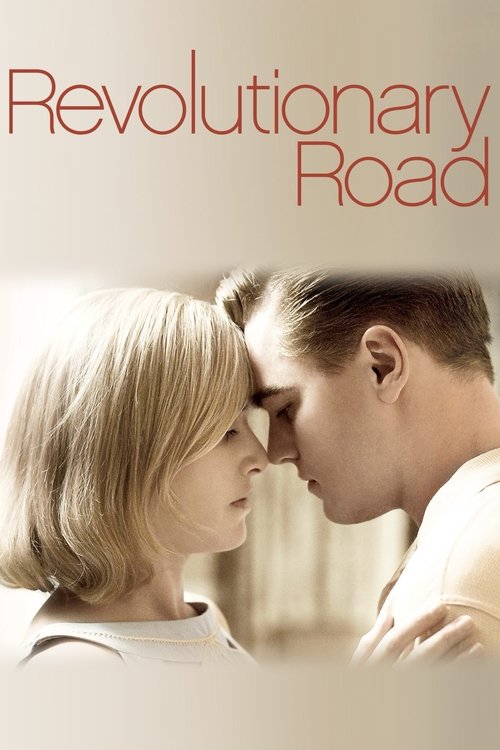
Revolutionary Road (2008)
Directed by Sam Mendes
No — Revolutionary Road is not woke, scoring 17 out of 100 on our wokeness meter.
Sam Mendes returns to the cul-de-sac of American disappointment, and this time the despair is period-accurate.
Consciousness Markers
April Wheeler's entrapment in domesticity and her yearning for a life beyond housewifery carries a genuine feminist reading, reinforced by Winslet's use of The Feminine Mystique as preparation, though it is a period exploration rather than a modern polemic.
The film indicts the hollow American Dream and corporate conformity — Frank's soul-crushing sales job and the deadening suburb — but frames it existentially rather than as a systemic anti-capitalist argument.
John Givings, a psychiatric-institution patient, is portrayed sympathetically as the one person who speaks the uncomfortable truth, a mild nod to the neurodivergent truth-teller trope.
The film is an emotional autopsy of a marriage rather than a message movie; it observes and devastates without preaching to the audience.
The cast is almost entirely white, reflecting the demographics of 1950s Connecticut suburbia; there is no deliberate diverse casting or color-conscious choice.
No LGBTQ+ characters or themes appear anywhere in the film.
Race is entirely absent as a subject; the film concerns white suburban malaise with no racial consciousness.
No environmental or climate themes are present.
No body positivity themes or body-diverse representation.
The film is a faithful period adaptation of a 1961 novel, not a revisionist reframing of history.
Why it received this score
Sam Mendes returns to the cul-de-sac of American disappointment, and this time the despair is period-accurate. Revolutionary Road is a faithful adaptation of Richard Yates's 1961 novel, and it plays as an autopsy: a marriage laid open on the table while the audience watches the instruments go in. DiCaprio and Winslet are excellent, which should surprise no one who saw them freeze to death together a decade earlier. The cast is almost entirely white, a demographic fact of 1950s Connecticut suburbia and not a casting argument. Nothing in the film reaches for a broader social point about race, and nothing about the environment, the body, or the closet intrudes on the Wheelers' private collapse.
April Wheeler's predicament carries a real feminist charge. She is a woman with ambitions and no exit, and Winslet prepared by reading Betty Friedan, which tells you where the sympathies lie. Still, this is a period portrait of entrapment, not a modern sermon. The film observes her cage and lets us feel the bars. It does not turn to the camera and explain them.
The angriest thread is economic. Frank's sales job is a slow death by paperwork, and the suburbs are a well-mown grave. The film indicts the American Dream, though it does so existentially, as a matter of personal suffocation. Michael Shannon's John Givings, fresh from a psychiatric institution, is granted the role of truth-teller, a mild courtesy to the unwell. Otherwise the film prefers devastation to instruction. It ruins a marriage in front of us and offers no lesson at the end. That restraint is the best thing about it.
Analysis generated by our Consciousness Algorithm


Synopsis
A young couple living in a Connecticut suburb during the mid-1950s struggle to come to terms with their personal problems while trying to raise their two children. Based on a novel by Richard Yates.
Questions about Revolutionary Road
Is Revolutionary Road woke?
No — Revolutionary Road is not woke, scoring 17 out of 100 on our wokeness meter. That earns it a verdict of Ultra Based.
Does Revolutionary Road have any woke elements?
1 of the 10 markers register at 30 or above, led by Feminist Agenda (35). On Feminist Agenda: April Wheeler's entrapment in domesticity and her yearning for a life beyond housewifery carries a genuine feminist reading, reinforced by Winslet's use of The Feminine Mystique as preparation, though it is a period exploration rather than a modern polemic.
How does Revolutionary Road compare to other 2008 movies?
It ranks #48 of the 212 films from 2008 we've scored; their average is 12. The wokest is Milk (68).
How is the Woke Score calculated?
An AI-assisted process researches the film and its reception, scores it 0–100 on ten markers, then combines those into one 0–100 Woke Score. It measures a specific set of 2020s cultural themes, not film quality.