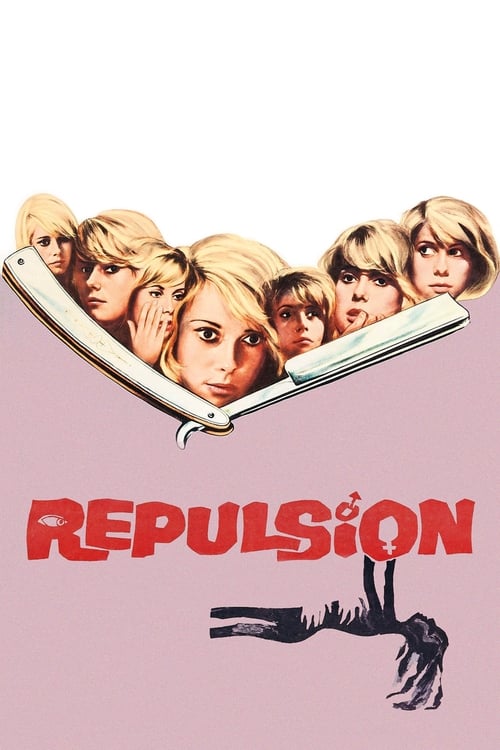
Repulsion (1965)
Directed by Roman Polanski
No — Repulsion is not woke, scoring 6 out of 100 on our wokeness meter.
In 1965 Roman Polanski made his first English-language feature, a black-and-white study of a Belgian manicurist in London whose terror of men curdles into hallucination and violence.
Consciousness Markers
The film centers a woman's subjective experience and depicts male sexual aggression, but it does so through a psychological horror lens rather than a modern feminist agenda.
The cast is entirely white European actors, with no meaningful racial or ethnic diversity. Catherine Deneuve's female lead is not a modern diversity-casting marker.
There are no LGBTQ+ characters, themes, or subtext in the film.
The film does not engage with race, racism, or racial identity in any substantive way.
There is no environmental or climate-related theme in the film.
The landlord's predatory behavior is personal rather than a systemic critique of capitalism or wealth inequality.
The film does not promote body positivity or challenge conventional beauty standards.
The film portrays schizophrenia and psychosis as terrifying madness, not as neurodivergence to be understood or celebrated.
The film is a fictional psychological horror story and does not revise or reinterpret historical events.
The film is atmospheric and subjective, with no preachy or didactic messaging.
Why it received this score
In 1965 Roman Polanski made his first English-language feature, a black-and-white study of a Belgian manicurist in London whose terror of men curdles into hallucination and violence. Catherine Deneuve's Carol is not a symbol. She is a closed system. The film locks us inside her apartment and her skull. We hear the ticking clock, the dripping bath, the footsteps. The result remains one of the more exacting depictions of schizophrenic breakdown in the genre. Its cultural vocabulary, however, is not the vocabulary of the present.
If we apply contemporary social metrics, the cupboard is bare. The cast is white European. Race is not a subject. LGBTQ lives are absent. Environmental ruin is not on the mind. The landlord who propositions Carol is a predator, not an indictment of property relations. The film does not celebrate body diversity. It does not frame psychosis as neurodivergence to be accommodated. It treats madness as a chamber of horrors, and that is the point. Carol's ordeal is rooted in male aggression and sexual fear, and the film honors her subjective experience with unusual rigor. This is a proto-feminist texture, not a modern movement platform. It observes. It does not sermonize.
The film's final photograph has been read as a hint of childhood abuse, a quiet explanation that never becomes a lecture. Polanski's camera is cruel, precise, and unsentimental. There is no lesson, no call to action, no checklist of virtues. The film leaves us with atmosphere, dread, and a performance of glacial fragility. As a document of 1960s art-horror, it deserves its reputation. As a vehicle for the progressive pieties of our own moment, it is almost aggressively indifferent. That indifference is not a flaw. It is simply the weather of another time.
Analysis generated by our Consciousness Algorithm


Synopsis
Beautiful young manicurist Carole suffers from androphobia (the pathological fear of interaction with men). When her sister and roommate, Helen, leaves their London flat to go on an Italian holiday with her married boyfriend, Carole withdraws into her apartment. She begins to experience frightful hallucinations, her fear gradually mutating into madness.
Questions about Repulsion
Is Repulsion woke?
No — Repulsion is not woke, scoring 6 out of 100 on our wokeness meter. That earns it a verdict of Ultra Based.
Does Repulsion have any woke elements?
Very few. None of the 10 markers reaches 30, the level where a marker counts as present; the highest is Feminist Agenda at 10.
How does Repulsion compare to other 1965 movies?
It ranks #2 of the 14 films from 1965 we've scored; their average is 4. The wokest is A Charlie Brown Christmas (25).
How is the Woke Score calculated?
An AI-assisted process researches the film and its reception, scores it 0–100 on ten markers, then combines those into one 0–100 Woke Score. It measures a specific set of 2020s cultural themes, not film quality.