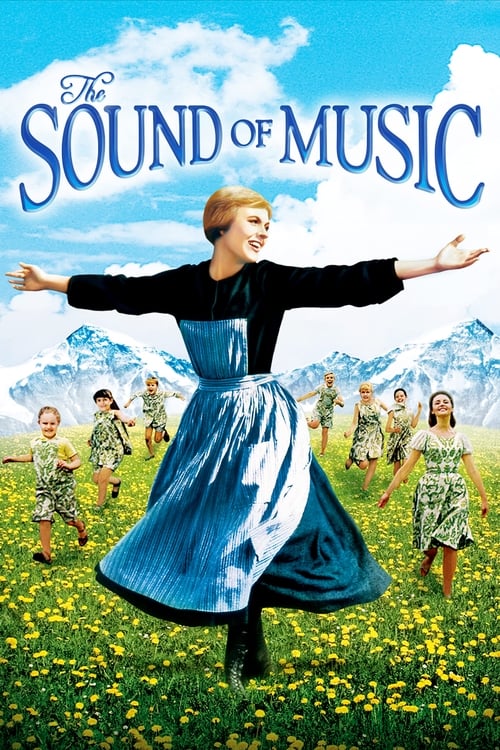
The Sound of Music (1965)
Directed by Robert Wise
No · Ultra Based
How we score movies →Consciousness Markers
The film offers a sanitized, emotionally manipulative version of Nazi Austria that prioritizes sentimentality over historical accuracy or moral reckoning. It treats fascism as mere backdrop rather than historical reality.
Maria is presented as spirited and independent initially, but her arc culminates in marriage and motherhood as ultimate fulfillment. The film does not interrogate gender roles or power dynamics within the family structure.
The cast is uniformly white and European. No attempt is made to reflect any demographic diversity, though this reflects the broader casting practices of 1965 Hollywood rather than deliberate exclusion.
The film contains no preachy messaging or lecture-like exposition. It presents itself as pure entertainment without attempting to educate or persuade the audience on social issues.
There is no engagement with racial consciousness or racial politics whatsoever. The film is set in Austria with no acknowledgment of the racial ideologies that defined the Nazi regime.
There are no LGBTQ+ themes, representations, or subtext in the film. The narrative centers entirely on heterosexual romance and family.
Climate concerns are entirely absent from the narrative. The film contains no environmental consciousness or messaging.
There is no critique of capitalism or wealth inequality. The captain's wealth and status are presented without question, and the family's escape is framed as a personal rather than political matter.
Body positivity is not a concern of the film. The cast conforms to conventional aesthetic standards of 1960s cinema, and there is no engagement with body diversity.
There is no representation of neurodivergence or any engagement with disability and neurodiversity themes.


Synopsis
In the years before World War II, a tomboyish postulant at an Austrian abbey is hired as a governess in the home of a widowed naval captain with seven children and brings a new love of life and music into the home.
Why it received this score
The Sound of Music presents itself as a feel-good family musical, yet beneath its confections of yodeling and dirndls lies a film profoundly indifferent to the social frameworks that contemporary progressive sensibility demands we interrogate. The narrative hinges on Maria, a woman who abandons her own spiritual journey to marry a captain and bear his children, a trajectory that reads as antithetical to feminist consciousness. Her agency is subordinated to the needs of the family unit, and the film frames this subordination as romantic fulfillment rather than examining the power dynamics at play.
The film's treatment of Nazi Austria is instructive in its evasions. While the story does involve escape from fascism, the political reality of the period is sanitized almost beyond recognition. The Nazis themselves appear as mere obstacles in a sentimental narrative about music and family rather than as historical actors engaged in systematic atrocity. The film offers no interrogation of Austrian complicity, no reckoning with the moral compromises of the era, and no complexity regarding the nation's relationship to fascism. We are asked to enjoy the spectacle of singing children and a charming escape without confronting what they are escaping from. The casting remains uniformly white and European, reflecting the production values of 1965 cinema.
The film shows virtually no awareness of the social consciousness that would later define progressive filmmaking. It is a work of pure escapism, and that escapism is its defining feature. From the perspective of contemporary cultural analysis, this makes it unremarkable rather than objectionable, a time capsule of mid-century entertainment values that predate our current moment's frameworks for cultural responsibility.
Analysis generated by our Consciousness Algorithm
Critic Reviews
“As for Andrews, she is just a joy, conveying enough doubt beneath that brisk, clean exterior to stop her character becoming a prig; her comic timing and the way in which she convinces in her relationships with the children are so understated they can be underrated.”
“The Robert Wise production is a warmly pulsating, captivating drama set to the most imaginative use of the lilting R-H tunes, magnificently mounted and with a brilliant cast headed by Julie Andrews and Christopher Plummer which must strike a respondent chord at the box office.”
“The 20th-Fox release will be one of the movies' all-time hits, one of the all-time great pictures. It restores your faith in movies. If you sit quietly and let it take, it may also restore your faith in humanity. It does this with infectious wit, with consistent gaiety, with simple and realistic spirituality, with romance of heartbreak and heartmend. This is set against the most beautiful scenery you have seen in your life. The Sound of Music is quite a picture.”
“Whom could this operetta offend? Only those of us who, despite the fact that we may respond, loathe being manipulated in this way and are aware of how cheap and ready-made are the responses we are made to feel.”