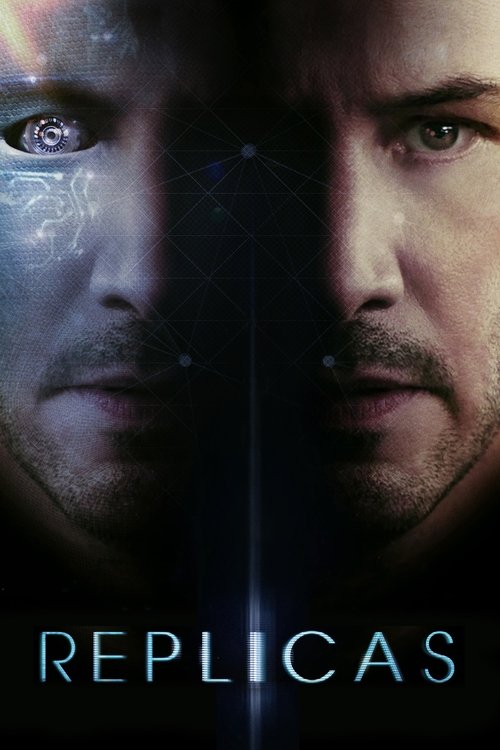
Replicas (2018)
Directed by Jeffrey Nachmanoff
No — Replicas is not woke, scoring 7 out of 100 on our wokeness meter.
Replicas arrives from 2018 with the confidence of a film that has nothing on its mind beyond the mechanics of its own plot.
Consciousness Markers
Bionyne Corporation is a stock evil-corporation antagonist whose research is secretly a government military weapon, and the ending involves selling clone transfers to the wealthy, but this is genre furniture rather than a systemic anti-capitalist argument.
The cast includes some actors of color (John Ortiz, Nyasha Hatendi) in supporting roles, but their presence is incidental and never framed as a statement about representation.
Alice Eve's Mona is a wife and mother defined almost entirely by her family role; the film offers no feminist critique or agency-driven arc for its women.
The film is a plot-driven thriller that never pauses to deliver social or moral sermons to the audience.
No LGBTQ+ characters, relationships, or themes appear anywhere in the film.
Race is never a subject of the film; the story is a generic sci-fi cloning thriller with no racial commentary.
No environmental or climate themes are present in the narrative.
No body-positivity themes or messaging appear in the film.
No neurodivergent characters or themes are depicted.
The film does not engage with or revise historical events.
Why it received this score
Replicas arrives from 2018 with the confidence of a film that has nothing on its mind beyond the mechanics of its own plot. Keanu Reeves plays William Foster, a neuroscientist in Puerto Rico who loses his wife and three children in a car crash, then clones them back to life using stolen corporate equipment. He has three pods and four bodies, so he deletes his youngest daughter from existence and wipes his family's memory of her. This is presented as a logistical problem, not a moral one. The film grossed nine million dollars against a thirty million dollar budget and holds a nine percent approval rating. It has earned its obscurity.
The cast includes John Ortiz and Nyasha Hatendi in supporting roles, and their presence is treated as ordinary hiring, which it is. No character is gay. No one discusses the climate. Race is never a subject of conversation, and the screenplay shows no interest in making it one. Alice Eve's Mona exists to be a wife and mother, resurrected and then deceived; the film grants her no interior life worth the name and no arc beyond the domestic. Bionyne Corporation is the customary sinister employer, its research secretly a military weapon, its ending a scheme to sell clone transfers to the wealthy. The film gestures at corporate malfeasance the way a furniture catalogue gestures at a living room.
The film never lectures. It is a thriller assembled from laboratory sets and ethical shortcuts, and it races from one contrivance to the next without pausing to instruct anyone about how to live. There is no sermon, no moral, no closing address to the audience. The result is a film of almost pure narrative appetite, executed badly, and free of the cultural instruction manual that so many of its contemporaries cannot resist including. For that small mercy, and for nothing else, it deserves a flicker of acknowledgment.
Analysis generated by our Consciousness Algorithm


Synopsis
A scientist becomes obsessed with returning his family to normalcy after a terrible accident.
Questions about Replicas
Is Replicas woke?
No — Replicas is not woke, scoring 7 out of 100 on our wokeness meter. That earns it a verdict of Ultra Based.
Does Replicas have any woke elements?
Very few. None of the 10 markers reaches 30, the level where a marker counts as present; the highest is Eat the Rich at 18.
How does Replicas compare to other 2018 movies?
It ranks #233 of the 325 films from 2018 we've scored; their average is 20. The wokest is Return (92).
How is the Woke Score calculated?
An AI-assisted process researches the film and its reception, scores it 0–100 on ten markers, then combines those into one 0–100 Woke Score. It measures a specific set of 2020s cultural themes, not film quality.