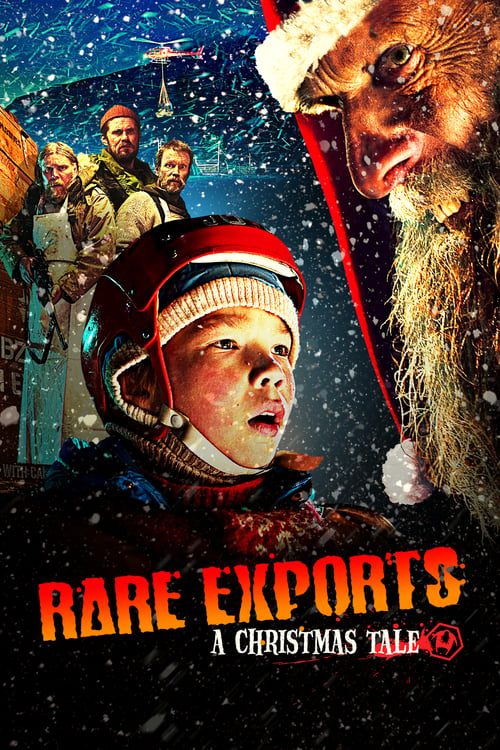
Rare Exports: A Christmas Tale (2010)
Directed by Jalmari Helander
No — Rare Exports: A Christmas Tale is not woke, scoring 4 out of 100 on our wokeness meter.
Here is a film in which Santa Claus is a horned, naked, feral creature buried beneath a Lapland fell, excavated by an American drilling crew, and eventually exported as a trained mall attraction.
Consciousness Markers
There is faint satire of Christmas commercialism and a plundering corporation (Subzero), but it is deadpan genre comedy rather than modern eat-the-rich class consciousness.
The film reimagines Santa Claus mythology as a pagan monster, but this is revisionist folklore, not the social-justice recasting of real history the marker denotes.
The cast is entirely Finnish and Nordic, a natural reflection of the Lapland setting with no diversity casting or commentary.
No LGBTQ+ characters or themes appear anywhere in this frosty Santa-hunting tale.
The film is explicitly an all-male world of reindeer herders and boys; there is no feminist agenda or gender commentary.
A Sámi burial mound is mentioned as plot mechanics, but the film engages no racial consciousness or identity themes.
The arctic landscape is atmospheric backdrop, not a climate crusade or environmental message.
No body positivity themes; the naked feral Santa is played for horror and comedy, not representation.
No neurodivergence themes or characters are present.
The film is a deadpan horror-comedy that never lectures or moralizes; it plays its premise entirely straight.
Why it received this score
Here is a film in which Santa Claus is a horned, naked, feral creature buried beneath a Lapland fell, excavated by an American drilling crew, and eventually exported as a trained mall attraction. The premise would seem to invite a full cultural audit. It does not survive one, because there is nothing there to audit. The cast is Finnish and Nordic from top to bottom, which is what happens when a film is set in arctic Finland and shot there. No demographic arithmetic intrudes. No character announces an identity. The reindeer herders hunt, bicker, and endure the cold, and the film regards them with the flat patience of a documentary about weather.
The two faint ideological pulses deserve a sentence each. The villainous firm Subzero wants to plunder a Sámi burial mound for profit, which registers as a whisper of corporate critique, though the film treats the company as a monster-delivery service instead of a thesis. And the mythology is thoroughly revisionist, converting a benign gift-giver into a pagan predator whose elves bite ears off. This is folklore turned inside out for suspense. It carries no argument about history or power. The satire of Christmas commercialism amounts to the closing gag in which the captured elves are trained and shipped abroad as seasonal labor.
Everything else is absent by design. There is no sermon, no moral instruction, no plea on behalf of any cause. The film plays its absurd premise with a straight face and expects the audience to meet it halfway. So we have an artifact from 2010 that predates the era of the annotated blockbuster, a modest Finnish genre exercise about frozen monsters and stolen children. It is bracing in its refusal to explain itself. We classify it accordingly, and we move on to the next screening.
Analysis generated by our Consciousness Algorithm


Synopsis
Young Pietari lives with his reindeer-herding father in arctic Finland. On the eve of Christmas, a nearby excavation makes a frightening discovery and an evil Santa Claus is unleashed…
Questions about Rare Exports: A Christmas Tale
Is Rare Exports: A Christmas Tale woke?
No — Rare Exports: A Christmas Tale is not woke, scoring 4 out of 100 on our wokeness meter. That earns it a verdict of Ultra Based.
Does Rare Exports: A Christmas Tale have any woke elements?
Very few. None of the 10 markers reaches 30, the level where a marker counts as present; the highest is Eat the Rich at 10.
How does Rare Exports: A Christmas Tale compare to other 2010 movies?
It ranks #164 of the 238 films from 2010 we've scored; their average is 11. The wokest is My Name Is Khan (84).
How is the Woke Score calculated?
An AI-assisted process researches the film and its reception, scores it 0–100 on ten markers, then combines those into one 0–100 Woke Score. It measures a specific set of 2020s cultural themes, not film quality.