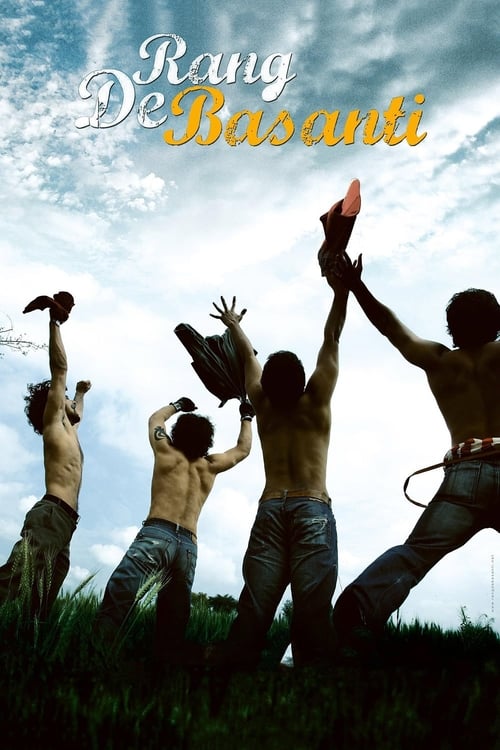
Rang De Basanti (2006)
Directed by Rakeysh Omprakash Mehra
No — Rang De Basanti is not especially woke, scoring 35 out of 100 on our wokeness meter.
Rang De Basanti arrives from 2006 with a leather-bound diary, a British documentarian, and five Delhi graduates who cannot be bothered.
Consciousness Markers
The plot hinges on a corrupt defence minister and a wealthy industrialist who sold substandard jet parts for profit, and Karan executes his own capitalist father; the anti-corruption, anti-wealth message is central and explicit.
The film is heavily didactic, with the protagonists delivering a climactic radio-broadcast confession and the narrative openly preaching about civic duty, government corruption, and patriotic sacrifice.
The film is steeped in anti-colonial Indian nationalism and the freedom struggle, but this is patriotic/historical consciousness rather than the modern racial-justice sensibility the marker denotes.
The film uses the historical freedom fighters as inspirational parallels for contemporary revolt, but it treats them reverently as national heroes rather than revising the historical record through a modern ideological lens.
The ensemble is a natural, organically Indian mix of Hindu, Sikh, and Muslim characters (DJ, Sukhi, Aslam) plus a British filmmaker, but this reflects the film's own cultural setting rather than any deliberate diversity-casting agenda.
A British woman filmmaker drives the documentary framing device and Sonia is a significant presence, but the film's concerns are patriotic and political rather than feminist; the women are largely catalysts for the men's awakening.
No LGBTQ+ characters, themes, or subtext appear anywhere in the film.
There is no environmental or climate theme in the film.
No body-positivity themes or messaging are present.
No neurodivergence themes or characters are present.
Why it received this score
Rang De Basanti arrives from 2006 with a leather-bound diary, a British documentarian, and five Delhi graduates who cannot be bothered. The film spends its first hour in that agreeable haze of motorcycle rides and campus lounging, then pivots hard into the martyrology of Bhagat Singh and his comrades. The ensemble is a natural cross-section of North Indian life, Sikh, Muslim, Hindu, with a Londoner dropped into the middle of it, and the film never pauses to congratulate itself for the arrangement. It simply is the setting. There is no romantic subtext anywhere in the ranks, no third-act coming-out. The revolutionaries are treated as sacred national furniture, dusted and displayed, their story pressed into service for a modern grievance but never rewritten.
The anger here is economic and civic. A defence minister takes bribes, an industrialist supplies substandard parts, and a young pilot dies for the profit margin. The film's response is to have one of its heroes shoot his own father, a wealthy man, in his own home. That is not a subtle position. The final act converts the group into broadcasters, and the broadcast is a sermon: a full confession of the ministry's corruption delivered into a live microphone while tactical units close in. The film wants us to feel the righteousness of the lecture, and it works, which is the uncomfortable part.
A British woman sets the documentary apparatus in motion, and Sonia grieves with real force, yet both function largely as ignition for the men's political awakening. Nothing here concerns the body, the climate, or the wiring of the mind. The patriotism on display is older and narrower than the identity vocabulary of the present decade, rooted in the freedom struggle and in a general disgust with graft. We are left with a rousing, sincere, occasionally exhausting piece of civic sermonizing, and a reminder that a film can be furious about corruption without ever joining the cultural conversation of the 2020s.
THEMATIC TAGS: ["true_story"]
Analysis generated by our Consciousness Algorithm


Synopsis
After a group of friends graduate from Delhi University, they listlessly haunt their old campus, until a British filmmaker casts them in a film she's making about freedom fighters under British rule. Although the group is largely apolitical, the tragic death of a friend owing to local government corruption awakens their patriotism. Inspired by the freedom fighters they represent in the film, the friends collectively decide to avenge the killing.
Questions about Rang De Basanti
Is Rang De Basanti woke?
No — Rang De Basanti is not especially woke, scoring 35 out of 100 on our wokeness meter. That earns it a verdict of Based.
Does Rang De Basanti have any woke elements?
3 of the 10 markers register at 30 or above, led by Eat the Rich (55), Lecture Energy (55) and Racial Consciousness (30). On Eat the Rich: The plot hinges on a corrupt defence minister and a wealthy industrialist who sold substandard jet parts for profit, and Karan executes his own capitalist father; the anti-corruption, anti-wealth message is central and explicit.
How does Rang De Basanti compare to other 2006 movies?
It ranks #12 of the 211 films from 2006 we've scored; their average is 11. The wokest is An Inconvenient Truth (92).
How is the Woke Score calculated?
An AI-assisted process researches the film and its reception, scores it 0–100 on ten markers, then combines those into one 0–100 Woke Score. It measures a specific set of 2020s cultural themes, not film quality.