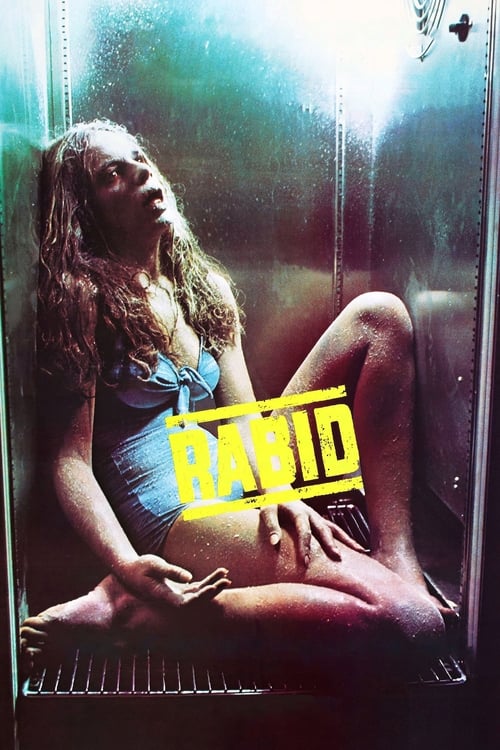
Rabid (1977)
Directed by David Cronenberg
No — Rabid is not woke, scoring 6 out of 100 on our wokeness meter.
David Cronenberg's Rabid arrives from 1977, a year in which a woman growing a blood-drinking stinger beneath her arm counted as entertainment.
Consciousness Markers
Cronenberg embeds political overtones about martial law and institutional collapse, but they remain atmospheric subtext rather than preachy moralizing.
A female protagonist exists, but she is a vampiric monster, not a vehicle for feminist messaging; the film's gender content is biological horror, not advocacy.
The cast is a uniformly white ensemble of Canadian and American actors with no notable diverse or inclusive casting choices; the film predates any such casting sensibility by decades.
No LGBTQ+ characters, relationships, or themes appear; the phallic/clitoral stinger is body-horror imagery, not queer representation.
No engagement with race or racial politics whatsoever; the epidemic and its victims are racially unmarked.
No environmental or climate themes; the contagion is a medical/biological phenomenon with no ecological framing.
The film's political subtext concerns martial law and state tyranny (echoing the October Crisis), not class warfare or anti-capitalist critique.
This is body horror in its purest form, treating the mutating body as a source of revulsion and dread — the antithesis of body positivity.
No neurodivergent characters or themes are present.
A wholly fictional narrative with no historical revisionism; its October Crisis parallels are subtextual commentary, not rewritten history.
Why it received this score
David Cronenberg's Rabid arrives from 1977, a year in which a woman growing a blood-drinking stinger beneath her arm counted as entertainment. The film follows Rose, played by Marilyn Chambers, who leaves a Quebec plastic surgery clinic with an appetite for human blood and a knack for starting an epidemic. The film then becomes a brisk tour of Montreal's collapse: martial law, soldiers in NBC suits, a garbage truck serving as a final resting place. The cast is uniformly white and uniformly Canadian, and nobody in the frame pauses to reflect on the matter. The movie has other business.
An assessment of the film's cultural conscience can be dispatched quickly. There is a female lead, but she is a vampire, not a spokesperson. Her stinger is biological horror, not a statement about anything beyond Cronenberg's interest in the body as a site of betrayal. The epidemic carries no ecological message, no racial dimension, no critique of capital. The one political thread worth pulling is the film's evocation of the October Crisis, the War Measures Act, and the sensation of a state turning its guns on its own citizens. That reading sits in the background like furniture. Cronenberg never stops the movie to explain it, which is its saving grace.
The result is a lean, nasty piece of work that treats the human body as a problem to be solved with a scalpel, and treats the audience as adults capable of drawing their own conclusions. It is not a lecture. It is barely a parable. Nearly fifty years of subsequent horror have borrowed its imagery and mislaid its restraint. Rose dies in an alley, is bagged, and is hauled away by men in protective suits, and the film offers no lesson about it. That absence is the whole point, and it is a rare vintage.
Analysis generated by our Consciousness Algorithm


Synopsis
A young woman develops a taste for human blood after experimental plastic surgery, and her victims turn into bloodthirsty zombies, leading into a city-wide epidemic.
Questions about Rabid
Is Rabid woke?
No — Rabid is not woke, scoring 6 out of 100 on our wokeness meter. That earns it a verdict of Ultra Based.
Does Rabid have any woke elements?
Very few. None of the 10 markers reaches 30, the level where a marker counts as present; the highest is Lecture Energy at 10.
How does Rabid compare to other 1977 movies?
It ranks #11 of the 27 films from 1977 we've scored; their average is 8. The wokest is A Special Day (60).
How is the Woke Score calculated?
An AI-assisted process researches the film and its reception, scores it 0–100 on ten markers, then combines those into one 0–100 Woke Score. It measures a specific set of 2020s cultural themes, not film quality.