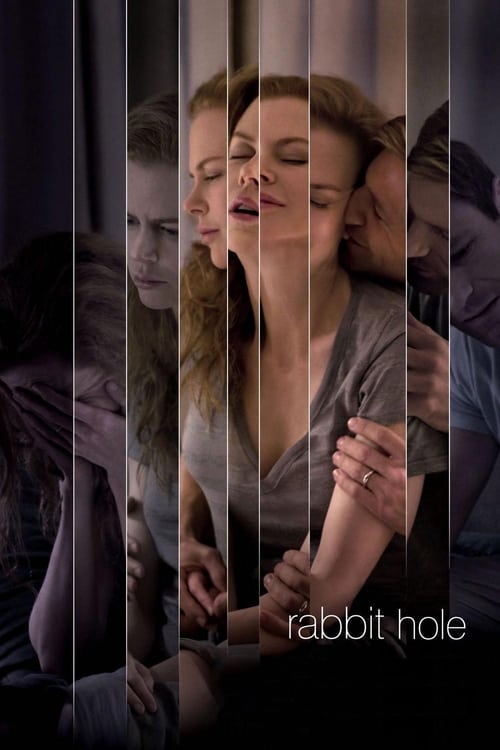
Rabbit Hole (2010)
Directed by John Cameron Mitchell
No — Rabbit Hole is not woke, scoring 2 out of 100 on our wokeness meter.
Rabbit Hole arrives with a title that suggests whimsy and delivers, instead, eight months of unrelenting grief.
Consciousness Markers
The cast includes a few minority actors in supporting roles, but there is no race- or identity-conscious casting agenda or commentary.
No LGBTQ+ characters, themes, or subtext are present.
The film centers on a grieving mother and her family relationships, but it does not advance or engage with a feminist agenda.
Race is not a theme, and no racial consciousness or commentary appears in the story.
There is no environmental or climate-related content.
The film does not critique capitalism, wealth, or class structures.
No body-positive themes or messaging are present.
No neurodivergent characters or themes are depicted.
The story is fictional and does not revise or reinterpret historical events.
The film is an intimate grief drama and does not lecture the audience on social or political issues.
Why it received this score
Rabbit Hole arrives with a title that suggests whimsy and delivers, instead, eight months of unrelenting grief. Nicole Kidman and Aaron Eckhart play a couple whose four-year-old son has been killed by a car, and John Cameron Mitchell directs their slow unraveling with the patience of someone who trusts silence. There is no thesis here, no lesson appended to the suffering. The film simply watches two people fail to comfort each other in a house full of a dead child's belongings. It is a drama about loss, and it declines to make that loss mean anything larger than itself.
The supporting cast includes Sandra Oh, Giancarlo Esposito, and Dianne Wiest, and none of them are present to illustrate a point about representation. They are present because the play had people in it. David Lindsay-Abaire adapted his own stage work, expanding the group therapy sessions and the subplot involving the teenager who was driving the car, and the additions serve the story rather than a checklist. When Becca slaps a stranger in a grocery store, the moment is about a woman coming apart, not about a system. The film has no interest in diagnosing society. It has one interest, which is the inside of a marriage after the worst thing happens.
So we arrive at the classification, and it is a clean sweep of zeroes. No identity-conscious casting, no ideological critique of wealth or power, no environmental sermon, no lecture waiting at the end of the third act. What remains is craft. Kidman was nominated for an Academy Award for this, and the nomination was earned the old fashioned way, through close-ups and restraint. Some films are so eager to instruct that they forget to be films. This one remembers. It is a quiet, painful, well made piece of work about people, and for that it earns our complete indifference on every metric that matters to this ledger.
Analysis generated by our Consciousness Algorithm


Synopsis
Life for a happy couple is turned upside down after their young son dies in an accident.
Questions about Rabbit Hole
Is Rabbit Hole woke?
No — Rabbit Hole is not woke, scoring 2 out of 100 on our wokeness meter. That earns it a verdict of Ultra Based.
Does Rabbit Hole have any woke elements?
No. All 10 markers score zero.
How does Rabbit Hole compare to other 2010 movies?
It ranks #191 of the 238 films from 2010 we've scored; their average is 11. The wokest is My Name Is Khan (84).
How is the Woke Score calculated?
An AI-assisted process researches the film and its reception, scores it 0–100 on ten markers, then combines those into one 0–100 Woke Score. It measures a specific set of 2020s cultural themes, not film quality.