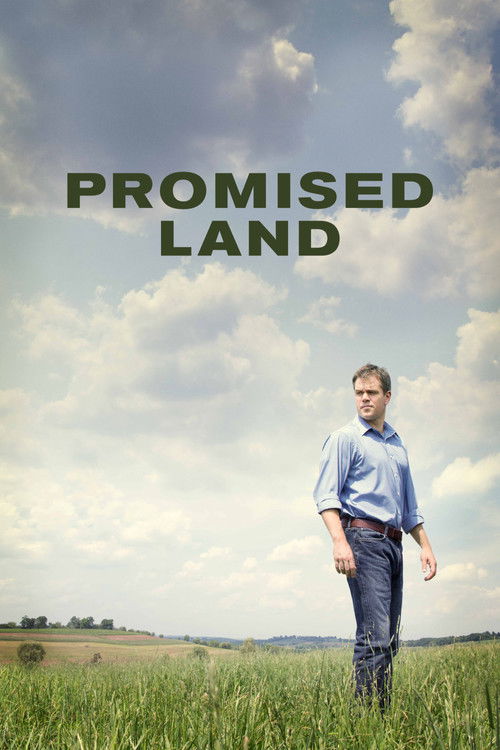
Promised Land (2012)
Directed by Gus Van Sant
No — Promised Land is not especially woke, scoring 39 out of 100 on our wokeness meter.
Gus Van Sant's Promised Land arrives with the quiet dignity of a film that knows exactly which argument it intends to lose.
Consciousness Markers
The entire plot revolves around hydraulic fracturing and its alleged contamination of land and water, functioning as an environmental cautionary tale that the energy industry actively campaigned against.
Global Crosspower Solutions is the villain, deploying deceptive PR and a corporate plant to manipulate a struggling town, framing big energy as predatory against family farmers.
The film carries an earnest environmental message and stages a town-hall debate over fracking, though its twist that the activist is a corporate plant muddies the sermon somewhat.
Frances McDormand's Sue Thomason is a competent corporate partner and Rosemarie DeWitt's Alice has some agency, but the film offers no feminist thesis or gender critique.
The cast is almost entirely white, led by Matt Damon, Frances McDormand, and John Krasinski, with no meaningful diverse casting or commentary on representation.
There are no LGBTQ+ characters, themes, or subtext anywhere in the film.
The film engages no racial themes whatsoever; its conflict is entirely economic and environmental within a white rural community.
No body-image, size-diversity, or body-positivity themes are present.
No neurodivergent characters or themes appear in the film.
The film is a contemporary fictional drama with no historical revisionism.
Why it received this score
Gus Van Sant's Promised Land arrives with the quiet dignity of a film that knows exactly which argument it intends to lose. Matt Damon plays Steve Butler, a natural gas landman who descends upon a struggling Pennsylvania farming town with lease agreements and a practiced smile. The energy conglomerate Global Crosspower Solutions functions as the designated villain, deploying staged photographs and a hired infiltrator to bend a small democracy toward its drilling rights. The film regards this corporation with undisguised suspicion, framing extraction as predation dressed in a windbreaker. That is the engine here, and it runs on a steady, earnest hum of environmental concern.
Frances McDormand's Sue Thomason is allowed competence, and Rosemarie DeWitt's Alice is allowed a pulse, but the screenplay never pauses to interrogate gender, race, or any identity beyond the economic. The town is white, rural, and aggrieved about water and property values. Nobody in the frame complicates that. The environmental messaging is the load-bearing wall, and it holds. A town hall debate over fracking chemistry supplies the closest thing to a sermon, though the late revelation that the activist is himself a corporate plant muddies the congregation's sense of whom to boo.
The film's central irony, that a man selling poison slowly discovers he believes in the land, is handled with a straight face and a warm score. It is sincere, well-acted, and modest in its ambitions, which is more than most message pictures manage. The picture lost money and irritated the gas industry, an outcome that suggests it landed somewhere near its target. We are left with a competent drama that preaches gently, indicts capital politely, and never once asks its audience to think about anything other than the wells.
Analysis generated by our Consciousness Algorithm
Part of


Synopsis
A salesman for a natural gas company experiences life-changing events after arriving in a small town, where his corporation wants to tap into the available resources.
Questions about Promised Land
Is Promised Land woke?
No — Promised Land is not especially woke, scoring 39 out of 100 on our wokeness meter. That earns it a verdict of Based.
Does Promised Land have any woke elements?
3 of the 10 markers register at 30 or above, led by Climate Crusade (60), Eat the Rich (55) and Lecture Energy (45). On Climate Crusade: The entire plot revolves around hydraulic fracturing and its alleged contamination of land and water, functioning as an environmental cautionary tale that the energy industry actively campaigned against.
How does Promised Land compare to other 2012 movies?
It ranks #12 of the 230 films from 2012 we've scored; their average is 12. The wokest is Killing Them Softly (92).
How is the Woke Score calculated?
An AI-assisted process researches the film and its reception, scores it 0–100 on ten markers, then combines those into one 0–100 Woke Score. It measures a specific set of 2020s cultural themes, not film quality.