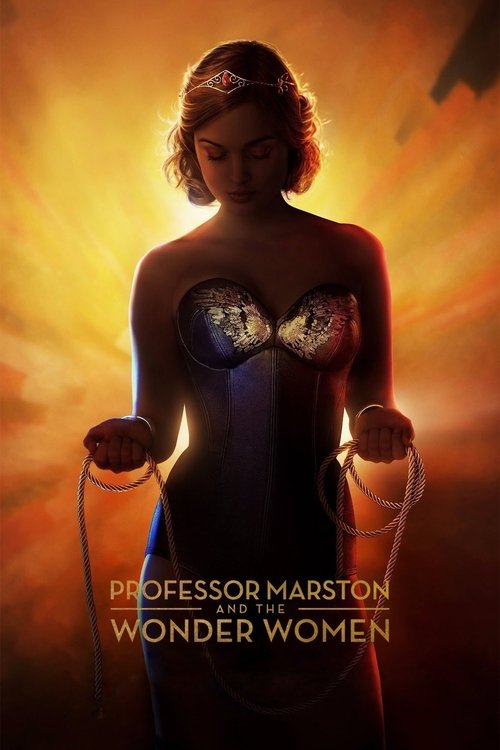
Professor Marston and the Wonder Women (2017)
Directed by Angela Robinson
Yes — Professor Marston and the Wonder Women is woke, scoring 67 out of 100 on our wokeness meter.
The Marston household, as Angela Robinson reconstructs it, is a three-body problem solved by mutual consent.
Consciousness Markers
The entire film is built around a bisexual/polyamorous three-way relationship between William, Elizabeth, and Olive, and explicitly frames Wonder Woman's imagery as lesbian and sadomasochistic in origin.
Wonder Woman is presented as a deliberate vehicle for the feminist movement, Elizabeth becomes the family breadwinner, and the epilogue invokes Gloria Steinem reclaiming the character in Ms. Magazine.
The film reinterprets the Marston household as an open polyamorous romance, a claim the family publicly disputed as fiction, though it stops short of a broader ideological rewriting of history.
The film periodically steps back to argue its theses about free expression, censorship, and feminine power, including a closing title-card moral about Wonder Woman's stripped powers.
The film centers a polyamorous triad and gives its two female leads equal narrative weight, but the principal cast is entirely white, limiting the marker to its relationship-structure dimension.
No engagement with race or racial politics appears anywhere in the film; the cast and subject matter are uniformly white.
No environmental or climate themes are present.
The film's conflict is with censorship and sexual prudery, not with capitalism or economic hierarchy.
No body-positivity themes; the fetish and costume material is about desire and power, not body acceptance.
No neurodivergence themes are present.
Why it received this score
The Marston household, as Angela Robinson reconstructs it, is a three-body problem solved by mutual consent. William, Elizabeth, and Olive fall into one another through lie detector tests and research notes, and the film treats their arrangement not as a scandal to be gawked at but as a working domestic economy. That the whole enterprise doubles as the origin story of Wonder Woman, with the costume prototyped on Olive's body and the bondage imagery lifted from fetish comics, gives the picture a tidy thesis. The private life explains the public artifact. Whether the historical Elizabeth and Olive were lovers is a question the surviving family answers with a flat no, and the film answers with three acts of yes.
The film's feminism is not subtext. It is the text, spoken aloud, repeatedly. Elizabeth takes a secretarial job and becomes the family's breadwinner while William flounders as an author. The Marstons pitch their heroine as an instrument for the women's movement, and the closing cards invoke Gloria Steinem's 1972 Ms. Magazine cover as a reclamation. Robinson lets her characters argue their positions in dialogue that occasionally sounds like a panel discussion with better lighting. The villains are censors and prudes, not markets or bosses, which keeps any economic critique entirely off the table.
The film's omissions are equally instructive. Race never enters the frame, and neither does climate, class, body image, or neurodivergence. The cast is uniformly white, and the story is set among Harvard academics and suburban bohemians. The progressive content here is sexual and gendered, a 2017 artifact concerned with desire and free expression. It is a handsomely mounted argument, well acted, sincere, and narrow. The Marstons themselves would likely have approved.
Analysis generated by our Consciousness Algorithm


Synopsis
The unconventional life of Dr. William Marston, the Harvard psychologist and inventor who helped invent the modern lie detector test and co-created Wonder Woman in 1941.
Questions about Professor Marston and the Wonder Women
Is Professor Marston and the Wonder Women woke?
Yes — Professor Marston and the Wonder Women is woke, scoring 67 out of 100 on our wokeness meter. That earns it a verdict of Woke.
What makes Professor Marston and the Wonder Women woke?
5 of the 10 markers register at 30 or above, led by LGBTQ+ Themes (85), Feminist Agenda (80) and Lecture Energy (40). On LGBTQ+ Themes: The entire film is built around a bisexual/polyamorous three-way relationship between William, Elizabeth, and Olive, and explicitly frames Wonder Woman's imagery as lesbian and sadomasochistic in origin.
How does Professor Marston and the Wonder Women compare to other 2017 movies?
It ranks #8 of the 309 films from 2017 we've scored; their average is 19. The wokest is I Am Not Your Negro (92).
How is the Woke Score calculated?
An AI-assisted process researches the film and its reception, scores it 0–100 on ten markers, then combines those into one 0–100 Woke Score. It measures a specific set of 2020s cultural themes, not film quality.