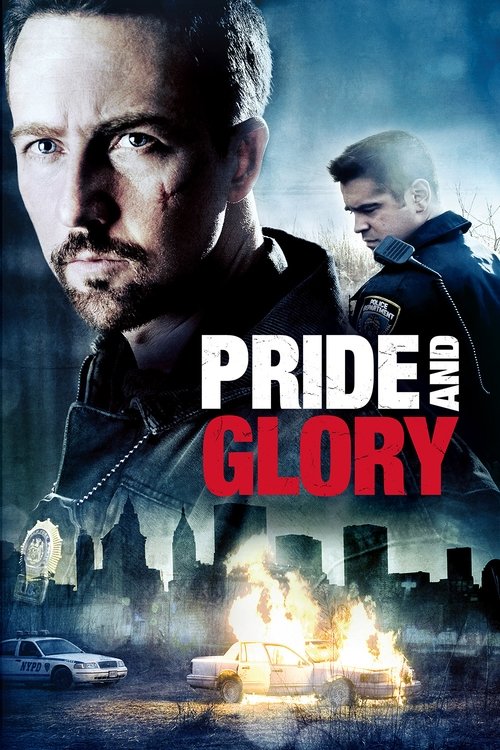
Pride and Glory (2008)
Directed by Gavin O'Connor
No — Pride and Glory is not woke, scoring 11 out of 100 on our wokeness meter.
The Tierney family has given three generations to the New York City Police Department, and by the time we meet them the ledger is running a deficit.
Consciousness Markers
The cast includes actors of color such as John Ortiz and Carmen Ejogo in supporting roles, but the film does not foreground diversity as a theme.
No LGBTQ+ characters or themes are present.
The film is a male-dominated police drama with female characters in conventional wife/girlfriend roles and no feminist agenda.
The film depicts Dominican characters through criminal stereotypes and was criticized for racist portrayals, but it does not exhibit progressive racial consciousness.
No environmental or climate-related themes are present.
The film critiques police corruption but does not advance an anti-capitalist or eat-the-rich message.
No body positivity themes are present.
No neurodivergence themes are present.
The film is a fictional story inspired by the director's family background, not a revisionist historical narrative.
The film presents moral dilemmas without overt lecturing or preachy messaging.
Why it received this score
The Tierney family has given three generations to the New York City Police Department, and by the time we meet them the ledger is running a deficit. Gavin O'Connor's 2008 crime drama follows Ray Tierney, a detective pulled back into a corruption investigation that runs through his brother-in-law and, eventually, his father. The film was written with a real NYPD officer's cooperation and shot with a grim, gray affection for precinct house ritual. It opened at number five, collected mixed notices, and settled onto the long shelf of police procedurals that critics call sturdy and audiences forget by spring. Edward Norton broods with precision. Colin Farrell enjoys himself. Jon Voight suffers on cue.
As a document of modern social consciousness, the film is close to a blank page. Women appear as wives, girlfriends, and grieving mothers, and the screenplay has no interest in rearranging that furniture. There is no queer presence, no environmental conscience, no argument about capital, no attention to body image or neurodivergence, and no revisionist reading of history. The corruption on display is institutional and personal, and the film lets us draw our own conclusions instead of delivering a sermon. The one place it touches identity, it stumbles badly. Its Dominican characters are drawn as interchangeable criminals, a choice that drew accusations of racist caricature at the time. John Ortiz and Carmen Ejogo do steady work in supporting roles, but the film never treats their presence as a statement.
So we are left with a well-acted, conventional tragedy about loyalty and its price. It has a pulse and a heavy fist, and it says something honest about how families protect their own. What it lacks is a message for the age. Its cultural legacy is a caution about representation handled without care, which is a different thing from representation pursued with intent. The needle barely stirs.
Analysis generated by our Consciousness Algorithm


Synopsis
A saga centered on the Tierneys, a multi-generational family of New York City Police officers. The family's moral codes are tested when Ray Tierney investigates a case that reveals an incendiary police corruption scandal involving his own brother-in-law. For Ray, the truth is revelatory, a Pandora's Box that threatens to upend not only the Tierney legacy but the entire NYPD.
Questions about Pride and Glory
Is Pride and Glory woke?
No — Pride and Glory is not woke, scoring 11 out of 100 on our wokeness meter. That earns it a verdict of Ultra Based.
Does Pride and Glory have any woke elements?
Very few. None of the 10 markers reaches 30, the level where a marker counts as present; the highest is Representation Casting at 25.
How does Pride and Glory compare to other 2008 movies?
It ranks #83 of the 212 films from 2008 we've scored; their average is 12. The wokest is Milk (68).
How is the Woke Score calculated?
An AI-assisted process researches the film and its reception, scores it 0–100 on ten markers, then combines those into one 0–100 Woke Score. It measures a specific set of 2020s cultural themes, not film quality.