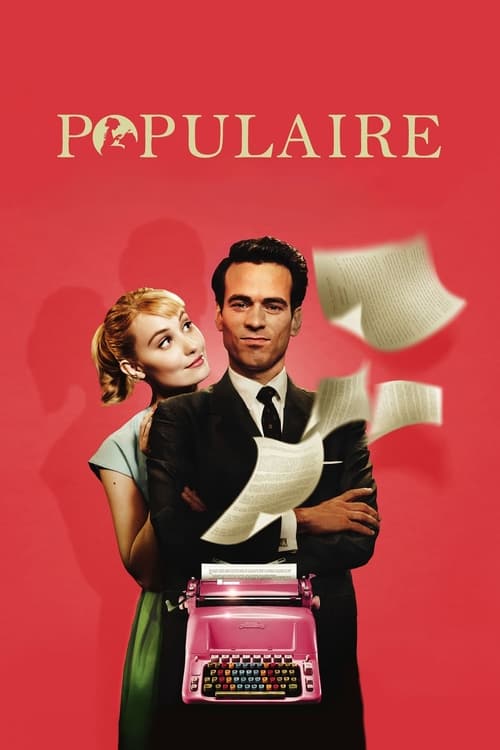
Populaire (2012)
Directed by Régis Roinsard
No — Populaire is not woke, scoring 9 out of 100 on our wokeness meter.
Populaire arrives from 2012 carrying the pleasant scent of a film with no interest in arguing with anybody.
Consciousness Markers
The protagonist is a woman who defies her father and becomes a world champion typist, but the story remains a conventional romance where her success is largely orchestrated by a male mentor.
The cast is entirely white French and Belgian actors, with no evident attempt at inclusive or color-conscious casting.
There are no LGBTQ+ characters, themes, or subtext in the film.
The film does not engage with race, racism, or racial identity in any meaningful way.
There is no environmental or climate-related content.
The film depicts corporate sponsorship and celebrity without critiquing capitalism or wealth inequality.
There is no body-positive messaging or challenge to conventional beauty standards.
No neurodivergent characters or themes are present.
The film is a fictional period romance set in the 1950s and does not revise or reinterpret historical events.
The tone is frothy and romantic, with no preachy or didactic social commentary.
Why it received this score
Populaire arrives from 2012 carrying the pleasant scent of a film with no interest in arguing with anybody. Régis Roinsard settles into 1958 and follows Rose Pamphyle, a provincial secretary who flees her father's marriage plans for a job with insurance agent Louis Échard, then discovers she can type at a speed bordering on the supernatural. He enters her in the regional speed typing championship. She loses. He trains her with colour-coded keys, piano lessons and posture drills. She wins. The costumes are sharp, the pink Japy typewriter is a triumph of production design, and the whole affair glides on the charm of Déborah François and Romain Duris.
There is a whisper of feminine ambition in all this. Rose defies her father, leaves the village, and finishes the film as the fastest typist in the world. That is not nothing. It is also a story in which a man selects her, trains her, deceives her for her own good, and watches her final triumph arrive moments after he has kissed her. Her independence holds for perhaps twenty minutes of screen time before it folds into a conventional romance with a conventionally withholding male lead. The rest of the cultural ledger sits empty. The cast is uniformly white and the romance is straight. The world of insurance offices, corporate sponsorship and celebrity endorsement drifts past without a single curious glance at the money underneath it. No character is given a body or a disposition that complicates the catalogue of pretty young women and stern older men.
The result is a frock, a score, and two attractive people learning to type. It wants to be Amélie and settles for being agreeable on a wet Sunday. Nothing here lectures, agitates, or asks anyone to reconsider the world it depicts. On any measure of contemporary social consciousness, this is a quiet film, and it seems content to remain so. The classification is straightforward: harmless, well-pressed, and unbothered.
Analysis generated by our Consciousness Algorithm

Synopsis
An insurance agent and his new secretary become locked in the grip of romance and competition as they train together for a speed-typing contest.
Questions about Populaire
Is Populaire woke?
No — Populaire is not woke, scoring 9 out of 100 on our wokeness meter. That earns it a verdict of Ultra Based.
Does Populaire have any woke elements?
Very few. None of the 10 markers reaches 30, the level where a marker counts as present; the highest is Feminist Agenda at 15.
How does Populaire compare to other 2012 movies?
It ranks #86 of the 230 films from 2012 we've scored; their average is 12. The wokest is Killing Them Softly (92).
How is the Woke Score calculated?
An AI-assisted process researches the film and its reception, scores it 0–100 on ten markers, then combines those into one 0–100 Woke Score. It measures a specific set of 2020s cultural themes, not film quality.