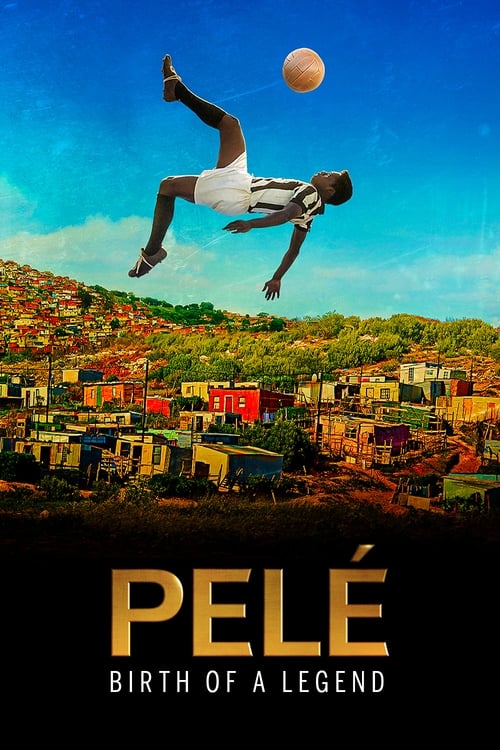
Pelé: Birth of a Legend (2016)
Directed by Jeff Zimbalist
No — Pelé: Birth of a Legend is not especially woke, scoring 31 out of 100 on our wokeness meter.
Pelé: Birth of a Legend arrives with the full apparatus of the inspirational sports biopic: the barefoot boy in the Bauru dirt, the father who once played and now cleans floors, the World Cup promise whispered over a radio.
Consciousness Markers
The film explicitly foregrounds the African roots of the Ginga style, the legacy of slavery and capoeira, and Brazil's rejection of its African heritage after the 1950 loss, making race and heritage a central thematic thread.
The film authentically casts Brazilian actors, many of them Black, to portray a Black Brazilian icon and his community, giving genuine on-screen representation of Afro-Brazilian life rather than a Hollywood-whitewashed version.
The De Brito monologue explaining the history of Ginga, capoeira, and African heritage functions as an earnest lecture, and the film's overall tone is didactic and inspirational rather than subtle.
The film takes notable historical liberties, such as fabricating a childhood rivalry with José Altafini, but these are dramatic embellishments rather than a modern ideological rewriting of history.
Pelé's mother Celeste appears as a supportive presence, but the film is overwhelmingly a male sports narrative with no feminist critique or agency-driven female arc.
The film touches on class tension and Pelé's impoverished upbringing, but it frames poverty as an obstacle to overcome through individual triumph rather than as an indictment of economic systems.
There are no LGBTQ+ characters, relationships, or themes anywhere in the film.
There is no environmental or climate-related content in the film.
No body positivity themes are present; the film is a conventional sports biopic.
There is no depiction or discussion of neurodivergence in the film.
Why it received this score
Pelé: Birth of a Legend arrives with the full apparatus of the inspirational sports biopic: the barefoot boy in the Bauru dirt, the father who once played and now cleans floors, the World Cup promise whispered over a radio. What distinguishes it from its many cousins is the casting. The Zimbalist brothers shot entirely in Brazil and filled the frame with Black Brazilian performers, Seu Jorge and Milton Gonçalves among them, which lends the film a texture of lived Afro-Brazilian life that a Hollywood production would have sanded smooth. That alone earns a measure of respect.
The film's central argument concerns Ginga, the style drawn from capoeira and the resistance of escaped slaves. De Brito delivers a monologue that walks us through the sixteenth century, the outlawing of capoeira, and Brazil's turn against its own African heritage after 1950. It is a genuine lecture, delivered with a straight face, and it makes race the organizing subject of the whole enterprise. A nation's shame over its African roots becomes the thing the boy must outrun, and the 1958 victory becomes a reconciliation with that heritage. Few sports films reach for so much.
Elsewhere the picture is conventional to the point of anemia. Pelé's mother exists to look worried in a doorway. Poverty is an obstacle to be sprinted past, not a system to be questioned. There are no queer lives, no disabled bodies, no environmental anxieties, no interiority beyond the pitch. Vincent D'Onofrio coaches. The Swedes lose. Critics were unkind on release, and their complaints about depth were not baseless, though they overlooked how much the film quietly insists upon. It is earnest, frequently clumsy, and more interesting than its reception suggests.
Analysis generated by our Consciousness Algorithm


Synopsis
The life story of Brazilian football legend, Pele.
Questions about Pelé: Birth of a Legend
Is Pelé: Birth of a Legend woke?
No — Pelé: Birth of a Legend is not especially woke, scoring 31 out of 100 on our wokeness meter. That earns it a verdict of Based.
Does Pelé: Birth of a Legend have any woke elements?
3 of the 10 markers register at 30 or above, led by Racial Consciousness (60), Representation Casting (50) and Lecture Energy (30). On Racial Consciousness: The film explicitly foregrounds the African roots of the Ginga style, the legacy of slavery and capoeira, and Brazil's rejection of its African heritage after the 1950 loss, making race and heritage a central thematic thread.
How does Pelé: Birth of a Legend compare to other 2016 movies?
It ranks #38 of the 285 films from 2016 we've scored; their average is 16. The wokest is 13th (92).
How is the Woke Score calculated?
An AI-assisted process researches the film and its reception, scores it 0–100 on ten markers, then combines those into one 0–100 Woke Score. It measures a specific set of 2020s cultural themes, not film quality.