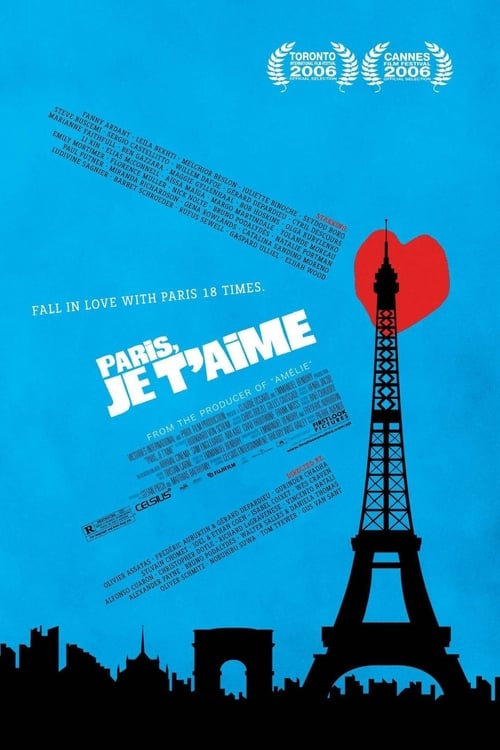
Paris Je T'aime (2006)
Directed by Olivier Assayas
No — Paris Je T'aime is not especially woke, scoring 22 out of 100 on our wokeness meter.
An omnibus of eighteen short films, one for each arrondissement that survived the editing process, Paris, je t'aime assembles twenty-two directors and a cast of unimpeachable international pedigree.
Consciousness Markers
The anthology assembles an international ensemble cast and a notably diverse roster of directors, including several women and filmmakers of color, though this reflects the project's global-city concept more than modern identity-conscious casting.
The 'Le Marais' segment by Gus Van Sant centers on a fleeting same-sex romantic connection, and Oscar Wilde appears in the Père-Lachaise segment, giving the film concrete LGBTQ+ content without activist framing.
Segments like 'Quais de Seine' and 'Loin du 16e' touch on Muslim identity and immigrant labor in Paris, but race and racism are treated as background texture rather than a central thesis.
Several segments are directed by women and focus on female perspectives, such as the immigrant nanny in 'Loin du 16e,' but the film does not advance a feminist agenda or critique patriarchy in any sustained way.
'Loin du 16e' briefly contrasts an immigrant nanny's labor with her wealthy employer's comfort, but the film offers no systemic anti-capitalist argument.
The film is a gentle, romantic omnibus about Paris rather than a preachy or didactic work, with only faint social observation in a few segments.
No environmental or climate-change themes appear in the film.
No body-positivity themes or fat-acceptance messaging are present.
No neurodivergence themes or neurodiverse representation are present.
The film is a fictional anthology and does not revise or reinterpret historical events.
Why it received this score
An omnibus of eighteen short films, one for each arrondissement that survived the editing process, Paris, je t'aime assembles twenty-two directors and a cast of unimpeachable international pedigree. The conceit is municipal: each segment runs about five minutes, each ends with a kiss or a shrug, and the whole thing is stitched together with transition shots of the city looking its most photogenic. It is a postcard album with better lighting, and it opened the Un Certain Regard selection at Cannes for its trouble.
The roster of directors is genuinely polyglot, drawing in Gurinder Chadha, Isabel Coixet, Walter Salles, Nobuhiro Suwa, and Yolande Moreau alongside the Coens and Cuaron. This breadth is a function of the global-city premise, not a hiring initiative, and the film treats it as a matter of geography. Even so, the assembled perspectives produce moments of real observation. The immigrant nanny in Loin du 16e sings to her employer's child and then rides the train home to her own, a quiet sketch of labor and class. Quais de Seine puts a young Muslim woman at the center of a flirtation. Gus Van Sant's Le Marais stages a brief same-sex glance between strangers. Oscar Wilde turns up at Pere-Lachaise, because of course he does.
None of this amounts to a thesis. The film observes inequality without proposing to dismantle it, notices race and faith as texture, and lets its women direct and be directed without much comment on either. There is no climate anxiety here, no body acceptance, no neurodivergent awakening, no rewritten history, and only the faintest trace of sermon. Paris, je t'aime wants to be loved, and mostly it is. A gentle, uneven valentine, filed under romance.
Analysis generated by our Consciousness Algorithm


Synopsis
Olivier Assayas, Gus Van Sant, Wes Craven and Alfonso Cuaron are among the 20 distinguished directors who contribute to this collection of 18 stories, each exploring a different aspect of Parisian life. The colourful characters in this drama include a pair of mimes, a husband trying to choose between his wife and his lover, and a married man who turns to a prostitute for advice.
Questions about Paris Je T'aime
Is Paris Je T'aime woke?
No — Paris Je T'aime is not especially woke, scoring 22 out of 100 on our wokeness meter. That earns it a verdict of Based.
Does Paris Je T'aime have any woke elements?
2 of the 10 markers register at 30 or above, led by Representation Casting (40) and LGBTQ+ Themes (30). On Representation Casting: The anthology assembles an international ensemble cast and a notably diverse roster of directors, including several women and filmmakers of color, though this reflects the project's global-city concept more than modern identity-conscious casting.
How does Paris Je T'aime compare to other 2006 movies?
It ranks #26 of the 211 films from 2006 we've scored; their average is 11. The wokest is An Inconvenient Truth (92).
How is the Woke Score calculated?
An AI-assisted process researches the film and its reception, scores it 0–100 on ten markers, then combines those into one 0–100 Woke Score. It measures a specific set of 2020s cultural themes, not film quality.