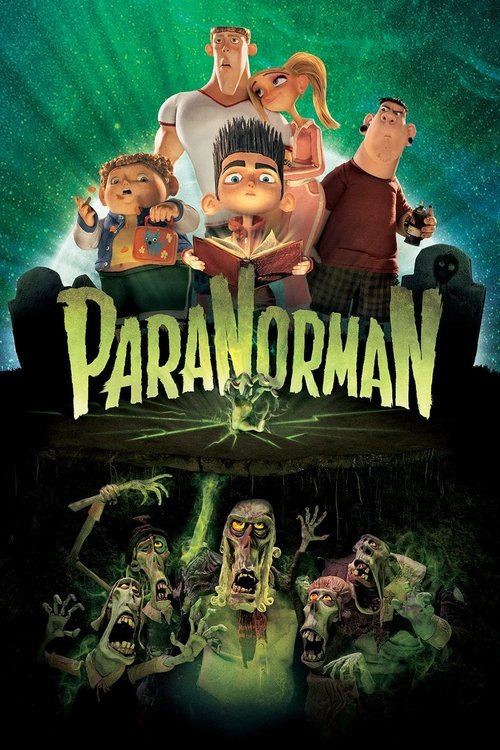
ParaNorman (2012)
Directed by Sam Fell
Partly — ParaNorman is somewhat woke, scoring 48 out of 100 on our wokeness meter.
ParaNorman arrives from Laika with the studio's customary artisanal gloom and a boy, Norman Babcock, who converses with the dead in a Massachusetts town that has spent three centuries executing its own guilt.
Consciousness Markers
The final-scene reveal that Mitch is gay made him the first openly gay character in a mainstream animated film, a deliberate choice the co-director tied directly to the film's anti-judgment message.
Neil is an overweight boy who is bullied yet remains cheerfully self-assured and comfortable in his body, explicitly modeling body acceptance without shame.
The climax has the children explicitly confront the mob that their rage and fear make them no different from the cursed townsfolk, delivering the film's anti-judgment moral with considerable directness.
The film reframes the Salem-style witch trial so the executed 'witch' is an innocent child medium and the righteous accusers are the true monsters, inverting the traditional historical framing.
The voice cast is overwhelmingly white, with only a minor supporting classmate (Salma) providing any ethnic variety; diversity is not a structuring concern of the film.
Courtney and the wronged witch Aggie are given agency, but the film advances no feminist thesis; gender is not a lens the story uses.
Norman is coded as an isolated, misunderstood outcast whose 'strangeness' alienates him, but the film never names or frames this as neurodivergence.
No racial themes, commentary, or dynamics are present; the town's persecution is framed entirely around supernatural difference.
No environmental or climate content whatsoever.
The antagonists are a colonial-era town council and a mob, not economic structures; no class or anti-capitalist critique is offered.
Why it received this score
ParaNorman arrives from Laika with the studio's customary artisanal gloom and a boy, Norman Babcock, who converses with the dead in a Massachusetts town that has spent three centuries executing its own guilt. The stop-motion is handsome, but the film's reputation rests on a joke in its final minutes, when a supporting jock is revealed to have a boyfriend. That made him, by the accounting of the time, the first openly gay character in a mainstream animated feature, a choice the co-director tied directly to the film's stated theme of not judging people. The rest of the social architecture is thinner than the mythology suggests.
On bodies and minds, the film is more earnest than its genre requires. Neil, the overweight boy who absorbs the same bullying as Norman, is cheerful about his shape and never asked to apologize for it. Norman reads as a textbook misunderstood outcast, though the screenplay never reaches for a clinical label. The witch trial at the center is reframed so the executed child is innocent and her accusers, resurrected as zombies, are the true monsters. When the climax arrives, the children explain to the townspeople, out loud, that their fear makes them no better than the cursed council. The moral lands with the patience of a substitute teacher who has decided to stay past the bell.
The absences are as telling as the presences. No economic critique troubles the colonial ghost story, no environmental anxiety, no racial reckoning. The town's persecution is supernatural, full stop, which spares the filmmakers any harder conversation. Gender is not a lens the story bothers to use, and the voice cast is a wall of familiar white faces. This is a gentle, well-crafted film that believes kindness is a sufficient thesis and mostly gets away with it. We classify it accordingly, with respect and without enthusiasm.
Analysis generated by our Consciousness Algorithm


Synopsis
In the town of Blithe Hollow, Norman Babcock can speak to the dead, but no one other than his eccentric new friend believes his ability is real. One day, Norman's eccentric uncle tells him of a ritual he must perform to protect the town from a curse cast by a witch centuries ago.
Questions about ParaNorman
Is ParaNorman woke?
Partly — ParaNorman is somewhat woke, scoring 48 out of 100 on our wokeness meter. That earns it a verdict of Woke-Adjacent.
What makes ParaNorman woke?
4 of the 10 markers register at 30 or above, led by LGBTQ+ Themes (70), Body Positivity (45) and Lecture Energy (45). On LGBTQ+ Themes: The final-scene reveal that Mitch is gay made him the first openly gay character in a mainstream animated film, a deliberate choice the co-director tied directly to the film's anti-judgment message.
How does ParaNorman compare to other 2012 movies?
It ranks #10 of the 230 films from 2012 we've scored; their average is 12. The wokest is Killing Them Softly (92).
How is the Woke Score calculated?
An AI-assisted process researches the film and its reception, scores it 0–100 on ten markers, then combines those into one 0–100 Woke Score. It measures a specific set of 2020s cultural themes, not film quality.