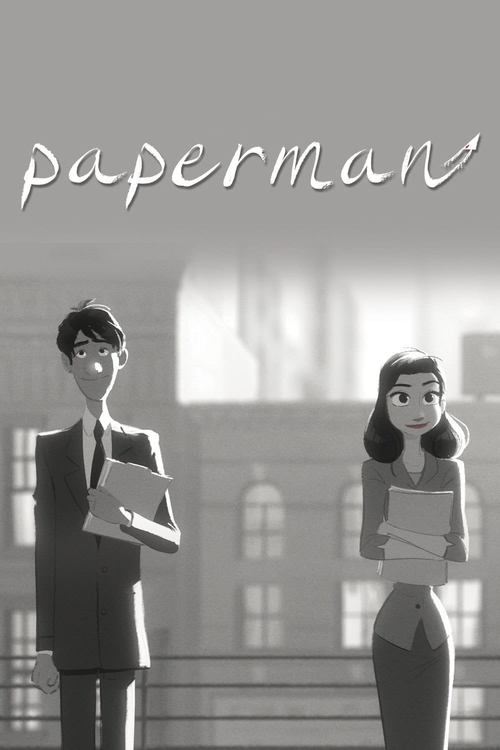
Paperman (2012)
Directed by John Kahrs
No — Paperman is not woke, scoring 0 out of 100 on our wokeness meter.
Paperman is a six-minute black-and-white confection from Walt Disney Animation Studios, released in 2012 alongside Wreck-It Ralph and later awarded the Academy Award for Best Animated Short Film.
Consciousness Markers
The short features two white, conventionally designed romantic leads and no meaningful diverse casting or representation commentary.
There are no LGBTQ+ characters, themes, or subtext in the film.
Meg functions as a romantic interest within a whimsical 1940s-set courtship story, with no feminist agenda or gender-political critique.
The film does not engage with race, racial identity, or racial justice themes.
There is no environmental or climate-related messaging in the story.
The office setting and mild boss annoyance are comedic texture, not an anti-capitalist or eat-the-rich statement.
George's large nose is a character-design choice, but the film does not promote body positivity as a theme.
No neurodivergent characters, diagnoses, or related themes are present.
The 1940s New York setting is atmospheric and romanticized, not a revisionist historical narrative.
The short is almost entirely silent and tells its story through visual whimsy rather than didactic messaging.
Why it received this score
Paperman is a six-minute black-and-white confection from Walt Disney Animation Studios, released in 2012 alongside Wreck-It Ralph and later awarded the Academy Award for Best Animated Short Film. It concerns George, an accountant with a large nose and a folder full of papers, and Meg, a woman whose lipstick-stained page becomes the object of a silent, windy courtship across 1940s New York. The film is almost entirely wordless. It relies on gesture, timing, and the gentle absurdity of paper airplanes behaving like Cupid's own fleet.
To assess its cultural agenda is to assess a souffle for its structural load. There is no racial consciousness here, no LGBTQ subtext, no feminist critique of the office romance. Meg is a romantic destination, not a thesis. The boss is a mild comic obstacle, not a symbol of capital's crushing weight. The urban setting is atmospheric, not an argument about climate or gentrification. George's nose is a design choice, not a body-positivity campaign. No character is coded as neurodivergent. The 1940s are remembered as a soft-focus playground for meet-cutes, not revised into a historical corrective.
The short is not preachy. It has no lecture energy. It wants to make you smile at a flying piece of paper, and it succeeds. That is not a crime. It is simply a reminder that some films are content to be charming, and that a lack of contemporary social signaling is not a moral failure. The Academy gave it an Oscar. The culture gave it a shrug. Both responses are defensible.
Analysis generated by our Consciousness Algorithm
Part of
Studio · Disney Animation
Are Disney Animation Movies Woke?
43 films across two labels, average 26 (Based). This film is 26 points below the Disney Animation average.
Studio · Disney
Are Disney Movies Woke?
391 films across nine labels, average 19 (Ultra Based). This film is 19 points below the Disney average.

Synopsis
An urban office worker finds that paper airplanes are instrumental in meeting a girl in ways he never expected.
Questions about Paperman
Is Paperman woke?
No — Paperman is not woke, scoring 0 out of 100 on our wokeness meter. That earns it a verdict of Ultra Based.
Does Paperman have any woke elements?
No. All 10 markers score zero.
How does Paperman compare to other 2012 movies?
It ranks #193 of the 230 films from 2012 we've scored; their average is 12. The wokest is Killing Them Softly (92).
How is the Woke Score calculated?
An AI-assisted process researches the film and its reception, scores it 0–100 on ten markers, then combines those into one 0–100 Woke Score. It measures a specific set of 2020s cultural themes, not film quality.