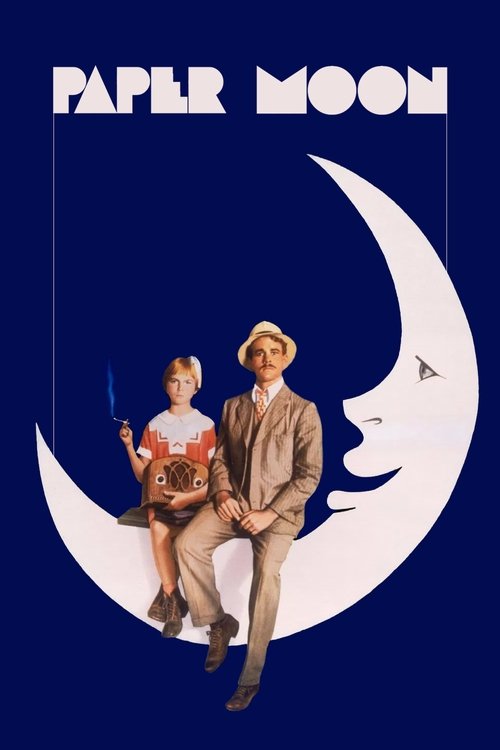
Paper Moon (1973)
Directed by Peter Bogdanovich
No — Paper Moon is not woke, scoring 4 out of 100 on our wokeness meter.
Paper Moon arrives from 1973, a black-and-white Depression-era road picture in which a nine-year-old girl and a grifting Bible salesman drift through Kansas and Missouri separating widows from their money.
Consciousness Markers
Addie is a sharp-witted, self-possessed girl who out-cons the grown men around her, but this is a 1973 character study rather than a deliberate feminist statement.
The Depression-era poverty and the conning of widows provide a backdrop of economic hardship, but the film has no anti-capitalist thesis or eat-the-rich posture.
The cast is entirely white, drawn from the standard Hollywood pool of the era, with no effort at diverse or inclusive casting.
No LGBTQ+ characters, themes, or subtext appear anywhere in the film.
The film is set in Depression-era Kansas and Missouri with an all-white cast and no engagement with racial themes whatsoever.
No environmental or climate content of any kind.
No body positivity themes; the film does not address body image or size acceptance.
No neurodivergent characters or themes are present.
The film is a period piece set in the 1930s but makes no revisionist claims about history; it simply uses the era as a setting.
A lighthearted road comedy-drama that entertains rather than preaches; there is no didactic messaging or moral lecturing.
Why it received this score
Paper Moon arrives from 1973, a black-and-white Depression-era road picture in which a nine-year-old girl and a grifting Bible salesman drift through Kansas and Missouri separating widows from their money. The picture is charming, and it knows it. Peter Bogdanovich shoots the dust and the storefronts with evident affection, and Tatum O'Neal, who won an Academy Award at the age of ten, out-cons every adult in the frame. Our survey finds remarkably little to classify here, which in this line of work counts as a kind of relief.
On representation, the cast is white and drawn from the standard Hollywood pool of the era without apology. No LGBTQ content appears. Race goes unmentioned in a film set in 1936 Kansas, and the silence is total. The environment is weather, not a cause. There is no body politics, no neurodivergent characterization, and no revisionist claim about the past; the 1930s function as texture, not argument. The picture entertains and declines to instruct, which places its sermonizing quotient at nothing at all.
What remains is Addie herself, a self-possessed child who reads a room faster than the men who believe they are using her. The film never announces this as a thesis. It simply lets her win, and the effect is a character study with a spine, not a platform. The Depression supplies poverty, desperation, and a general air of people getting by on nerve, yet the movie has no interest in a critique of capital. It likes its scoundrels. This is a road comedy with a melancholy undertow, and it asks nothing of us but attention. A rare vintage, and a quiet one.
Analysis generated by our Consciousness Algorithm
Part of


Synopsis
During the Great Depression, a con man finds himself saddled with a young girl who may or may not be his daughter, and the two forge an unlikely partnership.
Questions about Paper Moon
Is Paper Moon woke?
No — Paper Moon is not woke, scoring 4 out of 100 on our wokeness meter. That earns it a verdict of Ultra Based.
Does Paper Moon have any woke elements?
Very few. None of the 10 markers reaches 30, the level where a marker counts as present; the highest is Feminist Agenda at 8.
How does Paper Moon compare to other 1973 movies?
It ranks #16 of the 32 films from 1973 we've scored; their average is 11. The wokest is Soylent Green (39).
How is the Woke Score calculated?
An AI-assisted process researches the film and its reception, scores it 0–100 on ten markers, then combines those into one 0–100 Woke Score. It measures a specific set of 2020s cultural themes, not film quality.